Belladonna
Clarke - Dictionary of Practical Materia Medica · John Henry Clarke · 45,091 χαρακτήρες · πηγή ↗
 Όλα τα βιβλία για Belladonna →
Αντιδοτείται απόAceticum AcidumAconitum NapellusAngustura VeraAurum MetallicumCamphoraCitrus LimonumCoffea CrudaCoffea TostaColchicum AutumnaleCuprum Aceticum
Όλα τα βιβλία για Belladonna →
Αντιδοτείται απόAceticum AcidumAconitum NapellusAngustura VeraAurum MetallicumCamphoraCitrus LimonumCoffea CrudaCoffea TostaColchicum AutumnaleCuprum AceticumGeneral EN
Belladonna.
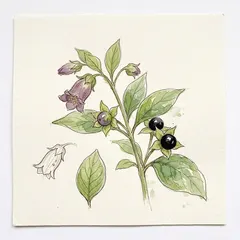
Atropa Belladonna. Deadly Nightshade. (Greece, Italy, Britain.) N. O. Solanaceae. Tincture of whole plant when beginning to flower.
Clinical EN
Abscess. Acne. Amaurosis. Apoplexy. Bladder weakness. Boils. Brain, affections of. Bronchial glands, disease of. Carbuncle. Colic. Constipation. Convulsions.
Cough EN
Croup.
Delirium tremens.
Depression.
Diarrhoea.
Dysentery.
Ear, affections of.
Enteric fever.
Epilepsy.
Erysipelas.
Erythema.
Excitement.
Eye, affections of.
Fear, effects of.
Glandular swellings.
Goître.
Gout.
Haemorrhoids.
Headache.
Heart, affections of.
Hydrocephalus.
Hydrophobia.
Hyperaemia.
Influenza.
Kidney, affections of.
Lung, affections of.
Malignant pustule.
Mania.
Measles.
Meningitis.
Menstruation.
Mouth affections.
Mumps.
Neuralgia.
Nose, affections of.
Nyctalopia.
Nymphomania.
Paralysis.
Parametritis.
Perichondritis.
Perimetritis.
Peritonitis.
Phlegmasia alba dolens.
Pleurisy.
Pneumogastric paralysis.
Pneumonia.
Pregnancy, disorders of.
Puerperal mania.
Rheumatism.
Roseola.
Scarlatina.
Sensitiveness.
Sleep, disorders of.
Smell, disordered.
Strangury.
Taste, disordered.
Tenesmus.
Testicles, affections of.
Thirst.
Throat, sore.
Tongue, affections of.
Tuberculosis.
Ulcers.
Uterine affections.
Vaccinia.
Vertigo.
Whooping-cough.
Worm fever.
Characteristics EN
Belladonna acts primarily on the brain, and Teste very acutely explains the diversity of its action on men and animals by suggesting that it acts with an intensity proportionate to the brain development. On goats and rabbits it has no poisonous action whatever. On carnivorous animals it acts with moderate intensity. On man it acts with highest intensity.
But on idiots, as Hufeland mentions, it has no more action than it has on some of the carnivora. An enormous number of the symptoms of Bell. are developed in and from the head and sensorium. Conformably with this, the pains of Bell. run downwards, i.e., away from the head. (Silic. and Gels. have a pain running up the back).
To understand aright the action and uses of this great medicine it is necessary to bear in mind some leading features which characterise its action in all parts of the organism. But before alluding to these I will briefly refer to its correspondence to scarlatina. Cases of Belladonna poisoning have frequently been mistaken for cases of scarlatina. But it is the smooth form only, these presenting a smooth, even, red surface that come under its controlling action and prophylaxis.
When such an epidemic is about, any one who may be exposed to infection may obtain almost certain immunity by taking Belladonna two or three times a day.
The several points to be remembered about Belladonna are that it is a medicine which has great general sensitiveness and also sensitiveness of the special senses—sensitive to light; to slightest noise; to motion or jar as when someone touches the bed. This is one feature which renders Bell. so appropriate in hydrophobia. It is a chilly medicine; sensitive to changes from warm to cold, to draught of air, to damp weather, to chilling from having the head uncovered, or having the hair cut; better from being wrapped up warmly in a room.
Under this drug there is a remarkable quickness of sensation, or of motion; the eyes snap and move quickly. The pains come and go suddenly no matter how long they may last. They are in great variety, but throbbing, burning, and stabbing are very characteristic: "stabbing from one temple to the other."
The great intensity and variety of the head pains has caused Bell. to be regarded as the headache medicine par excellence. Congestion of blood to the head. Vertigo, mostly at night on turning over in bed, or when getting up in the morning, also when walking and on every change of position. Headache with flushed face and brilliant eyes, dilated pupils.
Feeling in brain like swashing of water. Throbbing, pulsating headache, with beating arteries and violent palpitation of the heart. It has cured a very severe headache in a nervous man occurring whenever he was exposed to tobacco smoke. In the mental sphere are mania; rage; disposition to bite, scratch and tear things.
Fantastic illusions when closing eyes. Dull and sleepy; half asleep and half awake. Spasms and twitchings are very marked. Many disorders of vision.
Heat, redness and burning are three great characteristic notes of Bell., and are constantly cropping out in the pathogenesis. The face is purple, red, and hot, or yellow. Redness and pallor alternate. The mouth is exceedingly dry without thirst.
Stinging in oesophagus, < swallowing or talking. Oesophagus feels contracted. Sensation of a hand clutching intestines. Stool in lumps like chalk.
Spasmodic contraction of anus; obstinate constipation. Bleeding piles; back pains as if breaking. The menstrual flow is hot; of light colour; or bad smell. Cough short, dry, tickling, similar to cough of Rumex and Phos.
Whooping-cough; with crying or pains before the attack; flushed face; nose-bleed and bloody expectoration; sparks before eyes; stitches in spleen; involuntary stool and urine. Paralysis of lungs and heart (vagus nerve). Violent palpitation of heart. Stitches in chest.
Swelling of breast with bright red streaks radiating from centre of inflammation. Rheumatism < by motion. Sweat on covered parts only.
A striking picture of Bellad. is sometimes seen in cases of worm-fever. A case (aet. 3, pale, feeble child) reported by Lutze had the following symptoms: Awakened, or at least sits up at night in bed screaming, cannot be pacified; wets bed at night; passes worms now and then; cheeks and ear-tips brilliant scarlet, other parts of face, especially round mouth, white as snow; eyes brilliant, staring; pupils dilated. Skin dry and hot like fire. On being spoken to coaxingly flew into a violent rage.
Cina 200 had ameliorated. Bell. cm. and m. cured permanently.
Bell. is a great children's remedy, not less important than Cham. Complaints come suddenly; hot, red face, semi-stupor, every little while starting or jumping in sleep as if it might go into convulsions. A very general characteristic of Bell. is < on lying down. It refers to headache and all kinds of inflammatory affections.
Some characteristic symptoms are: "Tenderness of abdomen, < by least jar." "Pressing downward as if contents of abdomen would issue through vulva, < mornings; often associated with pain in back as if it would break." Starting, twitching, or jumping in sleep. Moaning in sleep. "Sleepy, but cannot sleep." The characteristic skin of Bell. is: "Uniform, smooth, shining, scarlet redness, so hot that it imparts a burning sensation to the hand of one who feels it." "Sweat on covered parts only" is also a marked symptom of Bell.
A number of cases of poisoning have been reported from application of Belladonna plasters to the skin, classical symptoms of the drug being produced and no little danger to life. One practitioner was warned by his patient that she could not tolerate a Belladonna plaster, but he, thinking there must have been a mistake, and that cantharides must have been in the plaster she had formerly used, had one made up under his own eyes and applied it himself. In less than one hour there was an unbearable pain and when the plaster was removed the surface was found to be blistered.
A case of poisoning reported in the Medical Press (September 9, 1891) brings out the profound and long-lasting effects of the drug. Three children, aged 7, 5, and 3 1/2, ate a number of the berries. Three days after, a doctor saw them. The condition of the eldest was as follows: pupils dilated to maximum and insensitive to light; pulse frequent; breathing feeble and hurried; skin dry, bright red; temperature lowered; extremities and face cold; urination and defecation suspended.
Co-ordination was lost; the patient staggered as if drunk and acted like a mad person. When asked his name he would shout as loud as he could, falling backwards with his hands in the air, his legs slightly bent as if about to sit down on a low stool, and then tumble on the floor. When raised from the ground and seeing his friends again he began to talk without ceasing, laughing, and singing local melodies in a boisterous manner. Suddenly his whole demeanour would change in to a melancholic depression of agony; he would look blank and wild on all around.
He would instantly jump up, run at the wall, and endeavour to spring on the highest articles in the room with the strength of a wild animal, and it was with difficulty that his movements could be controlled.
The youngest of the three lay depressed, in a soporific condition, eyes closed, skin cold, limbs powerless. Pupillary reaction, tendon and muscular reflex were almost gone, whilst the sense of heat and cold still remained. On shouting loud in his ear, he slowly tried to open his eyes in wonder; when shaken and put on his feet he made two or three steps backward as his elder brother and fell senseless on the floor. The second eldest lay in a deep sleep, face cyanotic; skin of extremities and part of body dry and cold; breathing feeble, pulse scarcely perceptible.
Loudest crying, or shaking could not rouse him; feeling and reaction lost. Washing out the stomach was effected in the eldest, but no evidence of the berries was obtained in that way. A long injection tube was inserted into the rectum and irrigation with hot and cold water alternately was carried out, with the object of exciting peristalsis. This was successful.
Besides a great quantity of black-brown masticated fruit with skins and seeds, broken berries were found to the number of 28 in the case of the eldest, 39 in the second, and 37 in the youngest. Pilocarpin and morphia were injected in the case of the eldest, and camphor subcutaneously in the other two. The skin was rubbed, warm applications administered and rectal injections of milk, egg and brandy.
Nothing was heard of the children till "June of the present year" (1891), [the date of the poisoning is not stated, but it was probably the previous autumn] when the children were brought to the doctor by their father. They all looked pale and feeble; the pupils contracted slowly, and all were sensitive to light. The eldest was irritable and desponding. In the other two hearing and speech were almost gone.
The almost. absolute deafness in these cases is noteworthy in connection with Dr. Cooper's cure of a very chronic case of deafness with single drop doses of Bell Ø.
Bell. is predominantly (but by no means exclusively) a right-side medicine: all affections of internal head, right side right eye; right ear right face; right teeth; right hypochondrium right chest; right upper extremity; right lower extremity; mouth and fauces left side. It is suited to plethoric persons with red face; and to conditions where there is local plethora, that is, inflammatory states with pain, throbbing, shiny redness as in acute gout. Symptoms are < afternoon; 3 p.m.; 11 p.m.; after midnight; during the night and not at all in the day; morning.
By touch; draught of air; cold applications; having hair cut; looking at shiny things; drinking; sleeping; lying down; lying on affected side. > Bending affected part backwards or inwards; leaning head against something; standing; by warmth. Bell. is suited to the bilious, lymphatic temperament. Light hair and complexion, blue eyes.
It grows in dry limestone soils and is the acute correlative of Calc. c.
Relations EN
Bell. must be compared with the other Solanaceae: Caps., Dulc., Lycopers., Hyos., Stramonium and the alkaloids Atropia and Solania. Antidotes: To effects of large doses, Vegetable acids, infusion of galls, or green tea, Coffea., Hyoscy; to effects of small doses, Camph., Coff., Hep., Hyo., Op., Puls., Sabad. (salivation), Vinum. It antidotes: Aco., Arum t., Atrop., Chi., Cup., Fer., Hyo., Jaborandi, Merc., Op., Plat., Plumb., sausage poisoning; oil of turpentine.
It follows well: Ars., Cham., Hep., Lach., Merc., Phos., Nit. ac., Cup. Is followed well by: Chi., Cham., Con., Dulc., Hep., Hyo., Lach., Rhus, Seneg., Stram., Valer., Verat. Similar to: Acon., Alcohol (merry craziness); Ars.
(pains of cancer); Bry. (rheumatism < by motion. In pleurisy and pneumonia it is distinguished from Bry. in that it has < lying on affected side whilst Bry. has the opposite);
Calc. c., Cham., Cicut., Coff., Cup., Eupat. purp. (diuresis and vesical irritation, but Eupat. has more hyperaemia and vesical inflammation); Gels., Hep., Hyo., Lach., Lil. tig. (Lil. has > by motion;
Bell. < by motion), Merc., Nux v., Op., Puls., Rhus, Stram. (rage), Tereb., Verat.; Arn.
(whooping cough). Complementary: Calc. c. Incompatible: Vinegar.
Causation EN
Hair-cutting. Head, getting wet. Sausages. Sun. Wind, walking in.
Mind EN
Melancholy, with grief, hypochondriacal humour, moral dejection, and discouragement
Great agitation, with continual tossing about, inquietude, and anguish, chiefly at night, and in the afternoon, sometimes with headache and redness of face
Desire to die, and inclination for suicide
Lamentations, groans, cries, and tears
Perversity, with tears (in children)
Timidity, disposition fearful, mistrustful, and suspicious; apprehension and inclination to run away
Fear of approaching death
Mental excitation, with too great sensibility to every impression, immoderate gaiety, and disposition to be easily frightened
Nervous anxiety, restlessness, desire to escape
Dotage, delirium, and mania, with groaning, disposition to dance, to laugh, to sing, and to whistle; mania, with groans, or with involuntary laughter; nocturnal delirium; delirium with murmuring; delirium, during which are seen wolves, dogs, fires, &c.; delirium by fits, and sometimes with fixedness of look
Stupefaction, with congestion to the head; pupils enlarged
Delirium
Great apathy and indifference, desire for solitude, dread of society and of all noise
Repugnance to conversation
Disinclination to talk, or very fast talking
Ill-humour, disposition irritable and sensitive, with an inclination to be angry and to give offence
Folly, with ridiculous jesting, gesticulations, acts of insanity, impudent manners
Fury and rage, with desire to strike, to spit, to bite, and to tear everything, and sometimes with growling and barking like a dog
Dejection and weakness of mind and body
Dread of all exertion and motion
Loss of consciousness
Fantastic illusions (when closing the eyes)
Dementia, to such an extent as no longer to know one's friends, illusions of the senses and frightful visions
Complete loss of reason, stupidity, inadvertence, and distraction, inaptitude for thought, and great weakness of memory
Memory: quick; weak; lost.
Head EN
Confusion of the head, cloudiness, and apparent intoxication, chiefly after eating or drinking, or else in the morning
Apoplexy
Fits of vertigo, with tottering, swimming in the head, dulness, giddiness, nausea, trembling of the hands, anxiety; sparks before the eyes, chiefly in the morning on getting up, on standing upright, or on stooping
Vertigo with anguish, and falling with loss of consciousness, or with weariness and fatigue before and after the attack
Vertigo, with stupefaction, vanishing of sight and great debility
Vertigo, with anguish and falling insensibly on the l. side, or backwards, with flickering before the eyes, esp. when stooping, and when rising from a stooping posture
Stupor and loss of consciousness, so as to know one's friends only at most by the hearing, sometimes with pupils dilated and mouth and eyes half open
Fulness, heaviness, and violent pressure on the head, chiefly on the forehead, above the eyes, and nose, or on one side of the head, and sometimes with giddiness, stupor, and sensation as if the cranium were going to burst, or with ill-humour and groans, drawing up of the eyelids and desire to lie down
Sensation of inflation and pressive expansion in the brain
Sharp, tractive, and shooting pains in the head
Dartings into the head, as if from knives
Violent throbbings in the head
Strong pulsation of the arteries of the head
Ebullition and congestion of blood in the head, chiefly on stooping
Congestion of blood to the head, with external and internal heat; distended and pulsating arteries, stupefaction in the forehead, burning, red face;
< in the evening, when leaning the head forward, from the slightest noise, and from motion
Stupefying, stunning headache, extending from the neck into the head, with heat and pulsation in it;
< in the evening and from motion;
> when laying the hand on the head, and when bending the head backward
Sensation of cold or of heat in the head
Headache, from taking cold in the head, and from having the hair cut
Sensation of fluctuation in the brain, as if there were water in it
Sensation, during the pains, as if the cranium were too thin
Sensation of a dull balancing in the brain, and shocks in the head, chiefly on walking quickly or ascending
Daily pains in the head, from about four o'clock in the afternoon till towards three o'clock the following morning, < by the heat of the bed and by a recumbent posture
The pains in the head are generally aggravated by movement, especially of the eyes, by shaking, by contact, by free air and a current of air; they are mitigated by holding the head back and by supporting it
Cramp-like pain in the scalp
Copious sweat in the hair
Affections of the hair, which may split, or come out, or be hard and dry, &c
Profuse pungent-smelling perspiration, esp. on the covered parts, while the body is burning
Shaking or turning of the head backwards
Hydrocephalus, with boring with the head in the pillows; sensation as if water were moving in the head;
< in the evening and when lying;
> from external pressure, and when bending the head backwards
Boring with the head on the pillow while sleeping
Boring headache in the r. side of the head; changing to stitches in the evening
Pressing headache, as if the head would split, pupils contracted, voice faint
Swelling of the head and of the face
Smooth, erysipelatous, hot swelling, first of the face, then extending over the whole head, with stupefaction or delirium, violent headache, red, fiery eyes.
Eyes EN
Heat and burning in the eyes, or pressure as from sand
Aching in the eyes and the sockets, extending into the head
Sensation of weight in the eyelids, which close involuntarily
Quivering in the eyelids
Ectropium
Paralysis of the optic nerve
Falling down of the eyelids, as if from paralysis
Shooting in the eyes and in the corners, with itching
Eyes red, brilliant, and convulsed, or fixed, sparkling, and prominent, or dull and turbid
Congestion of blood to the eyes, and redness of the veins
Look fixed, furious, and wavering
Look wild, unsteady, wavering
Spasms and convulsive movements of the eyes
Eyelids wide open
Inflammation of the eyes, with injection of the veins and redness of the conjunctiva and of the sclerotica
Heat in the eyes
Distension of the sclerotica
Inflammatory swelling and suppuration of the lachrymal aperture
Softening of the sclerotica
Spots and ulcers on the cornea
Medullary fungus in the eye
Swelling and inversion of the eyelids
Yellowish colour of the sclerotica
Eyes as if affected by ecchymosis, with haemorrhage
Sensation of burning dryness in the eyes; or flow of acrid and (salt) corrosive tears
Pupils immovable and generally dilated, but sometimes also contracted
Agglutination (nocturnal) of the eyelids
Desire for light, or photophobia, with convulsive movements of the eyes when the light strikes them
Distortion, spasms, and convulsions of the eyes
Momentary blindness
Confused and weak sight, or obscuration and entire loss of sight
Blindness at night (moon-blindness)
Presbyopia
Mist, flames, and sparks, before the eyes
Diffusion of the light of candles, which appear to be surrounded by a coloured halo
White stars and silvery clouds before the eyes, esp. on looking at the ceiling of the room
Objects appear double or reversed, or of a red colour
Trembling and sparkling of the letters when reading.
Ears EN
Piercing, aching, sharp pain, pinching, squeezing, and shooting in the ears
Inflammation of the external and internal (r.) ear, with discharge of pus
Excretion of pus from the ears
Stinging in and behind the ears
Ringing, murmuring, and buzzing in the ears
Humming and roaring in the ears
Paralysis of the auditory nerves
Great acuteness of hearing
Hardness of hearing; sometimes as if there were a skin before the ears
Swelling of the parotids, with shooting and tractive pains, which sometimes extend even to the throat
Stitches in the parotid gland.
Nose EN
Pain, as of a bruise, in the nose, esp. on touching it, and sometimes with burning
Nocturnal shootings in the nose
Swelling, redness, and burning it the point of the nose
Inflammatory swelling and redness of the external and internal nose
Bleeding of the nose, with redness of the face
Painful ulceration of the nostril
Nose very cold
Bleeding of the nose, chiefly night and morning
Haemorrhage from the nose and mouth
Great dryness of the nose
Sense of smell either too sensitive, esp. to tobacco smoke, or diminished
Putrid smell in the nose
Fluent coryza of one nostril, alternating with stoppage of the nose
Smell like herring in the nose during the coryza.
Face EN
Paleness of the face, which sometimes suddenly alternates with redness
Face hollow, with anxious look of the features, and wandering air
Burning heat of the face, sometimes without redness
Glowing redness and bloated appearance of the face, as from drinking wine
Deep, or scarlet, or bluish redness of face
Purple, red, hot face, or yellow colour of the face
Hard swelling and bluish redness of face, principally (of one) of the cheeks, and sometimes with burning, shooting, piercing, and pulsation
Erysipelatous swelling of the face
Semi-lateral swelling of the face
Spots of a scarlet or deep red colour on the face
Eruption of red pimples on the temples, in the corners of the mouth, and on the chin
Purulent and scabby pimples, chiefly on the cheeks and on the nose
Thickening of the skin of the face
Cramp-like pressure, sharp and drawing pain in the cheek-bones
Nervous, violent incisive pain in the face, following the course of the sub-orbital nerve
Nervous prosopalgia, with violent, cutting pains
Muscular palpitations and convulsive movements in the face, chiefly in the mouth, which is drawn towards the ear
Spasmodic distortion of the mouth (risus sardonicus)
Swelling, of the upper lip
Induration and swelling of the lips, with shootings in rough weather
Deep redness and dryness of the lips
Pimples, scabs, and ulcers; with a red circular margin, on the lips and in the corners of the mouth
Convulsive clenching of the jaws, which renders it impossible to open the mouth
Sensation as if the lower jaw were drawn very far back
Sharp pains in the jaws; shooting and tension in the maxillary articulations
Mouth half open, or spasmodically closed by lock-jaw; sensations under the jaw; affections of the articulations of the jaws (sometimes while chewing)
Swelling of the sub-maxillary glands, and of those of the neck, with nocturnal (shooting) pains.
Teeth EN
Violent grinding of the teeth
Sharp and drawing pains or successive pullings in the teeth, sometimes with pain in the ears, and chiefly at night or in the evening, during intellectual labour, or else after having eaten
The toothache is < by exposure to the air, or by the touch, while masticating
Toothache with inflammatory swelling of the cheek
Piercing in carious teeth, and flow of blood on sucking them
Painful swelling of the gums, with heat, itching, and pulsations, or with ulcerative pain on being touched
Bleeding of the gums
Vesicles on the gums, with pain like that of a burn.
Mouth EN
A sensation of great dryness, or a real and extreme dryness and choking in the mouth
Dryness of the mouth, without thirst
Foam before the mouth, sometimes of a reddish colour, or having the smell of rotten eggs
Accumulation and flow of saliva, viscid, thick, and whitish
Great accumulation of viscid, whitish mucus in the mouth and in the throat
Offensive smell of the mouth, chiefly in the morning
Inflammatory swelling and redness of the buccal cavity, and of the pharynx
Violent haemorrhage of the mouth
Excoriation of the interior of the cheek; the orifices of the salivary ducts are as if ulcerated
Sensation of cold, of torpor, and of numbness in the tongue
Tongue red, hot, dry, and cracked, or loaded with whitish mucus, or yellowish, or brownish; redness of the edges of the tongue
Inflammatory swelling and redness of the papillae of the tongue
Phlegmonous inflammation of the tongue
Soreness of the tongue, esp. on touching it, with a sensation as if it were covered with vesicles
Heaviness, trembling, and paralytic weakness of the tongue, with difficult and stuttering speech
Dumbness
Voice weak, whistling, and nasal.
Throat EN
Pain of excoriation, scraping, and shooting in the throat and in the amygdalae, principally on swallowing, and sometimes extending to the ears
Great dryness and burning in the throat and on the tongue
Inflammation and swelling of the throat, of the velum palati, of the uvula, and of the tonsils; suppuration of the tonsils
Inflammation of the throat, with sensation of a lump, which induces hawking, with dark redness and swelling of the velum palati and tonsils
Burning and dryness in the oesophagus
Stinging in the oesophagus, in the tonsils;
< when swallowing, and when talking
Tonsils inflamed, swollen, ulcers rapidly forming on them
Painful and difficult deglutition
Complete inability to swallow even the least liquid, which frequently passes out through the nostrils
Constant inclination to swallow, with a sensation as though suffocation would otherwise follow
Sensation of contraction, strangling, and spasmodic constriction in the throat
Sensation as if there were a tumour in the throat, or a plug which cannot be detached
Paralytic weakness of the organs of deglutition.
Appetite EN
Loss of taste
Food appears insipid or too salt
Putrid, or insipid, or slimy, or bitter taste of the mouth
Rye bread tastes acid
Want of appetite and distaste for all food, chiefly for meat, acids, coffee, milk, and beer
Burning, excessive, intolerable thirst, often with dread of all drink; or constant desire to drink with inability to swallow a single drop of liquid
Drinking is performed with trembling precipitation
Great and unbearable hunger
After having eaten, a feeling of intoxication, colic, pains in the stomach, heat, and thirst.
Stomach EN
Frequent risings, often bitter, or putrid, or sour and burning
Pyrosis
Obstructed and abortive risings
Nausea and inclination to vomit, chiefly on beginning to eat, or in the open air, or after breakfast, sometimes with burning thirst
Retching and violent vomiting, principally in the evening or at night; retching, with entire inability to vomit; vomiting of food, or of mucous or bilious matter, of blood; or acid and serous matter; vomiting with diarrhoea, or with vertigo, heat, and sweat
Spasmodic hiccough, sometimes with sweats and convulsions
Pressure, cramp-like and contractive pains, sensation of fulness and inflation in the stomach and in the epigastrium, principally after having eaten or while eating
Shootings, beatings, pulsations, and burning in the stomach and in the precordial region
Inflammation of the stomach and of the duodenum.
Abdomen EN
Colic with constipation, abundant flow of urine, risings and nausea
Violent pain in the abdomen, which allows no rest whatever
Shootings in l. side of the abdomen, on coughing, on sneezing, and on being touched
Pains and burning in the hypochondria
Pressure in the abdomen, as if by a stone, chiefly in the lower part of the abdomen and in the groin
Painful pressure in the pit of the stomach and stomach, esp. after eating
Painfully distended abdomen, very sensitive to the touch
Inflation and tension of the abdomen, chiefly in the hypochondria
Colic, with restlessness, below the umbilicus, as from clutching and griping with the nails, < from external pressure
Cramp-like, contractive, and constrictive pains and pinching in the abdomen, and esp. round the navel or in the hypogastrium, with a sensation as if one or other of the parts were squeezed, or seized with the nails; the pains necessitate a bending of the body, and are sometimes accompanied by vomiting, or by inflation and protrusion of the colon in the form of a pad
Digging in the abdomen
Cuttings and shootings in the abdomen, as from knives
Heat and great anguish in the abdomen
Rumbling in the abdomen, with frequent escape of flatus without smell
Soreness of the whole abdomen, as if everything in it were excoriated and raw, and painful sensibility to the touch of the teguments of the abdomen
Shootings in the groins
Itching in the abdomen.
Stool And Anus EN
Suppressed evacuations and constipation, sometimes with inflation of the abdomen, heat of the head, and copious sweats
Hard and scanty evacuations
Frequent inclination to evacuate, with tenesmus, but without result
Frequent small evacuations, often with tenesmus
Frequent small diarrhoeic stools of mucus
Evacuations whitish like chalk, or greenish; evacuations watery or slimy
Thin, green stools, with frequent micturition and perspiration
Dysenteric stools
Before stool, perspiration
During stool, shuddering
Spasmodic stricture of the rectum
Stinging pain in the rectum
Loose evacuations, with nausea and aching pains in the stomach
Involuntary evacuations, from paralysis of the sphincter of the anus
Bleeding piles; back pains as if breaking
Mucous membrane of anus seems swollen as if pressed out
Prolapsus ani.
Urinary Organs EN
Frequent desire to make water
Retention of urine
Difficult discharge of urine (and then discharge of a few drops of bloody urine only)
Continual dribbling of urine
When passing water, faeces escape
Frequent emission of urine, copious, pale, and watery, sometimes with profuse perspiration, thirst, increased appetite, diarrhoea, and obscuration of sight
In continence and involuntary emission of urine, even in the night and during sleep
Paralysis of the neck of the bladder
Strictures of the urethra
Urine turbid, of a yellow colour, or clear, the colour of gold or citron; or scanty and of a brownish-red colour, or the colour of blood, or a bright red colour
Red, or whitish and thick sediment in the urine
Sensation of motion in the bladder, as of a worm
Nocturna pressure in the bladder
Shooting, burning pains in the renal region.
Male Sexual Organs EN
Sharp and drawing pain in the spermatic cords, chiefly while making water
Retraction of the prepuce
Soft and painless nodosity in the glans
Shootings in the testes, which are drawn up
Inflammation of the testicles, great hardness in the drawn-up testicles
Pollutions, with flaccidity of the penis
Nocturnal sweat of the genital parts
Flow of prostatic fluid
Sexual desire diminished, with perfect indifference to all voluptuous excitement.
Female Sexual Organs EN
Violent pressure towards the genital parts, as if all were going to protrude, principally when walking, or when in a crouching posture
Shooting in the internal genital parts
Great dryness of the vagina
Prolapsus and induration of the matrix
Catamenia too copious, and too early, or too tardy
Catamenia too pale
Before the catamenia, fatigue, colic, loss of appetite, and confused sight
During the catamenia, nocturnal sweat on the chest, with yawning and transient shiverings, colic, or anguish of heart, burning thirst, sharp and cramp-like pains in the back and in the arms
Flow of blood beyond the period of the catamenia
Flow of blood between the periods
Menstrual discharge bright red, feeling very hot like hot sealing-wax
Metrorrhagia of clear red blood, with a discharge of fetid clots; with violent pain in the small of the back and bearing-down
Menstrual blood of bright colour, or of a bad smell
Leucorrhoea with colic
Diminished lochia
Spasmodic contraction of the uterus
Labour pains too distressing, spasmodic; too weak, or ceasing
After-pains
Congestion and inflammation of the uterus and labia
Stitches in the organs
Puerperal fever, nymphomania
Flow of milk from the breast
Mammae swelled, inflamed, or indurated.
Respiratory Organs EN
Catarrh with cough, coryza, hoarseness with tenacious mucus in the chest
Voice weak, hoarse, and whistling; nasal-toned voice
Loss of the voice
Great soreness of the larynx, with danger of suffocation on pressing the gullet, as well as on coughing, on speaking, and on breathing
Spasmodic constriction of the larynx
Larynx very painful, with anxious starts when touching it
Constriction of the trachea
Short, dry cough, from tickling in the larynx, with headache, redness, and heat in the face
Cough with stitches in the chest, in the lumbar region, in the hip, in the uterus; pain in the sternum, with tightness of the chest; with rattling of mucus on the chest
Dry spasmodic cough, with vomiturition, esp. after midnight
Whooping-cough, with crying, or pain in the stomach before the attack, with expectoration of blood (pale or coagulated), congestion of blood to the head, sparks before the eyes, spasms in the throat, bleeding from the nose, stitches in the spleen, involuntary stool and urine, oppressed breathing, stiffness of the limbs, shaking of the whole body, and dry general heat
Cough, as if one had swallowed dust, or as if there were some foreign body in the larynx, or in the pit of the stomach, which excites the cough; chiefly at night, or in the afternoon, in the evening in bed, and even during sleep; the cough is mostly dry, short, and sometimes convulsive, fatiguing and shaking, or hollow and barking
Before the cough, tears, or pains in the stomach; when coughing, shootings in the abdomen, or retching, or pain as of a bruise in the nape of the neck; after the paroxysm, sneezing
The least movement, when in bed at night, renews the cough
Cough with rattling in the chest, or with catarrh, and shootings in the sternum, or with headache and redness of face
Expectoration of thick and puriform mucus with the cough
Cough with spitting of blood.
Chest EN
Breathing laboured, unequal, quick, with moaning
Rattling noise, and crepitation in the bronchia
Vehement expirations
Feeling of suffocation when swallowing, or when touching and turning the neck
Oppression of the chest, difficult respiration, dyspnoea and shortness of breath, sometimes with anxiety, and chiefly in the evening in bed, and after having drunk (coffee)
Oppression of the chest in the morning when rising, cannot breathe in the room, better in the open air
Congestion to the chest
Irregular respiration, at one time small and rapid, at another time slow and profound
Respiration short, anxious, and rapid
In the morning after rising, want of breath, relieved in the open air
When walking, cramp-like oppression of the chest, with necessity to fetch a long breath
Pressure on the chest, with pain in the shoulder-blades and short breath
Tension in the chest
Shootings in the chest, sometimes as if from knives, and chiefly on coughing and yawning
Great inquietude and beatings in the chest
Painful blisters, filled with water, or small spots of a deep red colour on the chest.
Heart EN
Violent beatings of the heart, which sometimes are felt in the head
Palpitation of the heart when ascending
Trembling of the heart, with anguish and pressive pain
Violent palpitation of the heart, reverberating in the head.
Neck And Back EN
Painful swelling and stiffness in the neck and in the nape of the neck
Painful swelling in the glands of the neck and in those of the nape of the neck
Sharp pains in the armpits
Red and purulent pimples on the back and nape of the neck
Veins in the neck swollen
Sour sweat, only on the neck
Pain, as of dislocation; rheumatic and drawing pains in the back and between the shoulder-blades
Furunculus on the shoulder
Dartings, as if from knives, in the bones of the spine
Gnawing in the dorsal spine, with cough
Painful stiffness and cramp-like pains, in the sacral regions and in the back.
Upper Limbs EN
Arms benumbed and painful
Tractive pressure, with sensation of torpor, and sharp pains in the arms
Inclination to stretch the arms
Arms heavy, as if paralysed
Torpor and heaviness of the arms
Swelling and scarlet redness of the arms and of the hands
Drawing and aching pain in the shoulder, running rapidly from the top to the bottom of the arms, and exhibiting itself particularly at night, diminished by external pressure, excited by motion
Painful startings, cramp and convulsions in the arms and in the hands
Trembling of the hands
Pressure, with sharp pains in the carpal and metacarpal bones
Arthritic stiffness in the joints of the hand
Frequent dislocation of the joints of the fingers
Drawing back of the thumbs.
Lower Limbs EN
Shootings and burning pains, aggravated by fits, in the coxo-femoral joint, more unbearable at night, and increased by the least contact
Stiffness in the hip, after sitting for some time, with difficulty in getting up
Pain in the hip, which causes lameness
Involuntary limping
Tottering walk, when rising from bed in the morning, the legs refuse their service
Trembling of the knees
Drawing pains in the legs, esp. in the knees
Heaviness and paralysis of the legs and of the feet
Bending of the knees and of the feet in walking
Tension of the tendons of the ham
Swelling of the feet
Crawling sensation in the feet
Phlegmasia alba dolens.
Generalities EN
Shooting, or tearing, aching pains in the limbs Bruise-like pains in the joints and bones Rheumatic pains (in the joints) flying from one place to another The pains are aggravated, chiefly at night, and in the afternoon towards three or four o'clock
The least touch, and sometimes also the slightest movement, aggravates the sufferings Some of the symptoms are aggravated, or make their appearance after sleep Jerking in the limbs, muscular palpitations and shocks of the tendons St.
Vitus's, dance Sensation in the muscles, as if a mouse were running over them Cramp, spasms, and convulsive movements, with violent contortion of the limbs; convulsive fits, with cries, and loss of consciousness; epileptic convulsions, drawing back of the thumbs Renewal of the spasms by the least contact, or from the glare of light
Hydrophobia Burning in the inner parts Attacks of immobility and of spasmodic stiffness of the body, or of some of the limbs, sometimes with insensibility, swelling of the veins, bloatedness and redness of the face, pulse full and quick, with copious sweat Spasms in single limbs, or of the whole body, in children, during dentition
Full habit (plethora) Swelling in general of the parts affected Inflammation of the glands; induration of the glands; glands painful, prickling, swelling, hot swelling of the glands Attacks of tetanus at times, with the head thrown back
Spasmodic attacks, with involuntary laughter Before the convulsive fits, formication, with a sensation of swelling and torpor in the limbs; or colic and aching in the abdomen, extending to the head; after the attack, oppression at the chest, as if from a heavy weight The attacks are renewed by the least touch, as well as by the slightest opposition Great uneasiness in the head and limbs, chiefly in the hands
Trembling of the limbs, with fatigue and lassitude Heaviness in the limbs, with weariness, great indolence and dread of all movement and of all labour Failing of strength, paralytic weakness, and paralysis of the limbs Paralysis and insensibility of one side of the body
Fits of swooning and of syncope, with loss of all sensation and of all motion, as in death Ebullition of blood, with congestion to the head, and fatigue even to fainting Congestions (head, lungs) Apoplexia
Over-excitement and too great sensibility of all the organs Tendency to be chilled easily, with great sensibility to cold air Formication in the limbs.
Skin EN
Swelling, with heats and scarlet redness of the whole body, or of several parts, chiefly the face, the neck, the chest, the abdomen, and the hands
Cutting of the skin as though "sliced" with a sharp knife
Erysipelatous inflammations, with phlegmon, which sometimes turn to gangrene
Gangrene and sphacelus of several parts
Red places, inflamed and scarlet spots on several parts of the body, sometimes with small, quick pulse, difficulty of respiration, violent cough, delirium, liveliness of memory, inclination to rub the nose, and dilated pupils
Red spots, the colour of blood, over the whole body, principally on the face, neck, and chest
Eruption resembling morbilli
Eruption of petechiae, with itching and redness of the whole body
Miliary eruptions
Vesicles which discharge a great deal of serum, and are so painful as to extort cries and groans
Bleeding soreness of the bends of the joints
Eruption of pustules with whitish edges, with black slough, and oedematous swelling of the diseased part
Boils (returning every spring)
Red scaly eruption on the lower part of the body
Scrofulous tumours and nodes, which are painful
Pain, as of excoriation, burning and pulling in ulcers, principally on being touched, during motion, and in the night
Dry, burning-hot skin
Burning of the skin, particularly when the hand continues to burn after touching the skin, as though a hot stove had been touched, very characteristic
Red, hot, and shining swelling of the diseased parts
Smooth, even shining (not circumscribed) redness of the skin, with bloatedness, dryness, heat, burning itching and swelling of the parts (esp. face, neck, chest, abdomen and hands)
The ulcers secrete a purulent and sanguineous matter
Chilblains
Painful swelling of the glands (inflamed, stinging).
Sleep EN
Constant drowsiness, sometimes with cloudiness, and yawning, and chiefly towards the evening
Fits of somnolence and of lethargy, with profound sleep, immobility of the body, jerking of the tendons pale and cold face, hands cold, and pulse small, hard, and quick
Somnolence: stupor, lethargy (with snoring)
Coma, interrupted by momentary wakings, with furious looks
After the fit of coma, great hunger, burning heat, and dryness of the mouth
Pulsations of the blood-vessels; may hear the pulsations of the blood-vessels so loud when trying to sleep as to be kept awake by it
Comatose sleep at night, with frequent waking and convulsive movements
Sleep, with moaning and tossing about
Nocturnal sleeplessness, sometimes with desire to sleep and useless efforts to go to sleep, mostly in consequence of excessive anguish or great agitation
On sleeping, frequent starts with fright, groans, cries, starting of the limbs, carphology, aggravation of pains, singing, talking, delirium, and continual dreams
Nightmare
Dreams: anxious, terrible, frightful, vivid, dreams of fires, of robbers, and assassins; meditative dreams
On closing the eyes in order to go to sleep, frightful visions and jerking in the limbs
On waking, headache and aggravation of sufferings.
Fever EN
Coldness over the entire body, with paleness of face, or coldness of the extremities, with bloatedness and redness of the face
Shiverings and partial shuddering, chiefly in the back or the pit of the stomach, or in one arm, and sometimes with heat in other parts, chiefly in the head, or followed by universal shivering
Cold limbs, with hot head
Chilliness not relieved by the heat of the stove
Continuous dry, burning heat, with perspiration only on the head
Internal heat with restlessness; hot forehead and cold cheeks
Dry heat and thirst, and perspiration only on the head and neck (sour-smelling)
The shiverings appear mostly in the evening, sometimes with nausea; bruise-like sensation, and pulling in the back and in the limbs, pricking in the chest and obscuration of the eyes
Febrile attacks, in which shiverings alternate with heat, or of shiverings followed by heat, with aggravation at night or in the evening, resembling quotidian, or double quotidian, or tertian, with complete adypsia, or burning and inextinguishable thirst
Dry, burning heat, often with swelling of the veins, pulsation of the carotids, heat, redness and bloatedness of the face, burning thirst, agitation, furious delirium, and shiverings on being even slightly uncovered
Pulse strong and quick, or full and slow, or small and quick, or hard and wiry
If slow, the pulse is full
Pulse full; hard; strong, bounding, double
Sweat with or after the heat; copious sweat during the night, or in the morning; sweat of the parts that are covered only; ascending from the feet to the head; sweat when asleep; sweat of an empyreumatic smell, or which imparts a yellow colour to the sheets.