Rhus Toxicodendron
Rhus Toxicodendron. & Rhus Radicans · Clarke - Dictionary of Practical Materia Medica · John Henry Clarke · 55,296 χαρακτήρες · πηγή ↗
 Όλα τα βιβλία για Rhus Toxicodendron →
Αντιδοτείται απόAmmonium CarbonicumAnacardium OccidentaleAnacardium OrientaleAngustura VeraArgentum NitricumBelladonnaBryonia AlbaCamphoraCoffea CrudaCroton Tiglium
Όλα τα βιβλία για Rhus Toxicodendron →
Αντιδοτείται απόAmmonium CarbonicumAnacardium OccidentaleAnacardium OrientaleAngustura VeraArgentum NitricumBelladonnaBryonia AlbaCamphoraCoffea CrudaCroton TigliumGeneral EN
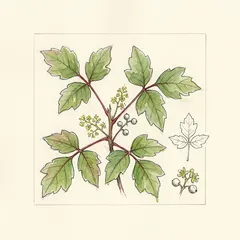
Rhus Toxicodendron.
POISON OAK. N. O. Anacardiaceae. Tincture of fresh leaves gathered at sunset just before flowering time.
and
Rhus Radicans.
POISON IVY. N. O. Anacardiaceae. Tincture of fresh leaves gathered at sunset just before flowering time.
[Under the name Rhus Hahnemann published his proving of "R. radicans, also called Toxicodendron." Botanists agree in recognising no distinction other than that of habit between the two. Millspaugh (American Medicinal Plants) tells in his masterly account of the plant that he has seen the two varieties springing from the same root-stock. He advises that the tincture should be made from specimens of both. Rhus tox. is a shrub with erect stem from two to four feet high.
The stem is devoid of rootlets. Rhus r. has more or less tortuous stems, four to thirty feet high, profusely studded with dark-coloured rootlets, by which it clings to its support Our own Ivy (Hedera helix) in the same way may run along the ground, rooting at intervals if it cannot find a support, and growing to a great height if it can; and it may be an erect shrub with no rootlets and no tendency to climb The two forms have been proved independently, and when necessary to distinguish them I shall name them Rh. r. and Rh. t.
When reference is made to both or either in this work I use the term Rhus without distinction. All other varieties of Rhus will be distinguished.]
Clinical EN
Abortion. Acne rosacea. After-pains. Amenorrhoea.
Anus, fissure of. Appendicitis. Appetite, lost. Beri-beri.
Bones, pains in. Caecum, inflammation of. Chilblains. Circulation, feeble.
Cyanosis. Dengue fever. Diarrhoea; chronic. Diphtheria.
Dysentery. Dysmenorrhoea. Dyspepsia. Ear, eczema of.
Ecthyma. Enteric fever. Erysipelas. Erythema nodosum.
Exostosis. Eyes, inflammation of; choroiditis; sight, weak. Feet, pains in. Gastro-enteritis.
Glands, inflammation of. Gout. Haemorrhages. Haemorrhoids.
Hands, pains in. Hernia. Herpes. Herpes zoster.
Housemaid's knee. Hydrocele. Influenza. Intermittents.
Jaw, cracking in. Liver, abscess of. Lumbago. Measles.
Menorrhagia. Metrorrhagia. Neuralgia. Ovary, tumour of.
Paralysis. Paraphimosis. Pemphigus. Periosteum, pains in.
Pleurisy. Pleurodynia. Pneumonia; typhoid. Ptosis.
Pyaemia. Redgum. Relapsing fever. Rheumatism.
Scarlatina. Sciatica. Sleep, restless. Small-pox.
Spine, diseases of. Sprain. Strictures. Tongue, affections of.
Typhus fever. Urticaria. Warts. Wens.
Yawning.
Characteristics EN
The Poison Ivy grows in thickets and low grounds in North America, flowering in June. It was introduced into England as a plant in 1640. In 1798 Dufresnoy of Valenciennes first used it as a medicine. It was brought to his notice by the cure of a young man of an herpetic eruption (dartre) of six years' duration, through his being accidentally poisoned with the plant.
Dufresnoy used it successfully in eruptive diseases, paralysis, rheumatism, and amaurosis. The milky juice, which turns black on exposure, is used as a marking ink (like Anacard.) and as an ingredient of varnishes for finishing boots. The tincture contains Rhoitannic acid (C18H28O13) and Toxicodendric acid, a poisonous, volatile principle. A peculiarity of the plant is that it is more poisonous during the night, and when bursting into leaf, or at any time in June or July when the sun is not shining upon it.
Absence of sunlight, together with dampness, seems to favour the exhalation of Toxicodendric acid. "An acrimonious vapour, combined with carburetted hydrogen, exhales from a growing plant of the Poison Oak during the night. It can be collected in a jar, and is capable of inflaming and blistering the skin of persons of excitable constitution who plunge their arms into it" (Porcher, quoted by Millspaugh, from whose work I take the above facts). Those who care for Signatures will not fail to connect the cardinal aggravations of Rhus—at night and from damp—with the increased virulence of the plant at night and in damp atmosphere.
(One prover of Rh. ven. was not influenced by contact with the leaves when his skin was dry, but only when perspiring; and the worst poisonings with Rh. divers. happened to persons when moist and heated.) Millspaugh relates instances of Rhus poisoning: Out of ten men employed to clear a piece of land of shrubs among which the Poison Vine greatly predominated only four escaped: "Most of the men soon began to show signs of being tired, and at the end of the fourth day six of them were flat on their backs too sick for anything." Actual contact with the plant is not necessary in order to produce its effect.
One sultry day in June a young lady drove a croquet ball across a lawn to a clump of Poison Ivy that grew beside it. Knowing her susceptibility she reached under the plant and drew out the ball without touching a leaf. During the evening of the same day her face began to itch and burn, and in the night it swelled so that the eyes were not merely closed, the lashes even disappeared in the swelling. It took nearly two weeks for her to recover.
Millspaugh summarises the effects of Rhus (the majority of poisonings have been caused by Rh. rad.) as follows: First redness and swelling of the affected part, with intolerable itching and burning, followed by vertigo, weariness, and a sort of intoxication. Infiltration of face and eyes, and agglutination of the lids after sleep; great restlessness, pain, thirst, and fever. The surface of the skin becomes after a time studded with confluent bullae where the cellular tissue is loose, then a dermatitis follows resembling erysipelas; this may spread rapidly and finally be communicated to the mucous membranes.
This is followed by swelling of the mouth and throat, cough, nausea, and vomiting. Rheumatoid pains develop about the joints, and a painful stiffness asserts itself in the lumbar region, while the legs and arms become numb. Confusion of mind and delirium may then set in, during which the patient may become so ill-humoured, restless, and anxious that he will jump out of bed. Concomitants are: Inflammation of eyes, dilation of pupils, weak vision, sometimes diplopia; epistaxis; brown-coated tongue with triangular red tip; swelling of parotids; difficult swallowing; griping; diarrhoea; profuse urination; oppression; rapid pulse; prostration; soreness of muscles, < by rest;
> by exercise; sleepiness; chilliness followed by fever and copious sweat The American provings were made with Rh. rad., and the majority of the poisonings have occurred from this plant. Though it is not certain that Hahnemann used Rh. tox. at all, or exclusively, Jahr gave a separate presentation of the Rh. rad. symptoms. H.
C. Allen (quoted Critique, vi. 409) notes in Rh. rad. a periodicity which marks it as a great antipsoric. It is, he says, on deeply psoric or tubercular constitutions that its toxic effects are most felt and longest lasting, and these constitutional effects "seem ineradicable without the antipsoric." One case of his showed a return of symptoms at 12.45 a.m. on July 5th, each year during sixteen years, except the year 1898, when the previous use of Tuberculinum, a dose once each month, prevented an attack; and modified the 1899 attack.
Guernsey considers Rh. rad. deeper acting than Rh. tox., being indicated in phlegmonous erysipelas, especially where it begins in ankles and moves gradually up the leg, moving in the deeper tissues, no fever; and for axillary glands when the swelling is very deep and hard. Farrington gives as distinctive indications for Rh. rad.; Occipital headache with rheumatic stiffness of nape. Drawing tearing pains in legs.
Pleurodynia when the pains shoot into the shoulders. Mahony (M. A., xxvi. 109) reports a case of eczema on perineum and scrotum with sweat in cleft of nates, both relieved in a week with Rh. rad. 12, twice daily Hahnemann quickly perceived the keynote of the Rhus symptoms: "We observe," he says, in his preface to the proving, "this curious action (which is found in few other medicines, and in these never to such a great degree), viz., the severest symptoms and sufferings are excited when the body or the limb is at rest, and kept as much as possible without movement.
The opposite of this, namely, an increase of the symptoms by movement, is much more rarely, observed." He contrasts Rhus with Bry., which has almost identical rheumatic pains with the opposite Conditions. Neidhard adds a note in Hempel's Jahr which brings out a modification of this "< by rest" which is of the greatest practical importance, as I can testify. Neidhard says that the disease in which he has made most use of Rhus is a form of rheumatism common in North America, and characterised by the following symptoms: "Rigidity, paralytic weakness of the joints, with stinging pain along the tendons and muscles.
Swelling and redness on or near the joints. Rheumatism of the hip-joint and wrist seem to be most effectually controlled by its action. The greatest rigidity and pain is experienced on first moving the joints after rest, and on waking up in the morning. After the joints are moved for a while the pain is lessened." Contrasted with Bry., Rhus has: "The more he moves the > he is"; whereas Bry. has "The more he moves the < he is." It is necessary to bear in mind this distinction or a wrong prescription will often be made.
Rhus has not only < during rest, but < after resting also. However, Rhus and Bry. complement each other: it is not unusual for the Conditions of a case to change under one of these remedies, and then the other will be required. Hahnemann says "these two antagonistic sister remedies "—each in its place—successfully met the typhus which prevailed in the countries desolated by the war which raged from the summer of 1813 and onwards. Of 183 cases treated by Hahnemann in Leipzig not one died.
This restlessness of Rhus will be found to qualify the symptoms in a large proportion of the cases in which it will be called for. It is as restless as Acon. and Ars., but in a different way from either. With Rhus it is due to the pain and soreness temporarily > by movement; or a nervous internal uneasiness which makes the patient want to be on the move when there is no particular pain present (Nash). The presence of restlessness is a leading indication for Rhus in fevers, typhoid and other.
Other indications are—clouded sensorium, stupefaction, muttering delirium, dry tongue. The characteristic tongue of Rhus is dry or dark coated, with triangular red tip. In intermittents a characteristic is "Cough during the chill." Hahnemann pointed out another keynote of Rhus: "Multiplied experience has taught me that Rhus is the most efficacious and the specific remedy for the frequently fatal effects of over-lifting, inordinate exertions of the muscles, and contusions." He was, of course, led to this inference by the "bruised and sprain-like pains" and "stiffness" of the provings.
Rhus is in the front rank of vulneraries. It meets threatened abortion from a sprain; and also prolonged after-pains and other effects of the strain of a severe labour; axillary abscess from this cause has been cured with Rhus. Straining, rheumatic coughs. Ailments from straining a single part, muscle, or tendon; over-lifting, particularly from stretching high up to reach things.
There is an analogy to this in the dreams—dreams of great exertion: rowing, swimming, working hard at his daily occupation. Rhus has cured many forms of paralysis: Rheumatic paraplegia from getting wet, lying on damp ground; sleeping in damp sheets; after exertion; after parturition, sexual excess, or fevers. Ptosis. Paralysis of single limbs.
Numbness of parts paralysed. Facial neuralgia, lumbago, and sciatica (esp. of left side), with restlessness; coming on after a wetting or after a bath are cured by Rhus. The neuralgic pains and eruptions make Rhus a perfect simillimum in many cases of herpes zoster. Fever-blisters round mouth.
Howard Crutcher relates (M. A., xxii. 38) how after standing on a wharf with his right side exposed to a cold wind from the river he began to have severe pains shooting up the ulnar nerve, a steady ache uniform throughout arm and forearm, but extremely severe in structures beneath deltoid. The pain was much < in a warm place; it did not interfere with movement. At 8 p.m.
Crutcher took Rhus 30 dry on the tongue, and almost immediately he was called into the open air again. In thirty minutes the pain was decidedly better; in ninety minutes it was gone. A case of Rhus poisoning reported by Morey (Med. Cent., February, 1898;
H. W., xxxiii. 309), showed an effect on the menstrual period, and was remedied by Crocus. Miss M. was severely poisoned by Rh. rad. (it is called "Ivy") in July, 1895, during her menstrual period.
She was treated with Bell. and Rhus internally, and an Oxide of Zinc ointment externally, and appeared to make a rapid recovery. On September 1, 1897, without further known poisoning, another similar attack developed during the menstrual period, and frequent minor attacks had occurred in the two years, always at the time of the menses. Later on she had another attack which developed rapidly and greatly alarmed her. The menstrual flow commenced a week before she came to Morey, was very scanty, dark, and clotted, as had been the case for sometime.
The flow had scarcely well begun when it ceased suddenly and the eruption appeared. Croc. was given, and the first dose re-established the flow, which was normal in appearance and quantity, and the eruption at once disappeared. Peculiar Sensations are: As if intoxicated. As if asleep.
As of a weight behind right orbit. As of a band strapped across forehead. As if head were swelling out. Brain, as if loaded; as if torn; as if loose; as if fluctuating; as if a quantity of blood shot into it when stooping.
As if muscles of back of head screwed together. As if a hundredweight on nape of neck. As if a veil before eyes. As of sand in eyes.
As if lids difficult to move. As if jaw would break. Teeth as if being torn out; too long; loose. As if tongue had been skinned.
As if a hernia about to protrude. As if pharynx inactive or paralysed. Stomach, as if overloaded; as if a stone in; as if pit of stomach swollen or drawn together. Hypochondria and abdomen as if beaten.
Digging as if caused by a worm. As if a knife in right abdomen. As if something torn loose in abdomen, chest, and inner parts generally. As if a lump lay like a pressing heavy weight in abdomen.
As if one side of rectum grown up. As if everything would come out of rectum. As if breath were stopped at pit of stomach. As if sternum were pressed inward.
As if sprained or dislocated: back, jaw, arms, wrist, hip, knee, ankle. As if one had been lying in an uncomfortable position. As if bruised in right side of lumbar vertebrae and in small of back. As if flesh of small of back had been beaten.
As if back were broken. As if some one were pressing on left shoulder. As if hand were held in hot water. Hand, as if withered; as if lame; as if pins pricking points and palmar surfaces of first phalanges of fingers.
Rectus cruris muscle as if bruised. As if hamstrings and tendons of limbs too short. As if knee too-short. Legs (and right foot) as if made of wood.
Feet and ankles as if asleep. Heels as if stepping on pins. As if running nails under skin of heels. As if walking on needles.
Joints as if bruised. As if bones ached. As if sinking through bed. As if something forced him out of bed.
Bones, as if being scraped; as if flesh being torn loose from them. As if whole body was burning. As if cold water poured over him. As if blood ran cold through veins.
As of subcutaneous ulceration. As if inner parts grown together. Peculiar Symptoms are: Craving for cold drink and laborious dreams. Herpes alternating with asthma and dysentery.
Chokes easily on swallowing. Swallowing = pain in middle of back. Anorexia in palate and throat. Nausea in chest.
Taste of blood with cough (no blood being raised). Coldness in left tibia. Scalp sensitive, < turning hair back. Hour-glass contraction of abdomen.
The symptoms are: < By touch; > by rubbing. < From riding; blows; jars; sprains. < By rest; and commencing motion;
> continued motion. (Lying down > colic and diarrhoea.) Lying on hard floor with pillow under back > pain in back. Must hold head to > weight in it. Bending head back > pain in occiput; = pain in head and down spine.
Limbs lain on fall asleep; no sweat on them. < Side lain on. Lying on left side = palpitation and pain in heart. Swallowing = pain in back.
Inclination to stretch. Stretching = cracking in knees; soreness in abdomen. Unwonted exercise = paralysis. Over-exertion = palpitation;
< coxalgia. < Evening; night; morning after sleep. Sensitive to cold open air; raw north-east winds. Effects of drinking cold water; getting wet, especially after being heated, cold bathing; sea bathing.
> By warmth and hot applications. < Warmth of bed. Sciatica is > by warmth from exercise. < Change of weather; damp, stormy weather; before a storm; snowstorm; in autumn; in winter.
Nausea < after eating. Craves cold water, which is vomited immediately.
Relations EN
Antidoted by: Bry., Bell., Camph., Coff., Crot. t., Grind., Merc., Sang., Sul., Verb. h. Antidote to: Bry., Ranunc., Rhod., Ant. t., Sapon. (Ars.). Complementary: Bry.
Inimical: Apis, before or after, especially in skin affections. Compatible: Arn., Ars., Bry., Calc., Calc. ph., Cham., Con., Lach., Ph. ac., Puls., Sul. Followed well by: Calc., Bell., Graph., Nux, Pho., Pul., Merc., Sep., Sul., Ars., Bry. Compare: The other Rhoes and Anacardia.
Eye symptoms, > by motion, Comoc. (Rhus > by warmth; Comoc. <).
Rheumatic paralysis from exposure to damp and cold, Caust. (Rhus restless, > by motion day and night; Caust. restless only at night). Parotid gland, Am. c.
(Rhus left; Am. c. right). Result of working in water, Calc. Granular ophthalmia, Arg. n.
(Rhus has more spasm; if lids are forced open scalding tears gush out and cause pimples round the eye). Cough excited by cold drink, Sil. (> Caust.). Sweat of body, head dry (Sil. sweat of head, body dry).
Nose-bleed at beginning of typhoid, Ph. ac. (with Rhus it >, not with Ph. ac.). Enables persons to withstand muscular fatigue, Fl. ac., Ars., Coca. Hypertrophy of heart from over-exertion, Bro., Arn., Aco.
Ulcers on legs in dropsy, Ars., Lyc. (Lyc. in dropsy from liver disease). Fear of being poisoned, Glo., K. bro., Hyo., Bap. Profuse gushing tears excoriating cheek, Euphr.
(Rhus < right eye; pus thinner). Ptosis or any ocular paralysis, Gels. (Rhus rheumatic patient, from wetting; Gels. with sluggish thought and suffused face).
Scarlatina, erysipelas, &c., with drowsiness and oedema, Apis (Rhus dusky red, bodily restlessness; Ap. rosy red, fidgetiness. Rhus itching preponderates; Ap. less tendency to form pus).
Enteritis, peritonitis, typhlitis, Lach. Heart affections with numbness of left arm, Aco. (tingling in fingers), Kalm., Puls. (numbness, especially about elbow), Act. r.
(as though arm tightly bound to body), Phyt. (right arm). Dreams of business of day, Bry. (Rhus and Bry. have opposite Conditions; and Rhus menta. state is hopeless and despondent, Bry. fretful, peevish, irritable.) Typhoid, Pho.
(follows Rhus well; pneumonia; stools yellow and blood-streaked, at times like "flesh water"), Ars. (irritable and anxious in spite of prostration), Bapt. (face dark red, besotted; stool dark, fluid, very offensive; drowsy, stupor; tossing about with delusion that limbs are scattered about bed feels hard), Arn. (complete apathy; involuntary stool and urine bloody sputa if lungs affected).
Empyema and induration of axillary glands, Bell. (Bell. at climaxis, Rhus after labour). Eczema, Mez., jug. r. (favus).
Cough < from evening to midnight, Mez. (Rhus also from uncovering). Colic > bending double, Coloc. (Rhus also > moving about).
Conjunctivitis from getting wet, Calc. Glaucoma, Caust. Cracking and breaking pain in jaw, Ign., Petr. Paralysis from rheumatic meningitis (from rheumatic myelitis, Dulc).
Acute spinal paralysis of infants, Sul. (complementary). Averse to be uncovered, Ars., Hep. Bearing down in hypogastrium, Puls.
Flesh feels beaten off the bones, Thuj. Aversion to darkness, Am. m., Bar. c., Calc., Carb. a., Stro., Val., Stram. Averse to be washed, Ant. c., Clem., Hep., Sep., Spi., Sul. Effects of raising arms high to lift things, Pho.
Bloody urine discharged in drops, Pul. Phimosis, Cann., Merc., Sul., Nit. ac., Sep., Thuj., Sabi. Hunger in early morning, Aga., Ant. c., Asar., Calc., Carb. a., Lyc., Ran. b., Saba., Zn. Semilateral coat of tongue, Daph., Lob.
(Rhus white). Hot breath, Calc., Carb. s., Sul. Nocturnal salivation, Cham., Nux, Pho. Difficult swallowing of solids, Atrop., Bell., Bar. c., Calc., Chi., Dro., Lyc., Plb., Sil.
Parotitis, Aur., Merc., Pilo.; metastasis to testes, Rhus, Pal., Bell., K. ca. Yearly returns, Ars. Cold from wetting head (Bell. from hair-cutting). Sensation of subcutaneous ulceration, Ran. b., Pul.
Chokes easily when swallowing, K. ca. > Warm food, Lyc. Epistaxis at night, (Bry. morning). Punctured wounds as if stepping on nails, Hyper., Led.
Backache > lying on hard floor, Nat. m. Hydroa, Nat. m. Acne from getting wet, or ice-cold drinks, when heated, Bellis. Desires cold drink and vomits it immediately, Ars.
Ailments from spraining a single part, muscle, or tendon, Calc., Nux. Vertigo < lying down (Apis >); < rising from lying or stooping, Bry. Jelly-like stools, Colch., K. bi.
Causation EN
Slightest anger. Cold. From wetting head. Damp sheets. Bathing, in fresh or salt water. Getting wet when heated. Strains. Over-exertion. Over-lifting. Raising arms high to lift things. Drinking ice-water. Beer (headache).
Mind EN
Anxious sadness and excessive anguish, esp.
(at twilight) in evening and at night, with wish for solitude and inclination to weep
Restlessness which will not suffer the patient to remain seated.; and compels him to throw himself about in bed
Anguish with fear of death and sighs
Fear of being poisoned
Suicidal mania (desire to throw himself into the water)
Irritability and ill-humour, with repugnance to labour
Moral dejection with anthropophobia
Helplessness and profound despondency
Uneasiness respecting one's children, affairs, and the future, with want of self-confidence
Weakness of memory and forgetfulness (cannot remember the most recent events)
Want of ideas and of mental energy
Difficult comprehension
Slowness of conception and mental dulness
Delusions of the imagination and visions
Mild delirium; with insensibility.
Head EN
Head bewildered as from intoxication
Stupefaction; with tingling in head and pain in limbs, > on motion
Staggering gait without vertigo
Staggers to r. when walking
Vertigo and staggering as if about to fall; esp. when getting out of bed (chilliness and pressure behind eyes)
Vertigo as if he were held up high, while sitting
Emptiness in head
Vertigo, with fear of death, on lying down in evening
Headache (< in the morning, while lying; from cold) immediately after a meal or after drinking beer, and also on moving the arms (> by heat and when moving about)
Headache < morning, r. side, with vertigo as if she would fall back on getting out of bed, acute darting pains in both temples, can hardly hold up, and a mist comes before sight when doing anything quickly or getting up in a hurry (produced
R.
T.
C.).—(Incito-motor function defective)
Attacks of headache with need to lie down; every vexation and exercise in the open air renews the attacks
Periodical headache
Pain in head as if brain were bruised, esp. in morning, < by moving and lifting up head
Passive congestion of head > by repose
Heaviness and pressive fulness of head (esp. in forehead; as if a weight were falling forward, with heat in face), with sensation, on stooping, as if the brain were about to burst
Head so heavy obliged to hold it upright to > the weight pressing forward into forehead
Sensation of compression or expansion in head
Drawings and tearings in head, and esp. in temples, principally in evening and at night
Lancinating headache day and night, extending as far as ears, root of nose, and the cheek-bones, with the teeth set on edge
Beating and pulsations in head, esp. in occiput
Pains, esp. in occipital protuberances
Sanguineous congestion in head
Burning sensation, esp. in forehead (when walking) and occiput
Occipital headache with rheumatic stiffness in nape (R. rad.)
Painful tingling in head
Sensation as if a quantity of blood shot into brain when stooping
Rush of blood to head with burning-tingling and beating in brain, bright redness of face, great restlessness of body in morning when at rest, < after eating
Liability to take cold from having head wetted
Buzzing and noise in head
Balancing and sensation of fluctuation in head at every step, as if brain loose, also when shaking head
Painful sensibility of exterior of head, as from subcutaneous ulceration, esp. on turning up hair and on touching it;
< on side on which he does not lie, and from becoming warm in bed
Contraction of the scalp as if the hair were pulled
Drawing and tearing in scalp
Swelling of head
Erysipelatous swelling of head and face with vesicles drying up and forming itching scabs
Gnawing tingling in scalp
Dry herpes on scalp
Periodical scald-head, reappearing every year
Scald-head with thick scabs, which destroy the hair, with greenish pus (offensive smell), and violent itching at night.—(Eczema of entire hairy scalp, causing loss of hair
R.
T.
C.)
Small, soft tubercles on the scalp
Wen of many years' duration cured with Rh. t. Ø, which caused erysipelas at same time (H.
W., xxxi. 199).
Eyes EN
Pains in eyes on moving ball of eye
Pressure and burning sensation in eyes
Eyes fixed, dull, and downcast
Smarting in eyes and lids
Affections of internal surface of eyelids
Inflammation of the eyes and lids, with redness and nocturnal agglutination
Profuse lachrymation (eyes full of water, blear-eyedness) with oedematous swelling round eyes
Meibomian glands enlarged, cilia fall out
Photophobia
Bladder-like swelling of the lids, closing the eyes
Swelling (erysipelatous) of whole eye and of surrounding parts
Rheumatic ophthalmia, particularly of r. eye
Gouty keratitis, < in damp, rainy weather, sight dim
Paralytic rigidity of the eyelids
Jerking and quivering of eyes and eyelids
Blue colour about the eyes
Heaviness of the eyelids
Styes; on the lower eyelids
Veil before eyes and weak sight; all objects appear pale.
Ears EN
Otalgia
Painful throbbing in ear at night
Swelling of ears
Discharge of sanguineous pus from ears, with deafness
Whistling, squeaking, or ringing in ears when walking, changes to low resonance when lying down, as if membrana tympani were burst
Swelling and inflammation of parotids with fever
Suppuration of parotids.
Nose EN
Redness of point of nose, with pain as from excoriation on touching the part
Hot swelling of the nose
Breath seems so hot it burns the nostrils
Dryness of the nose
Discharge of greenish fetid pus from nose
Epistaxis also at night and on stooping or hawking; blood dark; scabs about nares
Frequent violent and almost spasmodic sneezing
Abundant discharge of mucus from nose, without coryza.
Face EN
Face pale, sickly, wan, with eyes surrounded by a blue circle and nose pointed
Drawing and burning in superciliary region and in cheek-bones
Face disfigured and convulsed
Face red, with burning heat
Erysipelatous inflammation and swelling of face, with pressive and tensive shootings and burning tingling
Vesicular erysipelas, with yellow serum in the vesicles
Humid eruption and thick scabs on face, with running of fetid and sanguineous serum
Acne.—(Acne rosacea; impetigo on the face or on forehead.)
Commissures of lips sore and ulcerated
Herpetic, crusty eruption round mouth and nose, with itching, jerking, and burning sensation
Exanthema on cheeks, chin, and around mouth
Desquamation of skin of face
Incisive contractions and burning spasmodic pains in cheeks (which are red and hot)
Cold sweat on face
Eruptions of burning pimples round lips and chin
Cramp-like pain in jaw-joint when at rest and when moving the jaw, with cracking on least movement, > by strong pressure from without and by taking warm things
Spasms in the jaw
Constant desire to yawn until it seems as though the jaw would break
Hard and painful swelling (pressive digging) of the parotid and submaxillary glands (with sticking on swallowing)
Lips dry and brownish.
Teeth EN
Toothache as from excoriation, or with tearings, shootings, jerkings, digging, and tingling, frequently at night, or < in open air and > by external heat (and in warm room), sometimes also in consequence of a chill
Looseness of teeth
Teeth feel elongated
Looseness of lower incisors, cannot bite with them
Fetid exhalation, from carious teeth
Burning pain in gums as from excoriation, also at night.
Mouth EN
Dryness of mouth with violent thirst
Copious accumulation of saliva in mouth
A yellow, and sometimes also a sanguineous, saliva flows from mouth at night
While sitting asleep in afternoon saliva runs from mouth
In morning in bed mouth full of salt water
In morning mucus and tongue are salt
Copious accumulation of viscid mucus in mouth and throat, with frequent expectoration
Offensive smell from mouth
Tongue: dry, red or brownish, and cracked; triangular red tip; yellowish-white at root
Tongue white; often on one side
Sensation as if tongue covered with a skin.
Throat EN
Sensation of dryness of throat
Sore throat, as if caused by internal swelling, with pain as from a bruise even when speaking, and with pressure and shootings during deglutition
Sensation in throat as if something were torn out of it.—(Sore throat after exertion in speaking.)
Difficulty in deglutition and pain in swallowing solid food as from contraction of throat and oesophagus; difficult swallowing of liquids as from paralysis
Brandy causes an extraordinary burning sensation in throat
Copious accumulation of mucus in throat, with frequent hawking in morning
Pulsative pain in bottom of gullet.
Appetite EN
Putrid taste, esp. in morning and after a meal
Insipid, clammy, acrid, bitter, sour, or metallic taste
Greasy taste in mouth but food tastes all right
Taste as if stomach had been deranged with putrid meat, but food tastes right
Sweetish taste in mouth
Bitter taste of food, esp. of bread, which appears rough and dry
Anorexia with repugnance to all food, esp. bread, meat, coffee, and wine
Anorexia in palate and throat with empty feeling at stomach, and at same time ravenous hunger, which goes off after sitting for some time
Sensation of fulness and satiety in stomach, which takes away all appetite
After a meal strong disposition to sleep, pressure and fulness in stomach and abdomen, nausea with inclination to vomit, lassitude, vertigo, and shuddering
When eating sudden vomiting
Bread lies heavy on stomach
Want of appetite with unquenchable thirst
Hunger without appetite
Pain and heat of head after drinking beer
Thirst most frequently from a sensation of dryness in mouth, also at night or in morning, with desire chiefly for cold water and cold milk
Craving for dainties; for oysters.
Stomach EN
Risings with taste of food
Empty risings after a meal or after drinking
Eructations from stomach, which seems to be transferred to r. side of chest, as if it settled there
Violent risings with tingling in stomach, > by lying down, < on getting up
Pituita in the stomach
Pain in stomach and nausea from drinking ice-water
Nausea and disposition to vomit, principally after a meal and after drinking, as also in night or morning after rising, > by lying down
Vomiting immediately after eating
Pains in stomach as if there were a stone in it, esp. after a meal; and when standing
Pressure at stomach and scrobiculus, often with obstructed respiration
Beating and shooting in epigastric region
Squeezing, sensation of swelling, and pain as from ulceration in pit of stomach
Sensation of coldness in stomach
Sensation in pit of stomach as if something were torn away from it, esp. on stooping or making a false step.
Abdomen EN
Distension of abdomen, esp. after a meal
Pressive drawing from below upward, in l. hypochondrium
Soreness, as if beaten, in hypochondria, and still more in abdomen;
< on side lain on when turning and when beginning to move
Pressive heaviness in abdomen, from a weight
Contractive spasms in abdomen, which force patient to remain bent double
Hard and visible contraction of abdomen across navel; abdomen distended above and below this stripe.—(Pain in abdomen with tightness across forehead and sleeplessness
Violent and continuous pain round navel, caused by retching
R.
T.
C.)
Digging turning in abdomen, as if caused by a worm
Incisive tearings, jerks, and pinchings in the abdomen (esp. after eating;
> after stool)
Pain in region of ascending colon
Burning sensation in the abdomen
Relaxation of the abdomen, with internal shaking at every step
Violent colic, often at night, or < by all kinds of food or drink, sometimes with sanguineous evacuations
Sensation in abdomen as if something were torn away
Scarlet colour of abdomen
Soreness in integuments of abdomen, as if they were ulcerated, esp. on stretching in morning
Swelling of inguinal glands
Pressure in groins towards exterior as if a hernia were about to protrude
Bloated abdomen, esp. after eating
Great flatulence, with grumbling, fermentation, and pinching movements in abdomen
Exceedingly offensive flatus.
Stool And Anus EN
Constipation, sometimes alternating with diarrhoea
Hard and slow evacuations
Tenesmus, sometimes with nausea, and tearing or pinchings in abdomen
Painful tenesmus without stool
Evacuations loose, bloody, watery, or mucous, frothy, gelatinous, red, or streaked with white and yellow
Dysentery; jelly-like, odourless stools, more frequent after midnight, preceded and followed by much pain with great restlessness
Obstinate or dysenteric diarrhoea
Faeces perfectly white
Nocturnal diarrhoea, with violent colic, headache, and pains in all limbs (> after an evacuation or when lying on abdomen)
Chronic painless diarrhoea, only in morning preceded by marked commotion in the bowels
Diarrhoea with tearing pains running down back of the leg with every stool
Involuntary stools when asleep at night
Short respiration during stool
Tingling and itching in anus and rectum
Sense of constriction in rectum, as though one side had grown up
Protrusion of haemorrhoids from anus after a soft evacuation, with pain as of excoriation.
Urinary Organs EN
Retention of urine
Frequent and urgent want to urinate, day and night, with profuse emission
Incontinence of urine, esp. during repose (at night or when sitting)
Urine emitted in a divided stream
Emission, drop by drop, of blood-red urine, with tenesmus
Diminished emission of urine, although much drink may be taken
Deep-coloured, irritating urine, which soon becomes turbid
White, turbid urine
Urine clear as water with a snow-white sediment
Swelling of urethra.
Male Sexual Organs EN
Profuse eruption on genital organs (closing the urethra by swelling)
Inflammation of the glans
Running vesicles on the glans
Swelling of the glans and prepuce; prepuce dark red
Paraphimosis
Red spots (blotches) on the interior of prepuce
Swelling and thickening of scrotum (with intolerable itching)
Erysipelas of scrotum.—(Hydrocele; from over-lifting)
Scrotum flaccid and hanging low
Moist eruption on scrotum
Frequent erections at night, with want to urinate
Strong sexual desire in morning.
Female Sexual Organs EN
Catamenia premature and too profuse
Menstrual flow light-coloured and acrid, causing biting pain in the vulva
Erysipelatous inflammation of the external genitals
Soreness of vagina soon after (or hindering) coitus
Catamenia of too long duration
Menstrual discharge = violent pain in vulva
Membranous dysmenorrhoea
Menorrhagia from strains; from wetting
Discharge of blood during pregnancy
Pain as from excoriation and shootings in vagina.—(Uterine polypus with metrorrhagia
Relieves shooting pains of cancer uteri
R.
T.
C.)
Bearing-down pain; when standing
After-pains of too long duration, after severe labour, with much and excessive straining
Discharge of blood and clots of blood from uterus, with labour-pains
After labour, vitiated discharge from vagina, with shootings upward in the parts and a bursting sensation in the head
For weeks after delivery pain in r. limbs with numbness from hips to feet (varicose veins)
Abortion from strain
Axillary abscess after delivery
Breasts painfully distended, red in streaks, rheumatic state
Amenorrhoea from getting wet; with milk in breasts
Milk-leg, typhoid metritis after delivery
Diminished secretion (or suppression) of milk; with burning over body.
Respiratory Organs EN
Hoarseness and roughness of throat, with a sensation of rawness in chest
Sensation of coldness in throat on taking an inspiration
Tendency to be choked when swallowing
Burning exhalation from larynx
Sensation of constriction in throat-pit after a short walk
Cough excited by a tickling in air-passages; generally short and dry, with anguish and shortness of breath, and principally in evening before midnight
Dry, fatiguing cough
Dry, teasing cough coming on just before the chill and continuing during the chill
Cough with vomiting of food, esp. in evening, and when lying on back
Cough after waking in morning
During the cough gets a taste of blood in the mouth but does not cough up blood
Short cough with bitter taste in mouth, in evening after lying down and in morning after waking
Cough with stitches in chest and profuse general perspiration
Whooping-cough; spasmodic, violent cough, caused by tickling in larynx and chest, with expectoration (except in evening) of acrid pus or greyish-green cold mucus of putrid smell; or of pale, clotted, at times brown blood
Putting hand out of bed brings on a cough
Pneumonia with typhoid symptoms, often after re-absorption of pus
Cough with pain in stomach, or with shaking in chest and head
Terrible cough which seems as if it would tear something out of chest
Cough with expectoration of, a bright-red blood and sensation of faintness in chest.
Chest EN
Difficult respiration after a moderate walk
Anxious oppression of chest, even at night
Nausea in chest;
< stooping
Respiration impeded by a pressure and squeezing in pit of stomach
Shortness of breath in evening with tension in chest
Frequent want to take a full inspiration
Weakness in chest, which renders speech difficult after a walk in open air
Sensation of constriction in chest
Shootings and lancinations in chest and sides of chest; esp. when sitting with body bent forwards, when speaking, when breathing deeply, when sneezing, seldom when walking or when using vigorous exertion
Inflammation of lungs, also pneumonia nervosa
Pleurodynia, chest pains shoot into shoulders (Rh. rad.)
Tingling in chest, with tension of muscles of chest, < by repose
Rush of blood to chest.
Heart EN
Weakness and sensation of trembling in heart
Violent palpitation of heart while sitting quietly
Shootings in region of heart, with painful sensation of paralysis and numbness of l. arm
Pulse rapid, small, compressible.
Neck And Back EN
Rheumatic stiffness of nape and neck, with painful tension during movement
Painful swelling of axillary glands
Rheumatic tearing between scapulae, not affected by movement, < by cold, > by heat
Tearing between shoulders, drawing together from both sides
Transient coldness in back
Contusive pain in loins, esp. on touching the parts, and during repose
Pain in small of back when sitting still or when lying;
> when lying on something hard or from exercise
Bruised pain in sacrum when he lies still on it or sits still; feels nothing of it when moving
Painful rigidity in loins
Painful exostosis on sacrum
Distortion of the vertebral column
Pains in loins, in back, and nape, as from lifting too great a weight
Drawing and stitches in back, esp. when seated and on stooping
Opisthotonos.
Limbs EN
Swelling, stiffness, and paralysed sensations in joints, from sprains, over-lifting, or over-stretching
Lameness, stiffness, and pain on first moving after rest, or on getting up in morning;
> by constant motion
Trembling or sensation of trembling in limbs
The limbs on which he lies, esp. arms, go to sleep
Rheumatic tension, drawing, tearing in limbs, during rest
Excessively cold hands and feet all day.
Upper Limbs EN
Burning shooting under l. axilla, on the arm
Tearing and burning sensation in shoulder, with paralysis of arm, esp. during the cold season, during repose, and in heat of bed
Coldness, paralysis, and insensibility of arm
R. arm weak; rheumatic paralysis
Exostosis in arm, with burning sensation and ulcers, which discharge a sanious pus
Erysipelatous swelling and pustules, with burning itching in arms, hands, and fingers
Red spots on arms
Violent stitches in r. upper arm from without
Jerks, shootings, and tearing in arms
Tension in elbow-joint
Jerking tearing in elbows, wrists, and joints of fingers
Digging in bones of the forearm
Weakness and rigidity of forearm and fingers during movement, and trembling of those parts after the least exertion
Hot swelling of the hands in evening
Swollen veins on hands
Vesicular eruption in clusters on wrist
Rhagades; smarting of back of hands
Back of hand covered with chaps and hot; skin hard, rough, and stiff
Tearing in all the finger-joints
Warts on hands and fingers
Hangnails
Swelling of fingers
Jerking in thumbs
Contraction of fingers.
Lower Limbs EN
(Eruption with sweat in cleft of nates.)
Aching pains in legs; must change position every moment.—(Pains in l. lower limb, thigh chiefly, from septic absorption in old abdominal disease, with vesical irritation
R.
T.
C.)
Shootings and tearings in hip-joint, extending to ham, esp. when resting on foot; or with dull drawings and burning sensation during repose, and painful sensibility of joints on rising from a seat or on going up stairs (or other over-exercise; involuntary limping)
Tension and stiffness of the muscles and joints of hips, thighs, legs, knees, and feet
Paralysis of the lower extremities
Cramp in calf after midnight, when lying in bed, and when seated after walking; it goes off on bending the knee
Cramps in buttocks, thighs, and calves, esp. at night, in bed, or when seated after walking
Spasmodic twitching of the limbs when stepping out
Tension in the knee as if the tendons were too short
Painful swelling above knee
Drawing and jerking tearing in the thighs and legs
Lancinations in the thighs, legs, knees, feet, and toes
Heaviness in legs, esp. in hams and calves
Tingling pain in shafts of tibiae at night when the legs are crossed, with constant necessity to move, preventing sleep
Coldness in l. tibia
Paralysis of legs and feet
Shootings and wrenching pain in anklebones when resting on foot
Inflammatory swelling of instep, sometimes with pustules and miliary pimples on part affected
Swollen round ankles after sitting too long, particularly in travelling
Erysipelatous swelling of feet
Swelling of feet in evening
Numbness and paleness of feet (feet dead)
Distortion of toes
Corns on feet, with burning sensation and pain as from excoriation.
Generalities EN
[We are led to think of this remedy where we find an irresistible desire to move or change the position every little while, followed by great relief for a short time, when they must again move, and experience the same relief for a short time; this condition is usually < at night After resting for a time, or on getting up from sleep, when first moving about, a painful stiffness is felt, which wears off from continual motion; but relief is experienced from continual motion—e.g., a nursing mother may have sore nipples, and when the child begins to nurse, the nipple hurts exceedingly, but on continued nursing it becomes much easier
Pain in chest (often rheumatic), < by using arms—as in making a bed, sweeping, &c., stiffness of nape of neck; sensation as if flesh were beaten off the bones, or as if a dog were gnawing it off; as if any part were contracted; as if a part were increased in size; as if certain parts were grown together; of heaviness in outer or inner parts; jerking pains in outer parts; darting and rending pains; of tension or tightness in outer or inner parts; arthritic pain in the joints; trembling sensation in inner parts; dyspeptics often complain of trembling in the stomach; of scraping along the periosteum
For any troubles or complaints, whether acute or chronic, resulting from a sudden and a thorough drenching by a shower of rain; by getting wet in any way; there may be troubles of very long standing, which were so caused Troubles in general affecting the r. abdominal ring; l. chest; l. arm; l. lower extremity; l. side of body; of scalp, as in erysipelas when it runs up to the scalp; glands about the neck, particularly if they are swollen or inflamed with red streaks, as often are in scarlet fever; joints of the jaws, particularly when they are < on beginning of motion, and get > from continued motion; of the abdominal cavity in general; mons veneris, there may be a great deal of itching, sometimes a hard blue boil is found there; shoulder-blades; small of the back, as, e.g., when one stoops his back hurts so that he cannot straighten up without help—this may result from an old sprain, or from a sudden "crick" in the back; sacrum; buttocks; forearm; shoulder, back of hand; fingers joints in general shoulder-joint; elbow, wrist, bones of the arm; calves; joints of the leg hip-joint, knee, and ankle; weakness of joints
Coagulated blood from the nose; cough bloody, blood being coagulated; face covered like erysipelas; increase of saliva; difficulty in swallowing, it hurts so in the back; fluent catarrh of the nose Inability at first to move the parts affected One is very easily sprained by lifting; palsy of the limbs; staggering when walking Strictures after inflammation, and hence may sometimes be used for strictures resulting after gonorrhoea; swelling in general, with inflammation and without; debility; aversion to washing; wounds, with sprained muscles
Axillary glands where the swelling is very deep and hard Symptoms < before a storm of rain; after midnight; in the morning; before falling asleep; from bathing; can't bear cold water; complaints coming on in autumn; on taking a deep breath; on inspiration; from cold in general; in cold air; in cold and wet weather; from coughing; while chewing; from drawing up the limbs; from exertion of the body; after drinking; after fatigue; on uncovering the head; from surgical injuries; from sprains; from lying down; from lifting; from cold food; cold water; anything cold; during perspiration; from wet poultices; while resting; on first rising; while sitting; while talking; after undressing; in foggy, or foggy and wet weather; from getting wet; in winter; from getting wet while perspiring; women in confinement; small-pox; after-effects of syphilis
H. N. G.] Epidemic diseases with oedema of fauces threatening oedema glottidis, vesicles stud pharynx and voice is hoarse; rawness and roughness of pharynx (Dunham)
Rheumatic and arthritic drawings, tension, and tearings in limbs, increased to the highest degree during repose, as well as in bad weather, at night, and in the heat of the bed, often with sensation of torpor and numbness in the part affected after moving it Cramp and tension in different parts as from contraction of tendons Contraction of some of the limbs Tensive shootings and stiffness in the joints, < on rising from a seat, and in open air
Paralytic rigidity in limbs, esp. on beginning to move the part after repose Ready benumbing of parts on which patient reclines Torpor of some parts with tingling and insensibility Tingling in parts affected
Wrenching pain in limbs Paralysis, sometimes semilateral Red and shining swellings, with shooting pain as from excoriation when touched Contusive, or else a sensation in some places as if the flesh were detached from the bones
Pressive drawing in periosteum as if the bones were scraped Sensation in internal organs as if something were torn away Swelling and induration of glands Icterus
Jerking in muscles and limbs Convulsive movements and other sufferings, resulting from a cold bath Semilateral affections.—< And appearance of pains and symptoms during repose or at night, as also on entering a room from the open air; > obtained by movement and walking
The cold, fresh air is not tolerated; it seems to make the skin painful; (a keynote on rheumatism Dunham) Reproduction or < of many sufferings in unfavourable weather
General excitability of nervous system, < by slightest indulgence of anger Drawings in all the limbs when lying down Trembling of limbs after the least fatigue Unsteady gait
Great lassitude and weakness with want to lie down Syncope Inability to bear the open air whether it is hot or cold; it makes a painful impression on the skin.
Skin EN
Vesicular erysipelas where the vesicles are large
Exanthema on face in general-on chin, face, cheeks, mouth, nose, forehead, causing much burning itching
Pustulous chilblains
Exanthema in general; burning; burning itching; pustulous; with swelling; blotches; like milk-crust; moist; like nettle-rash; blue with erysipelas; scurfy; tensive or tight feeling in; pock-shaped; black; purulent; zona or shingles; petechiae; prickling; tickling; blisters which will sometimes spread up the limb, and are sometimes circular in form, spreading with a red edge in the advance, which gradually turns to a blister, the red border still keeping in advance (if the edges be black, Arsen.); itching < after scratching
Tetters in general
Ulcers burning; with corroding pus; with ichorous pus
Rash itches a great deal, in scarlet fever, small-pox, &c., with the peculiar restlessness
Phlegmonous erysipelas, esp. where the erysipelas begins in the ankle, and moves gradually up the leg, running up in the deeper tissues, no fever
Itching over whole body, chiefly in hairy parts
Stinging and tingling on skin, burning after scratching
Humidity of skin
Hardness of skin with thickening
Swelling (hard) of affected parts
Erysipelatous inflammations
Nettle-rash
Eruptions, generally vesicular, scabby, with burning itching, appearing esp. in spring and autumn
Eruption of small pustules on a red bottom, like zona
Gangrenous ulcers resulting from small vesicles, with violent fever
Petechiae, with great weakness, amounting to entire prostration
Black pustules
Herpes, sometimes alternately with asthmatic sufferings and dysenteric looseness
Warts, esp. on hands and fingers; large jagged, often pedunculated, exuding moisture and bleeding readily
Rhagades on hands
Panaritium
Tingling or shooting or else burning smarting in ulcers, esp. at night
Chilblains
Corns on feet, with burning sensation, and pain as of excoriation.
Sleep EN
Frequent, violent, and spasmodic yawnings
Spasmodic yawning without inclination to sleep, and with stretching of limbs and pain as from dislocation of articulation of the jaw
Yawning in general; with violent stretching of the limbs; falling asleep late; lying on the back during sleep
Strong disposition to sleep during day, and also in morning in bed
Somnolency, full of distressing and broken dreams
Sleeplessness, esp. before midnight, generally caused by a sensation of heat, ebullition of blood, and uneasiness which does not permit patient to remain lying down
Disturbed sleep, with anxious and frightful dreams
Coma somnolentum, with snoring, murmurs, and carphology
Sleep hindered by gloomy ideas
Waking caused by bitterness and sensation of dryness in mouth
Sleep at night hindered by a pressure at stomach, digging pinchings in abdomen, and nausea, with inclination to vomit
Inability to remain lying on side at night
Starts with fright and jerking of body during sleep
Incomplete and agitated sleep, with tossing and many troublesome thoughts
Vivid dreams of the business of the day, with talking during sleep
Weeping while asleep
Dreams of fire
Sleep, with open mouth and short breathing.
Fever EN
Pulse irregular; generally accelerated but weak, soft; sometimes it cannot be felt or is intermittent
Shivering and coldness, generally in evening, and accompanied by paroxysms of pain, and other accessory symptoms
External coldness along skin; coldness, but does not mind cold air
Shivering and shaking in open air, with violent thirst
Continual transient shiverings, as if cold water had been thrown over body
Sensation of coldness on moving even but a little
Chill in back and heat in anterior portion of body
Coldness and paleness of face, alternately with heat and redness
Shiverings and heat intermixed, either general and simultaneous (internal shivering with external heat, and vice versâ), or in different parts
General heat, as if hot water were thrown over him, or as if the blood were flowing hot through the veins
General perspiration, frequently already during the heat, and then often not in the face
Fever in evening, first shivering, then heat and thirst, (and perspiration) accompanied or followed by cuttings and diarrhoea
First headache (throbbing in temples); afterwards chilliness, with thirst and tearing pains in limbs as from fatigue; afterwards general warmth, with slight chills during motion and livid face; finally profuse, sour-smelling perspiration
Tertian or quotidian fever
Tertian fever with nettlerash, which disappears after the attack; during the apyrexia burning and redness in sclerotica
Double tertian fever; first shivering and thirst, then general heat, with shivering on least movement, lastly perspiration
During the shivering pain in limbs, headache, vertigo, pulsative toothache, accumulation of saliva in mouth, and inclination to vomit
During nocturnal heat drawing in all limbs
Transient heat with perspiration, commencing from umbilical region, and rapidly alternating with shiverings
During or after the fever, jerks, tingling in ears, deafness, dry coryza, sleeplessness, with restless tossing, jaundice, and nettle-rash, pressure in pit of stomach, palpitation of heart with anxiety, colic, diarrhoea, and other gastric affections, and nocturnal thirst
Malignant fever with loquacious delirium, violent pains in all limbs, excessive weakness, dry or black tongue, dry, brownish, or blackish lips, heat and redness in cheeks, carphologia, pulse quick and small, coma somnolentum, with snoring and moans
Sweat during the pains
Perspiration in general; with heat; offensive
Perspiration when seated, often with violent trembling
Nocturnal sweat, sometimes with miliary and itching eruption
Sweat in morning, sometimes of an acid smell
Sweats from warm drinks
Constant perspiration.