Thuja Occidentalis
Thuja · Clarke - Dictionary of Practical Materia Medica · John Henry Clarke · 62,238 χαρακτήρες · πηγή ↗
 Όλα τα βιβλία για Thuja Occidentalis →
Αντιδοτείται απόCamphoraChamomillaCocculus IndicusColchicum AutumnaleMercurius SolubilisPulsatilla PratensisStaphisagriaSulphur
Όλα τα βιβλία για Thuja Occidentalis →
Αντιδοτείται απόCamphoraChamomillaCocculus IndicusColchicum AutumnaleMercurius SolubilisPulsatilla PratensisStaphisagriaSulphurGeneral EN
Thuja.
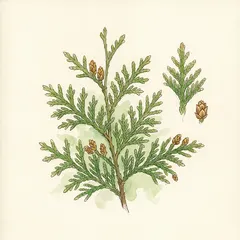
Thuja occidentalis. Arbor Vitae. N. O. Coniferae (Tribe, Cupressineae). Tincture of the fresh green twigs.
Clinical EN
Abdomen, distended. Abortion. Angina pectoris. Anus, fistula in; fissure of.
Asthma. Balanitis. Cancer. Catalepsy.
Chorea. Clavus. Condylomata. Constipation.
Convulsions. Coxalgia. Diarrhoea. Disparunia.
Dysmenorrhoea. Ear, polypus of. Enuresis. Epilepsy.
Epulis. Eyes, tumours of; granular inflammation of. Fatty tumours. Feet, fetid.
Flatus, incarcerated. Frontal sinuses, catarrh of. Ganglion. Gleet.
Gonorrhoea. Haemorrhage. Haemorrhoids. Hair, affections of.
Headache. Hernia. Herpes zoster. Ichthyosis.
Intussusception. Jaws, growth on. Joints, cracking in. Levitation.
Morvan's disease. Mucous patches. Muscae volitantes. Myopia.
Naevus. Neck, cracking in. Onanism. Ovary, left, pain in.
Ozaena. Neuralgia. Nose, chronic catarrh of; polypus of. Paralysis.
Pemphigus. Polypus. Post-nasal catarrh. Pregnancy, imaginary.
Prostate, disease of. Ptosis. Ranula. Rheumatism, gonorrhoeal.
Rickets. Sciatica. Seminal emissions, nocturnal. Sycosis.
Syphilis. Tea, effects of. Teeth, caries of. Tongue, ulcers of; biting of.
Toothache. Tumours. Vaccination. Vaccinosis.
Vaginismus. Warts. Whooping-cough.
Characteristics EN
The American Arbor Vitae is a "spiry evergreen attaining a height of from 20 to 50 feet, though generally not above 40, and a diameter of about 10 to 20 feet through the greatest breadth of foliage." It abounds in the upper zones of North America, from Pennsylvania northwards, where it "often forms what are commonly known as cedar-swamps. It grows upon the rocky banks of rivers, and in low, swampy spots, blossoming from May until June and maturing its fruit in autumn. The Arbor Vitae assumes a conical form with such true lines as to appear 'clipped,' thus forming one of our most valued high-hedge trees" (Millspaugh).
Thuja was introduced to France from Canada in the reign of Francis I. of France, and it has now an honoured place in most of our gardens and shrubberies. The native habitat of Thuja is not without its importance in relation to therapeutics. It loves swamps; it is Hahnemann's typical antisycotic and Grauvogl's hydrogenoid. Thuja is one of Hahnemann's discoveries.
Most of the remedies of his materia medica had been known in a fashion before his time. Of the therapeutic properties of Thuja practically nothing was known till Hahnemann proved it. Subsequent observers have only confirmed or added to Hahnemann's pathogenesis. Hahnemann found in Thuja the antidote to the miasm of the condition which he termed Sycosis, meaning thereby the constitutional disease resulting from constitutional gonorrhoea, and having as its characteristic manifestation excrescences, sometimes dry in the form of warts, more frequently soft, spongy, emitting a fetid fluid with a sweetish odour something like herring brine, bleeding readily and having the coxcomb or cauliflower form.
Teste remarks that in the period when the doctrine of Signatures prevailed the "resinous callosities of the stems and leaves of Thuja occ. might have seemed an indication that the plant was the specific for sycosis and warts." Teste dismisses this idea, but he asks whether resinous substances which have the power of modifying vegetable juices in a peculiar way may not affect the animal fluids in the same manner. He includes Castor. in his Thuja group, and gives an instance in which it acted on fig-warts.
Castor. is the product of an animal which subsists on the bark of resinous trees Hering gives this as the action of Thuja (1) on the fluids: "dissolution of fluids of the body, which become acrid, probably caused by Thuja perverting lymphatic secretions; disturbs digestion and sanguification"; and this (2) in the vegetative sphere: "A surplus of producing life; nearly unlimited proliferation of pathological vegetations, condylomata, warty sycotic excrescences, spongy tumours, and spongy pock exudates [which] organise hastily; all morbid manifestations are excessive, but appear quietly, so that the beginning of the diseased state is scarcely known." Boenninghausen found Thuja both preventive and curative in an epidemic of small-pox.
It aborted the process and prevented pitting. In veterinary practice Thuja has proved curative in farcy and in "grease." These facts open up another great branch of Thuja's homoeopathicity—its anti-vaccinal action. This extension was made by Kunkel and Goullon following on Boenninghausen's experience with small-pox. On this subject no one has written more forcibly or lucidly than Burnett (Vaccinosis and its Cure by Thuja).
"Arbor Vitae: nomen omen," says Burnett on his title-page. And in his hands Thuja has proved indeed a tree of life to numberless sufferers from the vaccinal taint. By "vaccinosis" Burnett means the disease known as vaccinia, the result of vaccination, plus "that profound and often long-lasting morbid constitutional state engendered by the vaccine virus." To this state Thuja is homoeopathic, and therefore curative and preventive of it. Burnett makes the profound observation, which I can confirm, that the vaccine virus does not need to "take" (that is, to set up vaccinia) in order to produce the vaccinal dyscrasia: that "not a few persons date their ill-health from a so-called unsuccessful vaccination." So that vaccinosis may exist apart from vaccinia.
The antivaccinal action of Thuja is part of its antisycotic action: vaccinia is a sycotic disease. Burnett gives the case of an infant ten weeks old, whom he was called to see as it was supposed to be dying. He found it ghastly white and in collapse. There was nothing to account for this except that the baby had had its wet-nurse changed two or three days before.
The wet-nurse was questioned and declared herself quite well and looked it; but "her arm was a little painful." She had been revaccinated in the Marylebone Workhouse the day before she took charge of the patient. Burnett found the vaccine eruption just turning into the pustular stage. He concluded that the infant was sucking the vaccinal poison with its nurse's milk. He gave Thuja 6 to both infant and nurse.
The baby gradually improved the same day, and next morning was, though still pale, practically well, and the vaccinal vesicles on the nurse's arm had withered. Burnett quotes a case of vaccinal rash in an infant following the vaccination of its mother, who was nursing it. The effects of chronic vaccinosis are protean. Prominent among them are neuralgias (of which Burnett gives many examples), morbid skin disorders, indigestion, and constipation; warts and new growths of many kinds.
In these effects a favourite method of Burnett's was to give a course of twenty-four numbered powders, only three or four of them medicated with Thuja 30; one to be taken at bedtime. With the same prescription he cured many cases of paralysis, his indications being: Left side of body; very chilly; < in morning, in wet weather, and in cold: with these indications present he also found enlargements of the spleen to dissolve. In 1889 I was consulted by Mr.
A., 38, about a lump, or rather two lumps, in the right breast, which was like that of a girl approaching puberty, the left breast being quite flat and normal. There was a hard, not sharply defined lump to the right of the nipple, and a smaller one to the left of it, but freely movable, the larger somewhat tender and irritated by the pressure of the brace. The tumours had existed eighteen months and came on at a time of much anxiety when his wife died of consumption. His paternal grandmother and two aunts had died of cancer.
He had been twice vaccinated, but on the second occasion the arm did not "rise." As a small boy his hands were covered with warts At eight he had shingles. On August 15th Thuja 10m F. C. was given.
October 21th If anything tumours a little less. Thuja 10m continued at intervals. February 4, 1890
Tumours can only be felt with difficulty. No pain. The medicine was repeated and when next seen some time later the patient was absolutely well. A very much vaccinated lady developed at the climacteric indurations in both breasts, especially the right.
Menses were accompanied by severe neuralgic pains. Thuja was given in 1m, 10m, and cm F. C. potencies. The last set up attacks of angina pectoris of such intensity that I did not repeat it.
The indurations disappeared, but in the course of the cure an eruption closely resembling small-pox developed over her breasts on more than one occasion. The first case I treated homoeopathically was one of new growths—a cluster of small warts on the forehead of a boy which had lasted eighteen months and followed the scratch of a cat. Thuja Ø in fractional doses and Thuja Ø painted on cured permanently in three weeks. A gentleman, about 50, consulted me recently about a wart on the right side of his head.
He was bald, and the wart was black and unsightly. It had been growing some months, and he was somewhat anxious about it as his father had had a similar wart develop in the same locality at the same age, and it had never left him. My patient had been twice vaccinated. Thuja 30, twenty-eight powders, one in seven medicated, one at bedtime.
In one month there was much reduction; Thuja was repeated, and in little over two months the wart was gone. Burnett says Thuja is the remedy for fatty tumours, which he regards as sycotic in nature. Thuja not only produces symptoms of the secondary stage of gonorrhoeal and vaccinal affections, it also produces urethritis and a variolous eruption.
Dudgeon has reported acute urethritis with yellow discharge lasting altogether a fortnight as the result of chewing a Thuja cone. Mersch (H. M., xxx. 686) gave Thuja 3 to a patient as a prophylactic against small-pox. This patient and another who took it for the same purpose developed simple urethritis.
Mersch proved Thuja Ø on himself and some others: (1) M. N. had rose-coloured blotches on the back, and several days after leaving off the medicine had warts develop on the outer side of the root of the thumb. These were still present three years after, though smaller and softer. (2) Mersch himself, who took Thuja for fifteen days, had heavy sensation in the head on waking, an eruption of desquamative annular blotches, and from the twelfth day a tearing along the right arm which compelled him to keep the arm flexed for eight days, < attempting to extend the arm; slightly > by heat.
A small soft wart appeared at the external portion of right middle finger. This disappeared a month after the proving was ended. ("< By extension" is a characteristic of Thuja; it = cracking in joints. The arm symptoms are also < when the limb hangs down, which is also an extension.) Apropos of the annular scaly blotches, I had a case of psoriasis of the legs in a youth which was benefited by Thuja more than by any other remedy, though the Thuja was given for some other affection.
A patient came to Raue (H. R., ii. 162) complaining that his semen had a very offensive smell. Raue did not know of a remedy producing the symptom, but selected Thuja. Two doses of the 200th and one of the 15th were taken.
The man was at the time in the hands of an eminent dentist for his teeth, which for five years had been a great trouble to him on account of their extreme sensitiveness to cold; the gums were in a deplorable state and the teeth were encrusted with tartar. After receiving the Thuja the extreme sensitiveness of the teeth disappeared in one night; then the offensive odour of the semen. In four days the patient again saw the dentist, who was amazed to find his gums quite sound. Moreover, the patient had lost an oppression of the chest which had been troubling him some time.
Goullon (Leip. Pop. Zeit. f. H., translated Rev.
H. Belge, September, 1895) relates the cure of a mental state by Thuja 30x. He remarks that, following the advice of Kunkel, he gives only a single dose of Thuja, one or two drops of the tincture on sugar or milk, at bedtime. When he has given a second dose the following night he has observed new symptoms "Thuja in fact has a very marked action on sleep, and its symptoms appear by preference at night—the headache, for example." This is the case: Miss R., 40; complained of her head, especially at certain moments, when ideas which did not concern her in the least came to her as if some one else was thinking by her side.
Thuja produces a confusion in the thoughts which patients cannot rid themselves of on account of great weakness and pain in the head. This patient had for months been attending on a paralysed sister, frequently getting up in the night and worrying herself about numberless things. Her nervous system was very impressionable, and for weeks had reached a point of extreme over-excitement. She could no longer calm herself, and in addition she sneezed and coughed much.
The problem was to give her sleep and take away the pain in the head. Even when she was not obliged to getup she could not get sleep. Her eyes were also very much irritated. The patient afterwards described her condition thus: "I felt in the anterior part of the head, principally the forehead, a sensation as if lead were compressing my eyes; these were inflamed, < by light, > in open air.
Before going to sleep I felt a congestion in the head with headache; at the same time queer, confused ideas which changed like a flash and fell upon the most odd things. These were > when I opened my eyes or sat up. Before my eyes images and statues arranged themselves. If I wished to think of something sensible, in the twinkling of an eye I lost the thread of my ideas.
All this happened at night; during the day the wicked sprites did not appear. My head and eyes pained me when there was much movement, as when several people were speaking at once." The effect of the dose she described thus After having taken the Thuja I tasted a sweet repose; the next morning a complete transformation had taken place in the head, the weight was gone, the eyes were more fresh, the brain free." Goullon cured a lady who had had headache for a year; on waking felt as if a tight hoop enclosed forehead, not passing away till noon.
Eyelids heavy as lead. Thuja 10x, one close at bedtime, permanently cured. A. W.
Holcombe (Med. Vis., xii. 225) relates experiences bearing on the sleep and dreams of Thuja. (1) Mrs. E., 48, had a growth, wart-like, about the size of a sixpence, on left temple.
It began as a slight roughness and itched at times. Also growth about the same size on a hard palate (left), very sore. Much headache, on left side of the head, throbbing in left temple, and the pains extend into left ear. Cannot sleet after 3 a.m.
Dreams much of falling. Feels smothering in a warm room. Thirsty, < noon and afternoon. Feet sweat much, offensive; sweats much about groins.
Thuja cm was given on October 25th. By November 15th the growths and all the rest of the symptoms had disappeared. (2) Led by this same symptom, "almost every night, dreams of falling from a height," Holcombe cured a man, 30, of tertian fever with Thuja cm when a large number of other seemingly well-indicated remedies had failed. Robert Farley (quoted A.
H., xxiii. 446) relates the case of two children, aet. 5, who had what he graphically terms "urinary tantrums." Two hours after being put to bed they would wake kicking, crying, and refusing to answer a question. This lasted an hour or more. Asked if they wanted to urinate they would refuse to answer, strike at attendant, or even say "No." Finally it was found that if they were taken up and put on the closet they would urinate and then go to sleep readily. One of the children developed signs of incipient inflammation of the left hip-joint.
The totality led to the selection of Thuja, which was given in the 200th. After the first night there were no more "tantrums," and in two months the child was perfectly well. This child's father had had gonorrhoea, treated by injection, some years before the patient was born. But the other child's father had not had gonorrhoea.
In the latter case, which was exactly like the former, the cure was immediate; in the former case relief occurred on the second night. C. W. Roberts (H.
R., xii. 137) found Thuja Ø, in five- to seven-drop doses at bedtime, control nocturnal seminal emissions better than any other remedy. "Nocturnal seminal emission" is an emphasised symptom in M. M. P.
Epulis is probably a malignant kind of sycotic hyperplasia. Percy Wilde (H. W., xxi. 199) records the case of a young married lady who had a large epulis on the lower jaw, rapidly increasing in size, ulcerating on the surface, very painful, and filling the mouth with an ill-smelling secretion. The entire tumour was removed by operation, and also the subjoined bone.
Three weeks later the tumour was as large as before and increased daily. Thuja 1x was now given. The growth stopped immediately; ulceration ceased; the pain disappeared. In three weeks the gum was healthy and remained so permanently.
Villers (quoted A. H., xxi. 421) relates a case of scalp tumour in a youth of seventeen. The tumour had existed two years, and had somewhat the appearance of a bean. It was situated about the posterior edge of the parietal bone, was devoid of sensation, and the hair had disappeared from it, making it very conspicuous.
Thuja 30 was given, a dose every twenty days. In four months the youth was almost cured, in five months entirely so, the hair having grown again completely over the spot. George Royal (quoted A. H., xxiii. 387) relates a case of persistent cough cured with Thuja.
Miss X., 19, fair, had for three months a painless, dry cough. The irritation was only in the throat. There were six small growths at the back of the throat, and one near the vocal cord. She never had a cough before.
Has leucorrhoea green and excoriating; menses a little too early. Thuja 30 cured the growths and the cough in about three weeks. Old-school observers (N. A.
J. H., xv. 63) have found in Thuja an efficient haemostatic, locally applied, especially after tooth extraction. R. B.
Johnstone (H. P., ix. 257) gives some indications for Thuja in hernia: (1) Women of sycotic history who have a tendency to left-side inguinal hernia after labour (Thuja, high). (2) When babies cry much the umbilicus protrudes, growing red and sore; especially when the father has a sycotic history. (3) Left inguinal hernia in infants; child cries all the time, and is only quiet when the left inguinal region is relieved from pressure, or the thigh is flexed on the abdomen.
Boenninghausen observed this symptom of Thuja, which bears on the action of Thuja on the sides and roots of teeth (a sycotic symptom), rather than on the crowns: "on blowing nose, a pressing pain in the hollow tooth, at the side of it." The left ovarian pains of Thuja are remarkable. They are severe, sometimes burning, extend down thigh, any attempt at exercise and especially walking <; they occur with every menstrual period, and are generally < before and during the flow. The pain compels the patient to lie down; but lying on left side <.
A keynote of Thuja is: "Frequent micturition accompanying pains." For example: "In evening, when in bed, terrible hammering and tearing in the ear, accompanied with micturition every half-hour and coldness of the legs up to the knees. The desire of Thuja is sudden and urgent, it seems impossible to reach the vessel or make the necessary preparations, but the patient can control it if compelled. There is severe cutting as with a knife at the end of micturition after the last drop has passed.
Thuja also has chronic incontinence from paralysis of sphincter vesicae. This is related to the general paretic weakness of Thuja. The patient feels she "could not go on exerting any longer." Burnett (H. W., xxv. 487) records a case of lichen urticatus in a boy of fourteen, which came into his hands after a long course of treatment, external, internal, and dietetic, at the hands of allopathic specialists without result.
The rash came periodically in warm weather; patient literally tore himself because of the irritation. The rash was < on the left (vaccinated side). Thuja 30 was given in infrequent doses. The spots continued to appear for a week and then disappeared.
The skin remained clear in spite of the patient indulging in all kinds of previously forbidden foods. Among the skin effects of Thuja the marks and stains must be borne in mind. The skin is mottled and discoloured; brown or red mottled spots; discoloration of the backs of the hands and feet Villers (J. of Hcs., iv. 408) treated a girl of twelve, who had had headaches going from front to occiput and sometimes in temples.
Pains mostly came towards night, and were accompanied with an awful state of fear. The only account she could give of her fear was that she saw green stripes. Alone or in company, in the dark or in a well-lighted room the dread was always the same. Three years before, the child had had an abortive attack of scarlatina, treated with cold compresses.
The urine had been abnormal all through the illness, but contained no albumen. Thuja 200, every tenth day. No more headache, nor fear. Patient slept well from the first dose, and in a few days the urine became clear.
"Floating stripes" before the vision is a symptom of Thuja. Peculiar Sensations are: As if a strange person were at her side. As if soul and body were separated. As if under the influence of a superior power.
As if whole body were very thin and delicate; as if its continuity would be dissolved; as if frail and easily broken; as if made of glass. As if a nail were pressing into vertex. As if vertex were pressed with a needle. As if a nail were driven from within outward in vertex.
As if a nail were driven into right parietal bone and left frontal eminence. Lightning-like headache. As if a convex button were pressed on left ear. As if head were screwed asunder.
As if forehead would fall out. As if bones of head were being knocked to pieces. Forehead, ears, and eyes as if stabbed. As if knives went tearing around in brain.
Scalp as if beaten. As if insects on occiput and temples. As if eyes were swollen and would be pressed out of head. As of fine sand in eyes.
As if a cold stream of air were blowing through eyes. As if a foreign body in eye. As if flesh were being torn from bones in left side and back. As if abdominal muscles were being pushed out by arm of a child.
As if a living animal were in abdomen. Sudden bounding in right iliac region as if something alive. As if blood could not circulate in back opposite pit of stomach. As if boiling lead were passed through rectum.
As if anus would fly to pieces during stool. As if skin of anus were cracked and chapped. Bladder as if paralysed. As if moisture running in urethra.
As if a tape prevented urination. As of a single drop running along urethra. As if testicles moved. As if something were grown fast in region of left lower ribs.
As of falling drops in chest. Legs as if made of wood when walking. As if lower limbs were elongated. As if muscles of thigh would break down.
Lightness in body when walking. As if flesh were beaten from bones. As if skin were pricked with needles. As from fleabites.
A keynote of Cooper's for Thuja is, "its pains keep extending from their original site." Another indication of his is, "pains > by wrapping up." Thuja is Suited to: (1) Hydrogenoid constitutions (possessing "an increased capacity to contain water; hence rain, cold, damp weather, beds, and food that increase the number of molecules of water in the system < the symptoms"). (2) Strumous and sycotic persons. (3) Lax muscles; light hair; children. (4) Lymphatic temperament, in very fleshy persons, dark complexion, black hair, unhealthy skin.
(5) Ailments from vaccination or from suppressed or maltreated gonorrhoea. Thuja is a strongly left-sided medicine (the left arm is usually vaccinated). The symptoms are: < By touch (scalp; vertex; eruption; anus; condylomata; = fingers to bleed); but > pain in eyebrow and in left malar bone. Pressure >.
Rubbing >. Scratching >. Closing eyes <. Fall = wart-like growth ill labium.
Overlifting < headache. Rest > headache. Bending head backward > headache. Lying on left side = anxious dreams.
Lying on affected side > asthma. Motion <. Extension <. Letting arms hang down <.
Walking <. Looking up > headache. Throwing head back > headache. Talking < asthma.
Ascending = palpitation. Riding = incontinence of urine; < pain in ovary. < 3 a.m.; early morning (the sycotic time).
< Night. < Cold water; cold: damp weather: change; draught; overheating; sun's rays. < Bright light. < Warmth of bed.
Warmth <. Cold > rheumatism. < After breakfast, after eating; after tea; coffee; fat food; onions. < By coitus.
< Blowing nose (pain in side of teeth). < Increasing moon. < Sun; bright light.
Relations EN
Antidoted by: Cham. (nightly toothache): Coccul. (fever); Camph., Merc., Puls., Sul.
Teste found Colch. the best antidote in his experience. Antidote to: Merc., Sul., Iod., Nux. Complementary: Med., Sabi., Sil.; Nat. s. in sycosis.
Compatible: Nit. ac., Sabi. Follows well: Med., Merc., Nit. ac. Followed well by: Merc., Sul. (these follow best
H. N. G.); also Calc., Ign., Lyc., K. ca., Puls., Sil., Vacc. Compare: Constitutional polychrests, Med.
Syph., Pso., Sul., Merc. Bad effect of vaccination, Apis, Ant. t., Vacc., Var. Aversion to touch or approach, Ant. c. (Thuja on account of fixed ideas).
Illusions of shape, Bapt., Petr., Stram. Imaginary conditions (Saba., imaginary diseases). Ozoena with thick green discharge; gleet; gonorrhoeal rheumatism; orchitis; prostatitis; Puls.
(the discharge of Puls. is thicker than that of Thuja). Ozaena in sycotics, K. bi. Condylomata, balanorrhoea, greenish leucorrhoea, Nit. ac. (Nit. ac. has more aching in bones, especially when not covered with muscles).
Long filiform condylomata, Staph. (Staph., especially after Mercury, system generally depressed). Balanorrhoea, Jacar. Red chancroid sores, Coral.
Iritis; green discharges; rheumatism; sweating, Merc. (Merc. < warmth of bed; sweating more excessive; Thuja, sweat on uncovered parts only).
Condylomata, Sabi. (itch and burn, especially in women). Condylomata large, like cock's-comb, Euphras. Syphilis and sycosis, fig-warts fan-shaped, much Aching, especially about joints, Cinnab.
("Cinnab. is preferable for warts on prepuce." H. C. Allen).
Sycotic eruptions, Sars. Ciliary neuralgia, Spi. (Spi. pains radiate downward; Thuja, upward and backward).
Nails grow soft, Fl. ac. (rapidly). Diarrhoea, &c., after vaccination, Sil. Affections of tea-drinkers, Sep.
Urinary affections, Canth. Effects of fat food, Ipec., Carb. v., Puls. Fissure about anus, Nit. to. Graph.
Dry, whitish scales on skin, Ars., Calc., Dulc., Lyc., Sep., Sil. Vaginismus, extreme sensitiveness, Sil. Hissing or singing of kettle in right ear, Lyc. Violent movements of foetus, Op., Croc., Sil., Sul.
Sense of levitation, Calc., Can. i., Con., Gels., Sil., Sti. p., Tic douloureux, Spi., Coccin. Phimosis, Cann. s., Merc., Sul., Nit. ac., Sep., Rhus, Sabi. Left ovarian pains, Colo., Bry., Phos. Yellow-staining leucorrhoea, Agn. c., Carb. a., Chel., Kre., Nit. ac., Nux, Pru. s., Sep.
Tongue: Ulcer on right border, Sil. (on left, Apis); semilateral swelling of, Calc., Sil., Lauro. (Lauro, left half with loss of speech), Semp. t. Piles < sitting, Lyc.
Ph. ac. (> Ign.). Vertigo when closing eyes, Lach., Ther. Headache as if a nail being driven in, Coff., Ign.
Headache from tea, Sel. Teeth decay at roots, Mez. (on edges, Staph.). Teeth crumble, turn yellow, Syph.
Ranula, varicose veins on tongue, Amb. "On blowing nose, a pressing pain in the hollow tooth or at the side of it" (Culex, vertigo every time he blows his nose). Abdomen protrudes here and there as from the arm of a foetus, Croc., Nux m., Sul. Left ovarian pain when walking or riding, must sit or lie down.
Croc., Ust. (Thuja, < at each menstrual nisus). Stool recedes after being partly expelled, Sanic., Sel. Early-morning diarrhoea expelled forcibly with much flatus, Alo.
Coition prevented by extreme sensitiveness of vagina, Plat. (by dryness, Lyc., Hdfb., Na. m.). Large, seedy, pedunculated warts, Staph. Feeling as if flesh beaten off bones, Phyt.
(scraped off, Rhus). Severe cutting at close of urination, Sars. Sweat: all over except head (opp. Sel.); when he sleeps, stops when he wakes (opp.
Samb.). Nails deformed, brittle, Ant. c. > Bending head back, Seneg. (Thuja, headache;
Seneg., eye symptoms > bending heard back and closing eyes; Thuja has < closing eyes). Fluids roll audibly into stomach, Cup. Enuresis when coughing, Caust.
Desires cold things, Pho. Swelling and sensitiveness of breasts at menstrual period, Con. Calc. < Walking, Aesc. h.
Discoloured skin, Adren. Cracking in cervical vertebrae (K. iod., grating). Cretinism, Bac., Thyr.
Causation EN
Vaccination. Gonorrhoea, badly treated or suppressed. Sunstroke. Sexual excess. Tea. Coffee. Beer. Sweets. Tobacco. Fat meat. Onions. Sulphur. Mercury.
Mind EN
Fixed ideas: as if a strange person were at his side; as if the soul were separated from the body; as if the body, esp. the limbs, were of glass and would break easily; as if a living animal were in the abdomen
Sensation as if whole body very thin and delicate and could not resist least attack; as if continuity of body would be dissolved
Insane women will not be touched or approached
Imbecility after vaccination, restless, drivelling
Mental dejection
Anxious apprehensions respecting the future
Disquiet, which renders everything troublesome and repugnant
The merest trifle occasions pensiveness
Music causes him to weep, with trembling of the feet
Hurried, with ill-humour, talks hastily
Indisposition to any kind of intellectual labour
Mental depression after childbirth
Very depressed, sad, irritable
Scrupulous about small things
Feels she cannot exist any longer; quiet, shunning every body
Aversion to life
Moroseness and peevishness
Overexcited, quarrelsome; easily angered about trifles
The child is excessively obstinate
In reading and writing he uses wrong expressions
Talks hastily and swallows words
Thoughtlessness; forgetfulness
Slowness of speech and of reflection; seeking for words when in conversation
Incapacity for reflection
Cretinism.
Head EN
Head feels empty, as in intoxication, esp. in morning, with nausea
Weakness and confusion of head, as from torpor, or paralysis of brain
Vertigo, as from motion of a swing
Vertigo when rising from a seat, or when lying down, or else when looking into the air
Vertigo on closing the eyes, disappears as soon as he opens them; or on stooping; or on looking upwards or sideways
Headache in morning, as after stooping, or after too profound a sleep, with redness of the face
The headache is > from looking upwards, and when turning the head backwards
Headache: < from sexual excess, overheating, overlifting;
> exercising in open air
Dull, stupefying, headache
Headache, < by stooping, > by bending head backwards
Heaviness of head, esp. in morning on waking; in occiput (cerebellum), with ill-humour and dislike to conversation
Headache, as if forehead would split, with internal shivering, > by walking in open air
Pressive headache, with shocks in forehead and temples
Compressive headache, esp. in temples
Pain as if a tight hoop encircled forehead, on waking.—(Headache, as if a tight hoop encircled forehead up till noon; eyelids heavy as lead
Goullon.)
Pain in head as if a nail were driven into vertex (afternoon and 3 a.m.;
< when at rest, > after perspiration)
As if a nail driven in r. parietal bone and l. frontal eminence
Boring pressing in head
Headache on l. side as if a convex button were pressed on part
Neuralgia going from before backward
Nervous, sycotic, or syphilitic headaches
Meningitis of sycotic children
Sunstroke: everything seemed jumping, < from sitting up, or from talking a long time, or closing eyes
Semilateral tearing in the sinciput and face, extending into zygomatic process, principally morning and evening
Tearing jerking in occiput
Lancinations across brain
Congestion of blood in head
Pulsation in temples
Excessively painful tenderness of l. side of head, and also of the hair, at night, when lying down, and when touched
Hair becomes hard, dry, and lustreless, and falls out
Hair thin, grows slowly, splits; brittle, looks crimped
Pressive drawing in the temporal muscles, esp. during mastication
Shootings in temples
Swelling of veins in temples
He wants to have head (and face) wrapped up warm
Itching and gnawing in scalp
The scalp is very painful to the touch, and the parts on which one lies
Cannot bear a bat on his head (agg
R.
T.
C.)
Dry herpes on the head, extending to eyebrows; dandruff
White, scaly, peeling-off eruption over the scalp, extending over the forehead, temples, ears, and neck.—(Flat black wart on r. parietal region
J.
H.
C.)
Tingling-biting, stinging-itching on the scalp, > by scratching
Perspiration, smelling of honey (sweetish), on uncovered parts of head (face and hands), with dryness of the covered parts, and of those on which one lies, mostly when first going to sleep;
> after rising.—(Pityriasis affecting forehead, face, ears and neck, < after washing in warm water
R.
T.
C.)
Eczema comes out on glabella (after Thuja 30)
R.
T.
C.).
Eyes EN
Pressure in eyes, and smarting, as if sand were in them
Tearing in eyebrows
Shootings in eyes, in a bright light, or in a keen air
Painful stitch through centre of l. eye, commencing in centre of brain
Malignant balanorrhoea
Wart-like excrescence on iris
Inflammation of cornea
Vascular tumour of cornea
Small brown spots on cornea
Episcleritis; sclero-choroiditis; staphyloma
Ophthalmia neonatorum
Phlyctenular conjunctivitis.—(Conjunctivitis of l. eye, with violent pain across forehead and in outer side of eyeball, constantly recurrent from childhood and due to suppressed eruption
R.
T.
C.)
Fungous tumour in orbit
Burning sensation in eyes
Sclerotica inflamed, and red like blood
Pupils dilated
Inflammatory swelling of lids, with hardness
Burning eruption on lids
Granular lids with wart-like granulations
Epithelioma of l. lower lid
Feeling as if lids swollen, and a foreign body in eye
Ptosis; lids fall down several times a day
Lids heavy as lead
Inflammatory softening of inner surface of lids
Red and painful nodosities on margins of lids.—(Tinea ciliaris; dry and branny lids
R.
T.
C.)
Styes; tarsal tumours; chalazae; thick and hard knots
Verrucae and tumours like condylomata
Purulent and itching pimples between eyebrows
Condylomata in eyebrows
Sensation of heat and of dryness in external canthi
Lachrymation, esp. in l. eye, when walking in open air (the tears do not run off, but remain standing in the eye)
The eye must be warmly covered, when uncovered it pains at once, and it feels as if cold air were streaming out of the head through the eye
Nocturnal agglutination of the lids
Weakness of the eyes; obscure sight
Clouded sight, when reading, with sensation of drowsiness
Sight confused as if directed through a veil
Diplopia
Myopia
Black dancing specks before the eyes
Floating stripes.—(Sees green stripes which frighten her.)
Flames of light, mostly yellow; looking into light of day sees spots like bottles of water moving; a luminous disc shining like a firefly
Sensation of dryness in eyes
In the dark it seems as if falling down of luminous lights or sparks alongside of the eye, during the day and in the light it is as if dark drops were falling down
The objects appear smaller before the r. eye
Short-sighted.
Ears EN
Otalgia, with squeezing compression and violent shootings, esp. in evening
Stitches into ear from the neck
Sensation as if inner ear were swollen, with increased difficulty of hearing.—(Vascular deafness with scurfy head
R.
T.
C.)
Oozing from the r. ear, smelling like putrid meat
Spasmodic pain in external ear
Noise in the ear as from boiling water
Roaring in l. ear, with cracking when swallowing saliva
Hammering and tearing in ear, in evening, in bed, with frequent emission of urine, and coldness in legs and feet
Pressive pain behind ears
Orifice of l. meatus blocked up by a polypus, of raspberry-cellular vessels; pale red, bleeding readily when touched; muco-purulent discharge; deafness; shooting pains.
Nose EN
Nose red and hot
Red eruption on nose, at times humid
Swelling in the alae nasi, with hardness and tension
Drawing tension in bones of nose
Painful scabs in nose
Painful pressure at root of nose
Blowing of blood from nose
Frequent epistaxis, esp. after being overheated
Dry coryza, which becomes fluent in open air, with continued headache
Fluent coryza, with cough and hoarseness
Greenish and fetid discharge from the nose
Blowing from the nose of a large quantity of thick green mucus, mixed with pus and blood; later of dry, brown scales, with mucus, which conies from the frontal sinuses and firmly adheres to the swollen upper portion of the nostrils
Accumulation of mucus in posterior nares
Chronic catarrh after measles, scarlatina, variola.—(Ozaena
Ussher.)
Warts on the nose
Smell in nose as from brine of fish, or of fermenting beer.
Face EN
Heat in face, sometimes only transient, or else with burning redness
Heat and redness of whole face, with fine nets of veins, as if marbled
Circumscribed burning redness of cheeks
Dropsically bloated face
Oedematous erysipelas of face
Greasy skin of face
Light-brown blotches (freckles) on face
Faceache, originating in l. cheek-bone near the ear, extending through teeth to nose, through eyes to temples into head; the painful spots burn like fire, and are very sensitive to the rays of the sun
Neuralgia of trigeminus after suppressed gonorrhoea or eruption on ear
Facial pains tending to spread to neck and head, chiefly l. side (many cases cured
R.
T.
C.)
Large, hard, dark wart with large base
Perspiration on face (esp. on side on which he does not lie)
Scabious, itching eruption on face
Red and painful nodosities on temples
Boring and digging pain in cheek-bones, > by touch
Twitching of the lips
Jerking sensation in upper lip, near corner of mouth
Upper lip sensitive
Wart on upper lip
Thick upper lip with pea-sized tumour on its parenchyma, enlarging when taking cold
Lips pale, swollen, peeling
Flat ulcers on insides of lips and corners of mouth
Eruption of pimples on lips and chin
Shootings in lower jaw, which seem to pass outwards through the ear
Cracking of articulation of jaw
Fungus on l. lower jaw, more angry in damp weather
Swelling of submaxillary glands.
Teeth EN
Toothache after drinking tea, with pressive pain extending into jaw
Toothache with acute drawing pains, esp. during mastication
The roots of the teeth become carious; or the teeth become carious from the side; the crown of the tooth remains sound
On blowing nose, a pressing pain in hollow tooth at the side of it
The teeth crumble off
Teeth crusted with tartar; extremely sensitive to cold water
Dirty-yellow teeth
Gnawing in (carious) teeth, with painful sensibility of whole side of head, greatly < by contact with cold things, or by mastication
Gums swollen (inflamed, with dark red streaks on them), with pain of excoriation
Alveolar periostitis where the pains come and go suddenly at short intervals (R.
T.
C.)
Epulis.
Mouth EN
Flat, white ulcers on the inside of the lips, and on the corners of the mouth
Aphthae in mouth (ulcers; mouth feels as if burnt)
Considerable swelling of salivary glands, with increased saliva in mouth
Sanguineous, or bitter saliva
Pain as of excoriation in tip of tongue, when touched
Swelling of tongue (esp. on r. side; bites tongue frequently), painful when touched
Condylomata under tongue
Varicose veins under tongue
Ranula, on both sides of tongue, transparent, bluish red, grey, and, as it were, gelatinous
Ranula and epulis with excess of venosity everywhere (Ussher)
Taste in mouth sweet as sugar, with gonorrhoea
Slowness of speech.
Throat EN
Roughness and scraping in throat
Pressure and pain as from excoriation, in throat and palate, during deglutition
A feeling of upward pressure in soft palate
Necessity to swallow
Shootings from gullet to ears
Swelling of tonsils and throat
Ulcers in throat and mouth, like chancres
Accumulation of a large quantity of tenacious mucus in mouth, which is hawked up with difficulty
Painful swallowing, esp. empty swallowing, or that of saliva
Throat feels raw, dry, as from a plug, or as if it were constricted when swallowing
Hawking up of mucus of red colour, like blood.—(Exophthalmic goître
C.
Sargent, of Chicago.)
Appetite EN
Mawkish and sweetish taste in the mouth, in the evening, and after a meal
Taste: sweet; of rotten eggs, mornings
Bread has a dry and bitter taste
Craves salt
Food never seems sufficiently salt
Thirst only at night, and in morning
Appetite for cold drinks and food
Unable to eat breakfast (a keynote of Burnett's)
Aversion to fresh meat and potatoes
Speedy satiety, when eating
Disagreeable sensations after eating fat food or onions
While masticating food mouth becomes very dry
After a meal great indolence, or dejection, with anguish, and palpitation of the heart, or great inflation and sufferings from flatulence.
Stomach EN
Risings of food, after a meal
Bitter or putrid risings
Continuous eructations of air while eating
Vomiting of mucus or of greasy substances
Induration of stomach
Swelling of pit of stomach
The fluid which he drinks falls into the stomach with a gurgling noise
Rancid risings, esp. after fat food
Nausea and uneasiness in region of stomach
Vomiting of acid serum and of food
Cramp in stomach, with excessive < towards evening
Pressure in scrobiculus after a meal, with pain when touched
Throbbing in scrobiculus
Anguish in scrobiculus, which extends upwards into head.
Abdomen EN
Painful pressure in hepatic region
After a dose of 30th headache comes on, and he feels on stooping forward as if liver over-lapped the ribs (agg
J.
C.
B.).—(Old rheumatism attacking bowels, liver, and kidneys
R.
T.
C.)
Pressure in lumbar region.—(Soreness with swelling in hepatic region and violent pain under r. shoulder going through to breast and down to elbow < on getting out of bed in morning
R.
T.
C.).—inflation of abdomen, often with contractive and spasmodic pains
Flatulence, as if an animal were crying in the abdomen
Pot-belly
Constrictive tension in abdomen
Induration in abdomen
The upper part of abdomen is drawn in
Soreness of navel
Pressive pains in abdomen, esp. towards the side (before evacuation)
Stitches in the hypochondria
Sensation as if something alive were in hypogastrium (as if the abdominal muscles were pushed outward by the arm of a foetus, but painless)
Soreness of navel
Pain in abdomen, as from constriction of the intestines
Grumbling and borborygmi in the abdomen
Depressing pain in groins
Drawings in groins, when walking and standing, with shootings along thighs when sitting
Painful swelling of inguinal glands, sometimes with drawing as far as knee
Intussusception of intestines
Yellow or brownish spots on abdomen
Zona.
Stool And Anus EN
Constipation which continues several days (obstinate, as from inactivity or from intussusception of the intestines), sometimes after pollutions
Tenesmus, with rigidity of the penis
Stool in hard balls
Difficult evacuation of hard, large faeces, covered with blood
Discharge of blood, during the evacuation
Diarrhoea: pale-yellow water is forcibly expelled, with much noisy discharge of wind; with colic;
< after eating; watery, painless; bright yellow, watery; streaming out with much gas, as if the cork were pulled out of a full jug, excessively exhausting, short and difficult breathing, anxiety, intermitting pulse, acute pressive pain in back opposite pit of stomach, with feeling as if no blood could circulate there, rapid disappearance of fat
In morning (after breakfast), periodically returning diarrhoea, always at the same hour
Stools oily or greasy
With stools, sensations in rectum as if boiling lead were passing through
Burning soreness in anus, lasting all day
Much flatus hard to expel, anus feels constricted, incarcerated flatus behind r. side of diaphragm
Pains in anus < from motion
Painful contraction of anus, during the evacuation
Burning sensation in anus, and between buttocks
Condylomata at anus
Haemorrhoidal tumours swollen, paining worse while sitting
Swelling of haemorrhoidal veins
Pressing, itching, and burning in the haemorrhoidal vessels, with dragging
Offensive perspiration at anus and in perinaeum
Fistula in ano
Fissure of anus
Tearings along rectum.
Urinary Organs EN
Kidneys inflamed; feet swollen
Diabetes
Stitch to bladder from rectum
Violent burning in fundus of bladder
Urging to urinate frequent and hasty
Stream interrupted
Frequent want to urinate, with profuse emission of a watery urine, also at night
The urine foams; the foam remains long on the urine
Involuntary secretion, of urine; at night; when coughing; in drops after having urinated
The bladder (and rectum) feels paralysed, having no power to expel
Sediment of brown mucus
The urine contains sugar
Boring in region of bladder, with painful drawing up of testes
Urine yellowish or wine-coloured
Orifice of urethra agglutinated by mucus
Cloudy sediment in urine
Bloody urine
Prolonged trickling of urine, after having urinated
Sensation as if a drop were flowing into urethra, after emission of urine, and at other times
Burning sensation in urethra, esp. in morning and during day; also after and during emission of urine
Shootings in urethra, during emission of urine, and at other times
Jerking, voluptuous formication in fossa navicularis
Smarting in sexual part of females, during emission of urine
Itching in urethra
Stream small and split, next day yellowish discharge from urethra, with chordee.
Male Sexual Organs EN
Venereal diseases
Affections in general appearing in male or female genital organs, particularly on the external organs; affections on l. side particularly
Profuse perspiration on genitals, esp. scrotum; sweet-smelling, like honey; staining linen yellow.—(Relaxed scrotum with sexual weakness and lethargy; unfit for strain
R.
T.
C.)
Pseudo-gonorrhoea
Painful spermatic cords from suppressed gonorrhoea
Feeling in testes as if they moved
Condylomata on glans and prepuce, moist, itching and suppurating, esp. while the moon is increasing
Ulcers, like chancres, on prepuce
Swelling of prepuce
Red excrescence on inner side of prepuce; like fig-warts
Smooth, red excrescence behind glans
Many red pedunculated condylomata surrounding glans
Round, unclean, elevated ulcers with red margins, moist and painful
Sycotic cauliflower excrescences; fig-warts smelling like old cheese or herring brine
Shootings in scrotum, in penis, and along spermatic cord, as far as navel
Drawing in testes, with retraction of one of them (l.)
Continued painful erections, esp. night and morning, with lancinations in urethra
Nightly painful erections causing sleeplessness
Irresistible inclination to onanism even during sleep
Nocturnal emissions; wake him; followed by heaviness and ill-humour
Pollutions with sensation of stricture in urethra
Seminal emissions cured with 5-drop doses of Ø (C.
W.
Roberts)
The semen has an offensive smell
Flow of prostatic fluid
Prostatic affections from suppressed or badly-treated gonorrhoea
Blenorrhoea along with otorrhoea; penis constantly erect and prepuce inflamed (cured in boy, 12
R.
T.
C.)
Gonorrhoea: scalding when urinating, urethra swollen; urinal stream forked; discharge yellow; green; watery; with warts; red erosions on glans; subacute and chronic cases, esp. when injections have been used and prostate is involved
Gonorrhoea with a soft lump having an abrasion on it on l. side of fraenum praeputiae, lump small and painless
Profuse and watery discharge from penis
Renewed gonorrhoea after coitus.
Female Sexual Organs EN
Affections appearing on external organs, esp. l. side
Warts, condylomata, and other excrescences about vulva
Ulcers on internal surface of vulva; vulva has a sore, smarting feeling
Itching and burning smarting, as from excoriation, in genital organs
Burning and biting in vagina
Vagina extremely sensitive during coition
Recto-vaginal fistula (cured
J.
C.
B.)
Pressure on genital organs
Contractive and spasmodic pain in genital organs, extending to hypogastrium
Ovaries, affections of
Swelling and excoriation of labia
Warts on orifice of uterus, with shootings and burning sensation when urinating
Uterine polypus
Cauliflower excrescences
Prolapse
L. ovary inflamed, < at each menstrual nisus; distressing pain, burning when walking or riding; must lie down; pain extends through l. iliac region into groin, and sometimes into l. leg, pain sometimes burning
Cutting, squeezing, shooting pains in region of l. ovary
Pain, located in ovaries or duct, from over-physiological action
Menses: too early and too short; scanty, with terrible distressing pain in l. ovarian and iliac region
Before menses: excitement and pulsation of arteries, back of head, headache and toothache; labour-like abdominal pains, tenesmus and fainting; much perspiration
During menses: tiredness, palpitation, spasmodic weeping; restlessness in legs; retching, pressing in stomach, distension, pain in abdomen and back; bearing down out of genital organs; burning in varicose veins of genitals; sensitiveness and swelling of breasts; general coldness
After menses: tiredness; rush of blood upward; toothache; sleeplessness; nightmare
Bleeding fungus of breast (completed cure after Phos.)
Sycotic excrescences; moist, bleeding and offensive
Leucorrhoea: mucous; is almost green
Abortion at end of third month, commencing with a scanty discharge of blood for five days, then more and more profuse
Bright red or clotted blood with bearing down in third month of pregnancy (cured with Thujopsis dolabrata
R.
T.
C.)
During pregnancy child moves so violently it wakens her, causing cutting in bladder with urging to urinate; pains in l. sacro-iliac articulation, running into groin
Labour: pains weak or ceasing; contractibility hindered by sycotic complications; pains in sacro-iliac articulation running into l. groin; pain from walking, insupportable, must lie down.
Respiratory Organs EN
Voice low
Sensation of a skin in the larynx
Polypus of vocal cord
Condylomata
Hoarseness, as from contraction of larynx
Shortness of breath from mucus in trachea
Shortness of breathing from fulness and constriction in hypochondria and upper abdomen
Asthma < at night, with red face; coughing spells, with sensation of adhesion of lungs
Asthma with gonorrhoea, without having been exposed to contagion
Asthma with little cough, but with sensation of something growing fast In region of l. lower ribs
Asthma of sycotic children (Goullon)
Respiration short and quick, < from deep inspiration and talking;
> from lying on affected side, but pains compel him to lie on back
Convulsive asthma
Shooting and tingling in trachea
Cough in morning, excited by a tickling in trachea
Cough, excited by a choking sensation
Sputa: green; taste like old cheese
Expectoration of small grey, yellow, or green gobbets, when coughing
Cough, with expectoration of yellow mucus, and pains in scrobiculus in afternoon
Cough only during day, or in morning after rising, and in evening after lying down
Cough as soon as one eats
During evening cough after lying down, the expectoration becomes loose; easier when he turns from l. to r. side.
Chest EN
Obstructed respiration, with violent thirst for water, and great anxiety
Spasms of lungs from drinking cold water
Stitching in chest, from drinking anything cold
Hot rising into chest
Pain in l. pectoral region extending to innominate bone
Dyspnoea, with need to take full inspirations
Oppression, at one time of l. side of chest, at another, of l. hypochondrium, with irritation which excites coughing
Pain in chest, as from internal adhesion
Pressure on chest, sometimes after a meal
Agitation, and sensation of swelling in chest
Haemorrhage from lungs; quantity very great and terribly offensive
Blue colour of skin round clavicles
Brown spots on chest.
Heart EN
Cramp in heart
Ebullition of blood in chest, and violent and audible palpitation of heart, esp. when going up stairs
Palpitation of heart, with nausea
Painful sensibility in region of heart
Anxious palpitation of heart when waking in the morning
Visible palpitation without anxiety
Stitches in region of heart
Pulse slow and weak in morning, in evening accelerated and full
In evening violent pulsations
Swelling of the veins.
Neck And Back EN
Uneasiness in nape of neck and chest
Tension in skin on nape when moving head
Greasy brown skin on neck
Tension and stiffness of nape and l. side of neck
Cracking in cervical vertebrae on making certain movements with head
Small red pimples on neck close together
Swelling of glands of neck
Swelling of veins of neck
Spinal curvature
Boils on back
Steatomatous tumours
Pressing pain in region of kidneys
Burning extending from the small of the back to between shoulder-blades.—(Pains from middle to lower back with tenderness of muscles on each side
R.
T.
C.)
Painful drawing in sacrum, coccyx, and thighs, while sitting; after long sitting prevents standing erect
Pain, as of a fracture, and stiffness in loins, back, and nape, esp. in morning, after rising.—(Weakness from injury to lower back followed by abscess, vesical weakness, enuresis with a clear gleet and balanitis
R.
T.
C.)
Drawing in back and loins, when seated
Boring in back
Pulsation in spine
Furunculi on back
Violent stitch between coccyx and anus 7 p.m. when walking
Itching burning in hollow below coccyx.
Limbs EN
Cracking of joints when extended
Trembling of hands and feet
Limbs go to sleep
Frozen limbs
One-sided complaints; paralysis
Rheumatism with numb feeling;
< in warmth and on moving;
> from cold and after sweating
Nails crippled; brittle or soft
Hangnails.
Upper Limbs EN
Profuse perspiration under axillae
Brown spots under the arms, like naevus maternus
Throbbing in shoulder-joint
Sticking in shoulders
Involuntary jerking of arm during day
Atrophy of r. arm after revaccination
Pain, as of ulceration, tearing, and throbbing, from shoulder to ends of fingers
Wrenching pain in shoulder and arm, with cracking
Digging drawing in arms, as if in bones or periosteum
Sensation of coldness in arms at night
Lancinations in arms and joints
Cracking in elbow-joint when stretching arms
Tearing pain along r. arm compelling him to keep it flexed
Herpes on elbow
Red marbled spots on forearm
Wrist and elbow of r. arm feel as if gripped by a hand (agg
Thujopsis dol
R.
T.
C.)
Trembling of hand and arms, when writing
Ganglion of wrist (cured by local use
R.
T.
C.)
Sensation of dryness in skin of hands
Brown colour on back of hand
White scaly herpes on back of hand and on finger
Perspiration on hands
Swollen veins in hands
Warts on hands; very numerous, esp. on dorsa; horny, painful
Brown colour of dorsum of hand
Coldness torpor, and paleness in fingers and finger-tips, extending sometimes to forearms.—(Erysipelatous swelling and) tingling and shootings in finger-tips
Red and painful swelling in finger-tips
Nails are crippled, discoloured, crumbling off
Suppuration of finger-nails
The pains in the arms are < when hanging down, or when exposed to heat; they are > by movement, cold, and after perspiration.
Lower Limbs EN
Lower limbs feel like wood when walking in open air
Tension from hip-joint to groin, and along back of thigh to knee
Sciatica, l. side, leg atrophied
Paresis and atrophy of r. leg with coldness
Drawings in legs
The hip-joint feels as if it were relaxed
Coxalgia, the leg becomes elongated
Brown skin on legs, esp. on inside of thigh
Enlarged naevus on thigh of child, aet. five months
Shootings in legs and joints
Great weakness and lassitude in legs, esp. when going up stairs
Heaviness and stiffness of legs, when walking (they feel as if made of wood)
Profuse perspiration on thighs and genital organs
Itching in thighs
Eruption of pimples on buttocks, thighs, and knees
Ulcers on thighs
Cracking in joints of knees and feet, when stretching them
Suppurating pustules on knees
Gonorrhoeal rheumatism in fibrous part of knee-joint
Pains in feet and ankles after suppressed gonorrhoea, could not walk
Pain in heel as if gone to sleep
Stitches above heel in tendo Achillis
White nodosities, with violent itching in toes
Inflammatory red swelling in ends of toes or instep, with pain and tension when treading, and during movement
Numbness of l. foot
Nets of veins, as if marbled, on soles of feet
Red, marbled spots on instep
Perspiration (fetid) on feet, esp. toes
Suppressed foot-sweat
Chilblains on toes.
Generalities EN
Emaciation and deadness of affected parts All manifestations excessive; their advent insidious Shootings in limbs (outer parts), and joints Burning darting pain
Drawing in the blood-vessels Cracking in joints on stretching limbs Swelling of the veins in the skin Jerking of some of the limbs and of some of the muscles
The flesh feels as if beaten off the bones Sensation of lightness of the body when walking Oedema about the joints; affects prominently epithelia, first causing hardening, hypertrophy; then softening Stitches in various parts, changing to burning
Tearing and pulsative pains, as if the parts affected were ulcerated Inflammatory swellings, with redness Sufferings after being overheated, drinking tea, or eating fat meat, or onions Bad effects from beer, fat food acids, sweets, tobacco, and wine; from the abuse of Sulphur and Mercury
One-sided complaints-paralysis St. Vitus' dance Trembling of some of the limbs
Easy benumbing of limbs, esp. at night, on waking Symptoms generally < in afternoon, or in night, towards 3 a.m.; they hinder sleep in evening Many of the symptoms are < during repose and by heat, esp. by that of the bed; they are > by movement, cold, and perspiration Many of the symptoms manifest themselves chiefly on l. side
Affections of the r. abdominal ring; wings of the nose; loins; inguinal glands; fingers, tips of fingers; toes.—(Glandular cervical enlargements R. T. C.)
Stiffness and general heaviness over whole body, esp. in shoulders and thighs Physical weakness, with sustained mental powers Frequent jerking of upper part of body Violent ebullition of blood in evening, with pulsation in all the arteries, < by movement, > on sitting down
Aneurism by anastamosis; swelling of the blood-vessels Dreams anxious, esp. of dead persons; of falling; of accidents Flushes of heat.—< In the afternoon; after midnight; while chewing; stretching the affected limb; while urinating.—> While drawing up the limb.
Skin EN
Painful sensitiveness of skin
Itching shootings in skin, esp. in evening and at night
Purulent pimples, like variola
Warts on any part of the body, with little necks, called fig-warts, tubular warts, same size all the way out;
"mother's marks."
Warts, hard, cleft, and seedy
Black sessile warts; on scalp
Pustules
Small-pox
Eruptions only on covered parts
The eruptions burn violently after scratching
Universal psoriasis
Sycotic excrescences, smelling like old cheese, or like the brine of fish
White, scaly, dry, mealy herpes
Sycosis of beard cured with single doses of Ø after failure of much other treatment (R.
T.
C.)
Condylomata (large, seedy, frequently on a pedicle)
Flat ulcers, with a bluish-white bottom
Zona
Corns burning
Crippled nails on fingers and toes
Furunculi
Chilblains
Dirty-brownish colour of the skin
Brown or red (or brown-white) mottled spots on the skin
The majority of cutaneous symptoms are > by touch.
Sleep EN
Urgent inclination to sleep in evening
Sleep retarded, in consequence of agitation and dry heat
Nocturnal sleeplessness, with agitation and coldness of body
Unrefreshing nocturnal sleep
Distressing, anxious dreams, of dangers and death, of falling from a height, soon after falling asleep, or else with starts and cries, esp. when lying on l. side
When half asleep it suddenly seems as if a chair were standing in the middle of the bed; tries to move it but cannot stir, cannot utter a sound
Continuous sleeplessness, with painfulness of the parts on which he lies
Sleeplessness with apparitions as soon as he closes his eyes; they disappear on opening them
Goes to sleep late on account of heat and restlessness
Lascivious dreams, without emission of semen, with painful erections on waking.
Fever EN
Shivering, with yawning, after midnight
The warm air seems cold, and the sun has no power to warm him
Shivering, every morning, without thirst
Shivering and shaking, with internal and external coldness (and thirst), followed immediately by perspiration
Chilliness in attacks at various times in the day, but mostly in the evening
Chilliness on l. side, which feels cold to the touch
Chill without thirst after midnight and in morning
Shivering every evening (at six o'clock), with external heat, dryness of the mouth, and thirst
Heat in the evening, esp. in the face
Dry heat of the covered parts
Burning in the face without redness
Perspiration at the commencement of sleep
Perspiration on parts uncovered, with dry heat of covered parts
Anxious, at times cold, sweat
Perspiration after the chill, without any intervening heat
Perspiration, at times oily (staining the clothes yellow), or fetid, or smelling sweet like honey
General perspiration, but not on the head
When walking in morning profuse perspiration; the most profuse on the head
Perspiration only during sleep, disappearing at once as soon as he awakens.