Colchicum Autumnale
Colchicum · Clarke - Dictionary of Practical Materia Medica · John Henry Clarke · 16,935 chars · source ↗
 All books on Colchicum Autumnale →
Antidoted byAceticum AcidumAmmoniacum GummiAmmonium CausticumBelladonnaCamphoraCastoreum CanadenseCocculus IndicusCopaiva OfficinalisLedum PalustreNux Vomica
All books on Colchicum Autumnale →
Antidoted byAceticum AcidumAmmoniacum GummiAmmonium CausticumBelladonnaCamphoraCastoreum CanadenseCocculus IndicusCopaiva OfficinalisLedum PalustreNux VomicaGeneral
Colchicum.
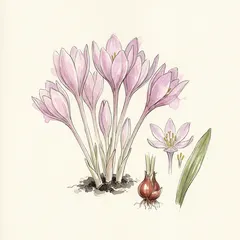
Colchicum autumnale. Meadow Saffron. N. O. Melanthaceae of the Liliaceae. Tincture of the bulb dug in spring.
Clinical
Appendicitis. Asthma. Cataract. Cholera. Colic. Cough. Cramp. Debility. Diabetes. Diarrhoea. Dropsy. Dysentery. Eye, affections of. Feels, painful. Gout. Heart affections of. Ileus. Intermittent fever. Intestinal catarrh. Lumbago. Myalgia. Nephritis (rheumatic and gouty). Pericarditis. Proctalgia. Prostatitis. Rectum, prolapse of. Rheumatism. Stiff-neck. Tongue, sensibility lost. Typhlitis. Typhoid fever.
Characteristics
Colchicum is best known as a remedy in gout and rheumatism, and the provings show its specific relation thereto. It acts on muscles, bones, and joints. It causes extreme relaxation of the muscular system—the head falls forward on the chest; or falls back when the patient is raised from the pillow; arms fall helpless by the side. Stitching, jerking, drawing pains in muscles; periosteum, and joints.
Extreme disinclination to move; < from motion. Mind befogged; but answers correctly. Absence of apprehension, no fear of death.
Results of getting wet and Letting chilled; changes to damp weather; autumn dysentery, spring rheumatism. (The flowers of the plant appear in autumn; the leaves not till the following spring.) It corresponds to the gouty constitution; leuco-phlegmatic and melancholic temperament; venous constitutions; uric acid diathesis, the sediment being pale yellow and rather like fine flour than sand. Also, urine black as ink; urine loaded with albumen and casts. There is the irritability and aversion to touch so common in gout; pain in small joints, and especially the great toes.
The stomach is acutely disordered, nausea and vomiting. "Nausea at thought, sight, or smell of food, especially of cooking," is a characteristic symptom. (Nash records a striking cure by Colch. 200, to which he was led by this symptom. The patient was an old lady who was vomiting blood, and passing as many as sixteen bloody stools in the day.
The doors of the room had to be most carefully kept closed to prevent any smell of cooking reaching her as that immediately provoked nausea.) Sensation of icy coldness in stomach; or burning. Coldness is a common symptom: abdomen; stomach;
Extremities
Profuse cold sweat; marked chills with or without periodicity.
Burning also is not uncommon: in cavities, especially abdomen.
The characteristic stool of Colchicum is jelly-like mucus; membranous shreds being also marked; violent tenesmus accompanies.
Protrusion of rectum.
"After evacuation, as in dysentery, there is generally relief (but in typhus fever, e.g., sometimes a terrific spasmodic pain of the sphincter ani comes on after stool.
This may occur in common diarrhoea)" (Guernsey).
The rice-water stool, hippocratic face, coldness, cramps, prostration, led Salzer to find in it the specific for certain epidemics of Asiatic cholera.
All functions, mental and bodily, are slow; nutrition and digestion are at a stand, and yet the patient does not emaciate rapidly.
There is great prostration; debility from loss of sleep; the prostration of typhoid fever and typhoid states.
On the other hand there are convulsions, cramps, and sometimes restlessness.
The pains of Colchicum are very acute and unendurable.
The Colch. dysentery and rheumatism are exceedingly painful.
Very sensitive and irritable.
Cannot endure strong smells.
Gouty diabetes, the uric acid reappearing as the sugar disappears.
The heart is affected as other muscles.
Oppression and anxiety > by walking.
Heart-beating.
Stitches about heart and loss of consciousness.
Heart affected (pericarditis) on disappearance of symptoms from extremities; rheumatism appears on disappearance of uric acid from urine.
Colch. will reverse this.
J.
R.
Simson, of Tonawanda, N.
Y., cured a very bad rase of typhoid presenting among other symptoms, this: "his left pupil was contracted so as to be almost imperceptible, while the right was dilated to the full extent." This is peculiar to Colch., and no remedy relieved the patient till he received this.
B.
Simmons calls attention (H.
P., August, 1889) to the powerlessness of the affected parts which accompanies many Colchicum affections, especially when occurring in leuco-phlegmatic subjects and when there is oedematous swelling of the parts.
He cured a woman, 36, mother of two children, of leuco-phlegmatic temperament, who complained of rheumatism of the hands, which were swollen; joints stiff and powerless, pain as if bruised; the arms being affected but in less degree.
"She was unable to brush her own hair, not so much from the pain as from the extreme weakness and powerlessness of the parts affected." T.
F.
Allen gives "Tingling in finger-nails" as characteristic of Colch.; no other remedy has it.
As usual with allopathic specifics, Colchicum has been terribly abused.
Here is an instance.
I was called suddenly to see an old gentleman of 72, whom I found in a state of collapse, pallid, surface was cold and clammy, almost pulseless.
He had been taken suddenly ill when in the water-closet, vomiting "black bile," and had fallen on the floor when trying to walk along the passage.
The history of the attack was this: He had formerly been "a martyr to gout." Four years previously he began to take, on lay recommendation, a powder which analysis showed to be composed of equal parts of Colchicum and Jesuit's bark.
He kept this up for six months and had no more gout.
But at the end of the six months he had the first attack of this kind.
It came quite suddenly and was, as far as I could learn, identical with the one in which I saw him.
In addition to the symptoms named there was looseness of the bowels, the stool being black like the vomit.
He was compelled to lie absolutely still, the least attempt to raise the head exciting nausea.
Recovery took place in a few days.
This is not exactly a case of what our friends would call "médecine substitutive," but I am inclined to name it "maladie substitutive," the substituted malady, Colchicism, being considerably worse than the gout it replaced.
These attacks had recurred every few months, although the powders were discontinued.
The < from motion is as marked as that of Bry.
The patient must rest and lie down.
Cannot lie on left side.
< From any exertion mental or bodily.
Bending forward > oppression and colic.
Symptoms are < night and evening.
Warmth > generally; but warm food < toothache; and damp, warm weather = profuse watery stools; warm stove or warm room = chilliness.
Symptoms generally are < from cold or damp; from getting wet; from bathing, living in damp dwellings; change to damp weather; from change of weather; also complaints from getting overheated.
Pains in gout go from left to right; headaches right to left.
Complaints of old people; asthmatic people.
Relations
Antidoted by: Bell., Camph., Coccul., Nux v., Puls., Spigel., honey and sugar. In poisoning give Ammon. caust. in sugar water. Follows well: Lyc. Followed well by: Carb. v.
(ascites). Compare: Aco., Arn., Ars. (Colch. has the prostration of Ars., but without its restlessness); Cact. and Abrot.
(metastasis to heart); Bry. (gout, rheumatism, serous effusions, < by movement); Chi., Coccul., Merc., Nat. m., Nux, Op., Pod.
(painless cholerine); Puls. (derangement of stomach by eggs; gout; nausea at smell or thought of food, especially if rich or fat); Sep., Calc., Ars., and Ambra.
(icy coldness in stomach); Lach. (black urine; < smell of food; cholera);
Ver. (cholera, cold sweat on forehead); Bar. c. (paralysis of tongue; cold, loss of sensibility);
Nux (debility from loss of sleep; irritability, all external impressions annoy; the debility of Colch. is more profound and there is dislike of all food, and nausea from smells). Colch. is botanically allied to the Veratrums, the Alliums, and Iris. Teste includes it in his Zincum group. It antidotes: Thuja.
Causation
Grief. Misbehaviour of others. Wetting. Checked perspiration.
Mind
Great dejection
Ill-humour
Peevish; dissatisfied with everything
The sufferings appear insupportable
The least external impression (bright light, strong smells, bad manners) drives him to distraction
Weakness of memory
Great desire for rest and disinclination to every mental exertion; absence of mind
Forgetfulness and distraction.
Head
Giddiness when sitting down after walking
Pulsations in the head
The headache is relieved, after supper, from warmth and lying quiet in bed
Pressure on the occiput, during intellectual exertion
Cramp-like pains in the head, esp. above the eyes
Semilateral tearing in the head
Tingling in the forehead and upon the head.
Eyes
Pupils much dilated, only slightly sensitive to light, or immovable or slightly dilated
L. pupil contracted, while r. is dilated (typhoid)
Pains in the eyes, like a digging pulling, deep in the eyeball
Swelling of the lower lids
Watering of the eyes in the open air.—(lritis; keratitis; maculae)
Suppuration of the Meibomian glands (ulceration, left lower lid); burning and redness of the edges of the eyelids
Visible traction in the lower lids.
Ears
Otalgia, with tearing shootings (after measles)
Tingling in the ears, as if they had been frozen
Sensation of obstruction in the ears
Purulent discharge from the ears, with drawing pains
Dryness of the ears.
Nose
Aching pain in the bones of the nose
Tingling in the nose
Pains as from excoriation in the septum narium, aggravated by touch
Bleeding of the nose in the evenings
Excessive sensibility of smell
Obstinate coryza, with snuffling of a great quantity of viscid mucus, proceeding from the nose.
Face
Features disfigured
Aspect sickly, sad, suffering
Face spotted with yellow
Very great paleness of the face
Cheeks red and hot (afternoon)
Oedematous swelling of the face
Sensation of separation in the bones of the face
Sensation in the masseters, as if they were distended, with difficulty in opening the mouth
Drawings and successive pullings in the muscles and bones of the face
Semi-lateral tearing in the face, extending to the ear and the head
Tingling in the skin of the face, as if it had been frozen
Lips cracked
Tearing in the lower lip
Cramp-like pain in the maxillary joint.
Teeth
Odontalgia, with tearing pains
Sensibility of the teeth, when they touch on closing the jaws
Acute pains in the gums.
Mouth
Heat in the mouth
Tearing in the palate
Abundant, serous salivation, with dryness of the throat
Heaviness, stiffness, and insensibility of the tongue
Tongue coated white
Smarting and sensation of dryness of the tongue and throat.
Throat
Sore-throat, as if from swelling of the orifice of the oesophagus
Tingling in the palate
Constriction of the gullet
Inflammation and redness of the palate, of the fauces
Inflammations, tearings and shootings in the palate, and in the throat
Accumulation of greenish mucus in the throat, and in the mouth.
Appetite
Appetite suddenly ceasing, merely from the sight or smell of food, with loathing, when merely looking at it, and still more from smelling it; the smell of broth nauseates, and that of fish, eggs, or fat meat almost makes him faint
Insipidity of food
Great thirst, esp. for coffee
Taste bitter; violent thirst.
Stomach
Frequent eructations
Constant hiccough
Nausea, increased, so as to occasion loss of consciousness, by the smell of fresh eggs, or fat meat
Nausea, during a meal
Nausea, after swallowing the saliva
Nausea, in an erect position, when moving at table, with inclination to vomit, with constant flow of saliva
Vomiting of food, or of bile, or mucus, of the ingesta, with trembling, violent gagging, colic, succeeded by bitterness in the mouth and throat; every motion excites or renews the vomiting
Stomach very sensitive to the touch
Sensation of excoriation, and tingling in the stomach
Sensation of cold, or of burning in the stomach, with heavy pain
Shooting in the pit of the stomach
Sensation of gnawing hunger in the stomach.
Abdomen
Inflation and fulness of the abdomen
Pressure towards the outside in the upper part of the abdomen
Colic, with tearing pains
Pain, as of excoriation, in l. side of abdomen, on its being touched
Dropsical swelling of the abdomen, with a fold over the pubic region
Pain, as of burning and pressure in the abdomen, in the region of the bladder, and in the internal genital parts
Pulsation in the abdomen.
Stool And Anus
Constipation
Evacuations slow, difficult, scanty, with urging, even of the soft stool, with pain in the small of the back
Involuntary evacuation of faeces
Watery discharges, going off without sensation
Diarrhoea, consisting of mucus like rice-water
Dysenteric diarrhoea, of white, transparent, gelatinous mucus
Ineffectual pressing to stool; he feels the faeces in the rectum, but cannot expel them
Discharge of much mucus from the rectum
Extremely painful stools
Sanguineous evacuations, mixed, as it were, with false membranes
Prolapsus recti
Tingling itching, burning, and tearing in the anus
During stool sensation as if the sphincter ani were torn to pieces
Cramps in the sphincter ani.
Urinary Organs
Urgent want to make water, with increased discharge of clear urine
Scanty discharge of urine of a deep colour, with tenesmus, and a burning sensation
Painful and scanty emission of urine of a bright red colour
Brownish or blackish urine
Whitish deposit in the urine
Burning sensation and pressure in the urinary organs, and the bladder, with diminished secretion
Pullings, tearings, and incisive pains in the urethra
Frequent micturition.
Respiratory Organs
Tingling in the trachea
Tickling in the pharynx, which excites a small dry cough
Frequent short and dry cough
Nocturnal cough, with involuntary emission of urine
Hoarseness in the morning with roughness of the throat.
Chest
Difficulty of respiration, and oppression at the chest, with anxiety; relieved by bending forward
Tensive, pressive, and periodical oppression of the chest; frequent pressure in small spots in the chest
Shootings in the chest, sometimes on breathing
Tearings in the chest, with obtuse lancinations
Pain, as of excoriation in the chest, on being touched and during movement
Tingling in the chest.
Heart
Violent palpitation of the heart
Pressure and oppression in the region of the heart, as if an attack of apoplexy threatened;
> by walking
Hydrothorax.
Neck And Back
Shooting tension between the shoulder-blades
Tearings in the back
Pain, as from excoriation in the loins, during movement
Drawing in the small of the back; worse during motion
Soreness in the small of the back when touching it.
Upper Limbs
Stitches in the r. shoulder
Painful lameness in the arms, which makes it impossible to hold the lightest thing
Trembling of the r. hand preventing writing
Tearings in the arms, the hands, and the fingers
Paralytic pain in the arms
Trembling of the hands
Heat of the palms of the hands
Cramp-like contraction of the fingers
Tingling in the fingers, as if they had been frozen
Tingling in the finger-nails
Torpor in the extremity of the fingers.
Lower Limbs
Tearings in the legs, the feet, and the toes
Paralytic pullings in the thighs
Hot (oedematous) swelling of the legs, with acute pains during movement
Tingling of the toes, as if they had been frozen.
Generalities
Rheumatic and arthritic tearing in the limbs, and other parts of the body, esp. in warm weather Tingling in many parts of the body, as if frost-bitten, when the weather changes Tearing twitches, like electric shocks, through one side of the body, with sensation of lameness Starting, shootings in the muscles, and in the periosteum of the limbs, esp. in cold weather
Frequent starting of the body Shooting in the joints Paralytic weakness, of the muscles Pains accompanied by paralytic weakness, and real paralysis
Great weakness, with sensation of lameness through all the limbs Dropsical swellings The sufferings are singularly aggravated by intellectual fatigue, by touch, by too brilliant a light, and by the smell of pork Aggravation of the symptoms from the commencement of the night till morning
General sinking, and consequent painful sensibility of the whole body, so that the patient cannot move without groaning Nervous fatigue and weakness from nocturnal labour.
Skin
Itching, as from nettles
Tingling in different parts, as after being frozen
Oedematous swelling and anasarca
Suppressed perspiration.
Sleep
Drowsiness in the day, with unfitness for exertion
Irresistible sleepiness, drowsiness
Sleeplessness from nervous excitability
Sleeplessness, without entire unconsciousness
Sleeplessness, because he cannot lie on the l. side, on which he is accustomed to sleep
Frequent waking with fright
Nocturnal heat, with violent thirst.