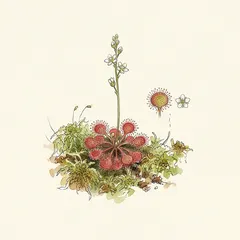
Drosera Rotundifolia
Drosera · Clarke - Dictionary of Practical Materia Medica · John Henry Clarke · 12,926 chars · source ↗
 All books on Drosera Rotundifolia →
General
Drosera.
Drosera rotundifolia. Round-leaved Sundew. N. O. Droseraceae. Tincture of active fresh plant.
Clinical
Amblyopia. Asthma. Bronchitis. Catarrh. Consumption. Cough. Coxalgia. Epilepsy. Haemorrhage.
Headache
Laryngitis.
Measles.
Nausea.
Phthisis.
Sciatica.
Vomiting.
Whooping-cough.
Characteristics
The chief feature of the Drosera effects is a spasmodic cough resembling whooping-cough, in which affection it is one of the leading remedies, as it is also in the spasmodic cough of phthisis. The characteristic cough is: Frequent spells of barking cough; < evening and after midnight; patient holds his side; vomits if he cannot get up phlegm; every effort to raise a little phlegm ends in retching and vomiting; there may be bloody stools. Teste, who places Drosera in his Zincum group of medicines, mentions that it grows in damp prairies, along the border of marshes, and is avoided by animals.
Barrich states that when eaten by sheep it gives them a cough which is fatal to them. Curiously enough, it was recommended by German physicians of the eighteenth century as a panacea for hoarseness, chest affections, and even for phthisis. Serrand, of Paris (translated H. R., vi. 153) maintains that Drosera has an important rôle in the prophylaxis of tubercle.
He refers to the fact that sheep eating Drosera leaves acquire a nocturnal cough and die, and that the pleurae of cats to which Drosera had been administered were found studded with tubercles. The indications calling for it in the premonitory stage are: pallor, weakness, loss of appetite, dry cough, emaciation. Three laryngoscopic indications are: (1) Anaemia and pallor of larynx; (2) vocal cords not sufficiently approximated from functional impairment of crico-arytenoid muscles;
(3) redness and swelling of mucous membrane covering and between the arytenoid cartilages. Dr. Serrand commends Dros. in cases of declared phthisis as well. He gives it in the low attenuations.
Buchmann of Alvensleben agrees with Hahnemann that Dros. in high attenuation should not be repeated. He cured himself of a bronchial catarrh which used to attack him every spring and fall, characterised by a violent tickling cough, which almost drove him to distraction at night, with Dros. 1x. and Ø. A single dose as soon as the tickling in the larynx commenced sufficed to allay it at once and allowed him to rest, and it was only repeated when the tickling returned. Among the characteristics of Drosera are: Spasmodic and constricting pains in abdomen; larynx; throat; chest; hypochondria.
Crawling in larynx; feeling as if a soft substance were lodged in larynx, as a feather. Difficult swallowing of solids. Voice fails. Stitching pains in chest and all parts; lancinations in brain.
Stitches from left loin into penis; itching stitches in glans. Haemorrhages of bright red blood, from nose; mouth (bloody saliva); with vomit; with stool; expectoration. Gnawing stinging pains in joints and long bones. Dros. has many pains about the hip-joints and has cured sciatica with the following characters: "Pressing pains, < from pressure, from stooping, from lying on painful part, > after rising from bed." Eruption like measles; prickling burning itching;
< undressing; > by scratching; bleeding, burning ulcers, cutting pains. Epileptic attacks: with rigidity; with twitching of limbs; after attack, haemoptysis and sleep. Symptoms are < towards evening and after midnight.
< By warmth; by warm drinks; > in open air. Many symptoms are < at rest and when lying in bed. Supporting the part > pains in head and chest.
Stooping <; walking >; singing and talking <. Motion of eye < head pains. Motion > stitching in chest and joints, and shivering. < From acids.
Relations
Antidoted by: Camph. Complementary: Nux. Compatible: Calc c., Puls., Verat., Gnaph. Compare: Bell., Coral., Cup., Hyo., Ip., Sambuc., Meph., Op., Coc. cact. In inability to expectorate Caust., Sep., Arn., Kali c. Teste considers Meny. the closest analogue.
Mind
Mental dejection, caused by ideas of imaginary enmity
Anxiety, esp.
(in the evening) in solitude, with fear of ghosts
Great mistrust
Restlessness, which does not allow prolonged attention to the same object
Inquietude respecting the future
Discouragement
Inclination to drown oneself
Pertinacity in executing resolutions
The least thing puts the sufferer beside himself.
Head
Painful perplexity of the head, as after loud speaking
Vertigo on walking in the open air, which occasions falling (to the l.)
Pressive pains in the head, esp. in the forehead and in the cheek-bones, sometimes with nausea and dizziness
Pressing headache (temples), with stupefaction and nausea (morning); worse when stooping and from heart; better from motion and in the cold air
Beating and hammering in the forehead from the inside outwards
Pains, as of excoriation in the scalp.
Eyes
Shootings in the eyes towards the outside, esp. on stooping
Suspension of the sight, or confusion and paleness of the letters while reading
Gauze before the eyes
Presbyopia and weakness of the eyes
Contraction of the pupils
Dazzling by candle-light and daylight.
Ears
Shootings and squeezing in the ears, esp. on swallowing
Hardness of hearing, with buzzing and roaring in the ears
Humming and drumming in the ears.
Nose
Bleeding at the nose, esp. in the evening
Discharge of blood on blowing the nose
Black pores on the nose
Constant dryness of the nose
Great sensibility to acid smells
Fluent coryza with sneezing.
Face
Paleness of the face, with cheeks hollow, and eyes sunken
Small pustules here and there on face, with fine stitching sensation < when touched
Burning and pricking sensation in the skin of the cheeks, below the eyes
Lips cracked and constantly dry
Pressure in the cheek-bones towards the outside, aggravated by pressure and contact
Black pores in the chin.
Mouth
Shooting pains in teeth, after taking hot drinks
Ulcers on tongue
Bleeding of the mouth
Ulceration of velum palati.
Throat
Rough, scraping dryness deep in fauces, and in region of soft palate, inducing short and hacking cough, with yellow mucous expectoration, hoarse deep voice, oppression in chest as if breath could not be expelled when coughing or talking
Shootings in the throat, after eating anything salt
Stinging in the throat during deglutition
Difficulty in swallowing solid food, as from contraction of the throat
Sensation of dryness in the throat
Sensation in the throat, as if crumbs of bread had been stopped in it
Hawking of yellowish or greenish mucus.
Appetite
Thirst, esp. in the morning (during the hot stage of the fever and not during the cold stage)
Insipidity of food
Aversion to pork
Bitter taste of food and esp. of bread.
Stomach
Bitter risings
Frequent hiccough
Water-brash
Vomiting at night, and after dinner
Vomiting of bile, in the morning
Vomiting of blood
Nausea after eating fat food
Vomiting of slimy matter and of food during the cough
Shootings and beatings in the pit of the stomach
Clawing sensation in the pit of the stomach.
Abdomen
Pains in the hypochondria, on coughing and on being touched (he has to press on them with the hand when he coughs).—Colic after taking acids.
Stool And Anus
Frequent evacuations of sanguineous mucus, with cutting pains; after the stool, pain in abdomen and small of the back.
Urinary Organs
Frequent want to make water, with scanty emission, often drop by drop
Emission of urine at night
Brownish urine of a strong smell
Watery, inodorous urine (with fetid stool of white mucus).
Female Sexual Organs
Catamenia suppressed
Catamenia retarded
Leucorrhoea, with pains like those of childbirth, spasmodic pains in the abdomen.
Respiratory Organs
Tingling in the larynx, which excites a slight cough, and shootings extending to the throat
Sensation, as if there were a soft body, such as a feather, in the larynx
Sensation of dryness, or roughness, and of scraping in the bottom of the gullet, with inclination to cough
Hoarseness, and very low voice
Oppressed breathing when talking; mostly while sitting
Sensation of oppression in the chest, as if the voice and breath were retarded when speaking and coughing
Fine stitches in larynx extending down to r. side of oesophagus
Cough without much sound
Cough as soon as the head touches the pillow
Accumulation of slimy matter, alternately hard and soft, yellowish, greyish or greenish
Cough and hoarseness
Cough, proceeding from the depth of the chest, with pains in the hypochondria and in the chest, mitigated by pressing the hand upon them
Cough at night, and in the evening, immediately after lying down
Dry, spasmodic cough, with retching
Fatiguing cough like whooping-cough (attacks, every one to three hours, with barking or dull-sounding coughs, choking the breathing, caused by tickling or dryness of the throat; yellow and bitter expectoration; has to swallow this mucus down) with bluish face, wheezing respiration, attacks of suffocation, bleeding from the nose and mouth, and anxiety
The cough is excited by laughter, weeping and mental emotions; after having had the measles; aggravation after lying down, and still more increased after midnight; when at rest; when lying in bed; from heat; from drinking; from singing
Vomiting of food during the cough, and afterwards
Cough, with fetid breath
Singing, tobacco-smoke, and drinking, excites the cough
Cough, with expectoration of a bright red blood, or of blackish clots
Cough, in the morning, with bitter and nauseous expectoration
Cough, with expectoration of purulent matter, and shootings in the lower part of the chest
Greenish expectoration
Laryngeal and tracheal phthisis.
Chest
Restricted respiration on speaking, as if the throat were contracted, chiefly when seated
Oppression of the chest, as if something stopped the voice on coughing or on speaking, or, as if the breath could not be expelled
Tightness of the chest on coughing
Pains in the chest on coughing and on sneezing; he has to press his chest with the hand
Pains, as from subcutaneous ulceration in the sternum, on pressing upon it
Black pores on the chest and shoulder.
Neck And Back
Stiffness at the nape of the neck, with pains during movement.—Bruise-like pains in the back, particularly early in the morning.
Upper Limbs
Twitchings in r. shoulder, only when at rest
Pains, as from a bruise, in the joints of the arms and of the hands
Cramp and stiffening of the fingers, on grasping an object
Nocturnal pains in the bones of the arm, going off during motion in the day.
Lower Limbs
Paralytic pains in the coxo-femoral joint, and in the thighs, on walking, which occasion limping
Incisive shootings in the legs
Violent stitch in the os ischium, on rising from a seat
Tearings in the joints of the foot, as if they were dislocated, only when walking
Stiffness in the joints of the feet
Cold sweat in the feet, which are constantly cold.
Generalities
Rapid emaciation (with acute laryngitis) Gnawing shootings in the cavities of the bones of the arms and of the legs, exceedingly violent, with violent shootings in the joints, during repose, rather than during movement Shooting and painful pressure in the muscles (of the limbs), mitigated in no position Pains as from a bruise, excessively distressing sensitiveness, paralytic weakness in all the limbs
All the limbs feel sore, as from too hard a bed Weakness in the whole body, with cheeks and eyes hollow Epileptic convulsions, with sleep and spitting of blood, after the fit The majority of the sufferings appear at night and in the morning, as well as in a warm atmosphere, and during repose
Gnawing-stinging in the long bones; worse during rest.
Skin
Violent itching while undressing; when scratching, the skin readily peels off.—Black pores on chest and shoulder.
Sleep
Snoring during sleep, and when lying on the back
Frequent starts with fright, during sleep
Nocturnal waking, on the breaking out of perspiration
Frequent waking with perspiration, or as if too wakeful
Sleep at noon and in the evening at sunset.
Fever
Shuddering over the whole body, with heat of the face, icy coldness of the hands and absence of thirst, or shiverings with coldness and paleness of the hands, the feet, and the face
In the morning hours, coldness of one side (l.) of the face, while the other side (r.) is hot
Chilliness and chill while at rest, finds it everywhere too cold, even in bed
Chilliness during the day, heat during the night
Heat almost exclusively in the face and on the head
Warm perspiration at night, esp. after midnight and during the morning hours, mostly in the face
Heat, with headache and convulsive cough.—(Intermittent) fever, with nausea, and inclination to vomit, and other gastric sufferings, or with sore throat.