Ledum Palustre
Ledum · Clarke - Dictionary of Practical Materia Medica · John Henry Clarke · 21,249 chars · source ↗
 All books on Ledum Palustre →
Antidoted byAngustura VeraApis MellificaCamphoraCinchona OfficinalisParis Quadrifolia
All books on Ledum Palustre →
Antidoted byAngustura VeraApis MellificaCamphoraCinchona OfficinalisParis QuadrifoliaGeneral
Ledum.
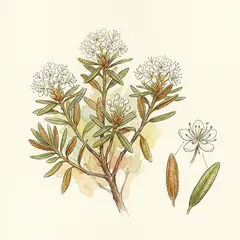
Ledum palustre. Wild Rosemary. Marsh Cistus. Marsh Tea. Labrador Tea. N. O. Ericaceae. Tincture of dried small twigs and leaves collected after flowering begins. Tincture of whole fresh plant.
Clinical
Ascites. Asthma. Bites. Black-eye. Boils. Bruises. Deafness. Ear, inflammation of. Eczema. Erythema nodosum. Face, pimples on. Feet, pains in; tender. Gout. Haemoptysis. Hands, pains in. Intoxication. Joints, affections of, cracking in. Ménière's disease. Pediculosis. Priapism. Prickly heat. Punctured wounds. Rheumatism. Skin, eruptions on. Stings. Tetanus. Tinnitus. Tuberculosis. Varicella. Whitlow. Wounds.
Characteristics
In the preface to his proving of Ledum Hahnemann says it "is suitable for the most part only for chronic maladies in which there is a predominance of coldness and deficiency of animal heat." Teste, who is one of the chief clinical authorities on Ledum, mentions that it is native to damp regions of the North of Europe, and that no animal except the goat eats it, on account of the strong resinous smell of its leaves, which "keeps off lice and prevents flour from getting mouldy." In Sweden a decoction of Ledum is used for freeing, oxen and pigs from lice.
Linnaeus says that this same decoction, if taken internally, has cured "violent headaches and a species of angina." The leaves of Ledum are also used in Sweden in beer to increase its intoxicating power; and also in tanning. Led. is an example of a common article of diet being at the same time a very powerful medicine. Mérat and de Lens say Led. cures itch and scald-head, which Teste explains by its parasiticide action. This anti-parasitic action led Teste to think of Led. as a remedy for bites and punctured wounds, especially as certain symptoms of the proving seemed to agree with it.
The success which has attended this use of Led. in mosquito-bites, stings of bees and wasps, rat-bites, needle-pricks resulting in whitlows, confirms the observation. "Redness, swelling and throbbing in point of index finger, from prick of a needle:" Led. aborted a felon in a few days (W. P. Wesselhoeft).
Teste relates a case of punctured wound: A young lady fell with an embroidery needle in her hand, and the hand was pierced through and through. The wound was serious. There was no haemorrhage, but Teste noticed the intense cold which accompanies and characterises Ledum fever. Within a week Led. cured the patient.
Yingling records (H. P., x. 400) a parallel case: A. J. M., 38, drove a rusty spike through his left foot near the arch of the instep, glancing to the inside of the foot without passing through the bone.
This was at 5 p.m. At 8 p.m. this report was brought to Yingling: A few moments after accident the patient felt stiffening pains in the foot, running up the leg, and rapidly increasing in severity. Great chilliness with chattering of teeth followed. Lower jaw became somewhat stiff; general shivering; neck felt stiff;
"can't endure it much longer." Led. 3x was sent, and rapid improvement took place from the first dose. A compress of Calend. 3x was also applied, an attack of tetanus being evidently aborted. Led. occupies the second place in Teste's Arn. group, in which are also Crot. t., Fer. magn., Rhus, Spig. The sphere of Led. is frequently identical with that of Arn., according to Teste; but Led. has a special action on the capillary system in parts where cellular tissue is wanting, and where a dry, resisting texture is present, as in the fingers and toes.
"It is, perhaps for this reason that it acts better on the small than on the large joints;" hence its appropriateness in gout. The characteristic skin affection of Led. is thus described by Teste: Not so much a boil, as with Arn., as a sort of bluish or violet-coloured tuberosities, especially on the forehead, and an eczematous eruption, with a tingling itching, that spreads over the whole body, penetrating into the mouth, probably also into the air-passages, and occasions a spasmodic cough, which is sometimes very violent and might be mistaken for whooping-cough.
The same phenomenon takes place with Rhus and Croton. "In a gouty subject I have seen cough precede by two days the breaking out of vesicles on the skin, which could not fail to suggest the use of Ledum. These vesicles, which had probably existed on the bronchial membrane, before showing themselves in the face, on the shoulders, &c., became quite apparent on the tongue, where they might be traced to its root." The Led. eczema is frequently concentrated on one leg, less frequently on both at once. [Ingalls (Amer.
Hom., xxv. 210) commends a light paste of Ledum (equal parts of Led Ø., alcohol, and water) as an application for carbuncles, giving Led. 1x internally at the same time.] Dr. R. Hilbert, a German physician, has obtained very satisfactory results from the use of an infusion of the leaves of Ledum palustre as an expectorant in bronchitis. He states that the feeling of pain along the trachea, which is characteristic of the early stages of acute bronchitis, disappears after a few doses of the remedy.
The fever rapidly subsides, especially in the case of children. In chronic bronchitis the infusion facilitates expectoration and lessens cough. It is particularly useful in bronchitis with emphysema of the aged, because of its action in rendering the bronchial secretion less viscid; in these cases, moreover, it lessens dyspnoea, stimulates the circulation, and lessens cyanosis (Cooper). Guernsey points out that Led. is appropriate to the remote no less than the immediate effects of punctured wounds: e.g., as when a patient says: "Ten years ago I stepped on a nail, and ever since then have had a pain running up to the thigh." The pains of Led. shoot upward (of Kalm. downward).
A, very notable condition of Led. is < from warmth. This is at times so great that the patient can only get relief to his rheumatism by sitting with his feet and legs in cold water. Warmth of the bed is intolerable; he must get up and walk about. An octogenarian had rheumatism of left arm, chiefly elbow and wrist, coming on in the night or early morning.
There was no more sleep for him unless he rose and took a cold bath, after which he could sleep. I cured him with Led. 30. As with Merc. the symptoms are < at night; but with Merc. there is "sweat without >," and the characteristic tongue and offensive mouth. The eye-symptoms of Led. are marked, and Nash says Led. 200 is unequalled as a remedy for "black-eye" from a blow; if there is pain in the eyeball itself Symphyt. will be necessary.
Ecchymoses of conjunctiva. Slight injuries cause ecchymoses. Inflammation of ear, with deafness from getting cold (as having hair cut). The haemorrhages of Led. are bright red and gushing; uterine; respiratory.
Haemoptysis alternating with attacks of rheumatism. (Raue puts it "coxalgia alternating with haemoptysis." Stens cured a young man who had violent stitch pain in right hip, followed by haemoptysis, this in turn followed by rheumatism of hands, with Led. 200 when the case was apparently on the point of sinking into rapid phthisis.) Suffering parts waste. Discolouration remains long in contused parts. Many cases of whooping-cough have been cured with Led.
Lembke (quoted by Hoyne, H. W., xiv. 66) gives these indications: Before the paroxysms: Arrest of breathing. During: Epistaxis, shattered feeling in head and chest, rapid respiration. After: Staggering; spasmodic contraction of diaphragm; sobbing respiration.
< Evening. The pains are sticking, tearing, throbbing. Pricking, biting sensations. Sensation of torpor of integuments, especially after suppressed discharge from ears, eyes, and nose.
Sensation as if something was gnawing in temples, occiput, and ears. As if eyeball would be forced out. As if sand in eyes. Noises in ear as from ringing of bell, or from a wind-storm; as if ear was obstructed by cotton.
Itching as from lice on chest; as of lump in throat. As of boiling in hip-joint. As if muscles of thigh in wrong position. As if knee beaten.
Pain in ankle as from sprain; limbs as if beaten and bruised. Hot, tense, hard swellings. "Ledum has often been given to horses when they go lame and draw up their legs. The pains move upward" (Hering).
E. Carleton (Med. Adv., xxv. 293) completed the cure of a case of primary syphilis, in which Aur. had done good, where these symptoms appeared: Feet held to the earth as by a magnet when attempting to move; when moving felt as if pricked with needles, the pain rising gradually from feet to head; every joint and muscle of body and limbs stiff and sore; sour night-sweats; great emaciation with loss of appetite. Led. 200, in water, cured completely and speedily.
Suited to: Pale delicate persons. Complaints of persons who always feel cold and chilly. Rheumatic, gouty diathesis; constitutions abused by alcohol. Sanguine temperament (Teste).
There is < from moving, especially moving joints; while walking; when stepping, > from rest. Symptoms are < evening and night, and before midnight. < From taking wine. < By covering;
> by application of ice-water. < By warmth; ("the limb is cold, can't get warm; and gets < when it does become warm in bed").
Relations
Antidoted by: Camph. (according to Teste Rhus is the best antidote). It antidotes: Effects of alcohol; Apis, Chi.
("Cinchona bark given for the debility produced by Led. is very injurious."—Hahn.) Compatible: Aco., Arn., Bell., Bry., Nux v., Puls., Rhus, Sul. Compare: Kalm. (bot.; Kalm. pains shoot down;
Led. pains shoot up); Arn. (trauma. Led. follows Arn. when it fails to relieve soreness; punctured wounds);
Crot. t. (skin cold); Hamam. (traumatic ecchymosis; black-eye), Ruta (bruises: Ruta, especially of periosteum Symph. of bone;
Hyperic. of nerve) Apis (nightly itching of feet) Am. m., Nat. c. (blistered heels) Zn., Rhus, Glo., Nux, Sel., Fl. ac., Ant. c., Pul., Bovis., and Sil. (< from wine); Sil.
(chronic rheumatism, extending from feet upwards; Sil. > covering up, Led, > uncovering); Lyc.
> uncovering); Bry. (rheumatism < motion; Led. more gout of great toe, scanty effusion, tends to harden into nodosities;
Bry., copious effusion. Led. hot swelling of hip- and shoulder-joints); Aco. (haemoptysis of bright red foamy blood) Rhus [gout and rheumatism affecting small joints (Rhod. also) Led. pains travel up;
< warmth of bed (Rhus >); motion < (Rhus. >)]; Sul. (itch);
Staph. (pediculosis); Merc. (bloody semen).
Causation
Alcohol, abuse of. Hair-cutting. Suppressed discharges. Wounds: Bruises; Bites; Punctured wounds; Stings.
Mind
Anxiety
Timidity
Tendency to anger and rage
Vehement angry mood; vehemence
Dissatisfied; hates his fellow-beings
Desire for solitude
Imperturbable gravity
Morose and peevish humour
Misanthropy
Dementia.
Head
Intoxication
Stupefying dizziness, sufficient to occasion falling backwards or forwards, < by stooping or being in open air
Vertigo, head inclines backward
Raging, pulsating headache
Pressing headache when head is covered
A misstep causes the sensation of concussion of the brain
Head bewildered, with painful shaking of brain, on making a false step
Stupefying headache
Pressive headache, as if whole brain were weighed down
Tearing in head and eyes, which are inflamed, with fever in evening
Violent throbbing pains in head
Inability to bear any covering on head
Itching, as if lice were crawling over scalp, and forehead
Integuments of head easily affected by cold
Pimples and boils on the forehead (as in drunkards)
Blood-boils on the forehead.
Eyes
Itching in the internal canthi of the eyes
Aching in eyes, esp. in evening, sometimes with burning
Inflammation of eyes, with agglutination and tearing pains
Violent suppuration of eyes, with discharge of fetid pus
The tears are acrid, and make the lower lids and cheeks sore
Burning lachrymation of eyes
Pupils dilated
Confusion of sight, with sparkling before eyes.
Ears
Noise in ears
Tinkling in ears
Roaring in ears as from wind
Ringing and whizzing in ears
Hardness of hearing (r. ear) as from obstruction of the ears.
Nose
The nose is painful when touched
Violent burning in nose
Bleeding in nose
The blood is pale.
Face
Paleness of face
Face bloated, at one time red, at another pale
Redness and tuberous eruptions on face and forehead, like those of drunkards, with shooting pain when touched
Dry and furfuraceous tetters on face, with burning in open air
Pimples and furunculi on forehead
Violent and tearing pains in face at night, alternating with shootings in one of the teeth, and terminating in shuddering, followed by deep sleep
Engorgement of the gland below the chin.
Mouth
Stinging in forepart of tongue
Exhalation of a fetid smell from mouth
Mouldy or bitter taste in the mouth
Buccal haemorrhage.
Throat
Sore throat, with shooting pain during and after deglutition.—Sensation as if there were a plug in the throat, with shootings on swallowing.
Appetite
Violent thirst for cold water
Want of appetite and speedy satiety
Contractive pain in sternum when eating quickly
Nausea, with inclination to vomit, on expectorating
Water-brash, with cramp-like pains in abdomen.
Stomach
Pressure on stomach after a light meal.
Abdomen
Pain in abdomen as if intestines were bruised
Sensation of fulness in upper part of the abdomen
Colic as if diarrhoea would set in, from umbilicus to anus (with cold feet)
Ascites
Drawing pain in abdomen
Gripings in abdomen, in evening.
Dysenteric belly-ache
Frequent discharge of flatus.
Stool And Anus
Constipation
Diarrhoea, during which the faeces are mixed with mucus and blood
Blind smarting piles.
Urinary Organs
Burning in urethra after urinating
Stream of urine frequently stops during its flow
Frequent want to urinate, with scanty emission
Diminished secretion of urine
Frequent and copious emission of urine
Swelling of urethra.
Male Sexual Organs
Violent and prolonged erections
Pollutions of sanguineous or serous semen
Inflammation of the glans
Inflammatory swelling of penis; the urethra is almost closed
Increased sexual desire.
Female Sexual Organs
Catamenia too early and too copious; the blood is bright red.
Respiratory Organs
Tickling in larynx
Cough, preceded by suffocating suspension of respiration (and opisthotonos)
Fatiguing spasmodic cough, which resembles whooping-cough
Tiresome cough, chiefly in morning, with yellowish expectoration and irritation in chest, and palpitation of heart
Cough, with purulent expectoration, esp. in morning or at night
Greenish expectoration of a fetid smell, during fit of coughing
Hollow shaking cough, with expectoration of bright red blood
Haemoptysis, bright blood
Phthisis, preceded by history of neuralgia and rheumatism in head and limbs, with inflammatory tendency (Van den Berghe)
Tingling of trachea (bronchitis).
Chest
Obstructed and painful respiration
Spasmodic and sobbing respiration (double inspiration) as after weeping bitterly
Respiration obstructed when going up stairs
Constrictive oppression of chest, < by movement, and walking
Burning in chest
Pain in chest on breathing, as if there were something alive in it
Shootings in chest, esp. on raising or moving arms
Eruption on the chest, resembling sheep-rot
Gnawing itching in chest, with red spots and miliary eruption
Pain, as from excoriation under sternum.
Heart
Pushing or pressing inward at l. edge of sternum; palpitation; also in haemorrhage.
Neck And Back
Painful stiffness in back and loins after sitting
Tearing from loins to occiput, esp. in evening
Violent cramp-like pain above hips, with suspended respiration in evening.
Limbs
Affections of, in general; knee-joint; hip-joints; toe-joints; gouty pain in; when striking the toes there is a coldness in the parts, and a gouty pain shoots all through the foot and limb; cracking of the joints, i.e., on moving them
Heat in hands and feet in evening
Long-continued warm sweat on hands and feet.
Upper Limbs
Tearing and pressive pulling in arms
Lancinating pains in shoulder, on raising or moving arms
Aching pain in joints of shoulder, and of elbow, < by movement
Rheumatism in r. elbow-joint due to urate deposit, on periosteum apparently
Rheumatic pain in the joints of the arm
Eruption, like sheep-rot, on arms
Tearing pains in hands and fingers
Fine stinging in hands
Boring pain in first joint of thumb
Arthritic nodosities in joints of hands and fingers
Perspiration on palms
Itching, miliary eruption on wrist
Trembling of hands on moving them, or on grasping anything
Panaritium.
Lower Limbs
Rheumatic, paralytic pain in the coxo-femoral joint
Pressure in the region of r. hip-joint, < during motion
Rheumatic pains in hip, knee, and foot-joints
Contusive pain, and pain as from excoriation in periosteum of femur, and in knees
Pressure on l. thigh, posteriorly; as if the muscles were not in their right places, like pains of dislocation, in every position, but esp. violent when walking or when touched
Tensive stiffness of the knee, which cracks and yields in walking
Cramp-like tension in the knees, calves, and heels
Weakness and trembling of knees (and hands) when seated or walking
Hard and tight swelling of knee, with shootings and nocturnal aching and tearing pains, and hardness of whole leg
Swelling of leg, above and below knee, with heat and drawing shooting pain
Legs red and swollen with shooting pains in instep and ankles, and prickly pains up leg
Pressure above l. inner ankle, < by movement
Very severe gnawing itching on dorsum of both feet; always < after scratching; only allayed after he had scratched the feet quite raw; much < by heat of bed
Obstinate swelling of feet; with intolerable pain in ankle-joint on treading
Pressure on inner border of l. foot
Stiffness of feet
Pain in soles, when walking, as if they were galled; as if filled with blood
Inflammatory or else oedematous swelling of legs and feet
Incisive pains in toes, while asleep at night
Swelling of fleshy part of great toe, with pain when treading with it
Fine tearing in (l.) toes; podagra.
Generalities
Arthritic, pressive, and acute pulling pains, or pains merely pressive in limbs, < by heat of bed in evening (till midnight) Numbness and sensation of torpor in several of the extremities Tearing or shooting, pulsative and paralytic pains in joints, < by movement The pains in the joints are the only ones which are < by movement
Gouty nodosities in joints Hard, hot, tense swellings, with tearing pains Dropsical swellings of some parts, or of skin of whole body Emaciation of affected parts
Pains change location suddenly Coldness and want of vital heat Heat of the bed is insupportable, and occasions heat and burning in limbs; wants to uncover Sufferings are <, or come on, after getting warm in bed, compelling the patient to get out of bed, which affords them relief
Leucorrhoea For complaints of people who are cold all the time, in bed, in the house, &c.; they always feel cold and chilly Pale delicate persons Affections of external forehead; heel; under part of heel; ball under the toes.
Skin
Oedematous swellings, also of skin of whole body
Hot, tensive, hard swellings, with tearing pains
Dryness of the skin and want of perspiration
Large, rough exanthema on the face
Dry exanthema
Whitlows or felons on fingers of a seamstress are often caused by needle pricks
Itching < by scratching
Itching and gnawing in skin, with burning after having scratched
Gnawing itching, as if caused by lice
Miliary eruptions
Eruption, like rot in sheep, with desquamation
Bluish spots over body, like petechiae
Ecchymosis remaining a long time in bruised parts after pain and inflammation subside
Dry, furfuraceous tetters, itching excessively (burning in open air)
Furunculi.
Sleep
Great inclination to sleep during day, as when intoxicated; a kind of drowsiness with great wish to lie down
Nocturnal sleeplessness, with restless tossing, jerking, fantastic visions and images on closing eyes
Agitated anxious dreams
Uneasy dreams, in which he changes from place to place, and from one subject to another
Lascivious dreams, with emission of semen.
Fever
Violent shivering and shuddering, with coldness in limbs
Chilliness with thirst and sensation as if cold water were poured over the parts
Morning and forenoon predominating chilliness with thirst
General coldness, with heat and redness of face
Heat without thirst more towards evening
Perspiration all night, with inclination to uncover oneself
Night-sweat, of putrid or sour smell
Perspiration causes itching
Intermittent fever
Chilliness without subsequent heat, accompanied by thirst, esp. desire for cold water
Heat all over without thirst; on waking up, body covered with perspiration, accompanied by itching of whole body
Intermittent fevers with malignant rheumatic pains
Heat in hands and feet in evening
Fever in evening, with pain in head and eyes
Sensation of great heat, alternating with sweats
Perspiration easily excited by walking, esp. on forehead, and sometimes of a sour smell.