Natrum Muriaticum
Clarke - Dictionary of Practical Materia Medica · John Henry Clarke · 45,491 chars · source ↗
 All books on Natrum Muriaticum →
Antidoted byActaea RacemosaAngustura VeraArsenicum AlbumCinchona OfficinalisCornus CircinataNitri Spiritus DulcisPhosphorusSepia OfficinalisTheridion Curassavicum
All books on Natrum Muriaticum →
Antidoted byActaea RacemosaAngustura VeraArsenicum AlbumCinchona OfficinalisCornus CircinataNitri Spiritus DulcisPhosphorusSepia OfficinalisTheridion CurassavicumGeneral
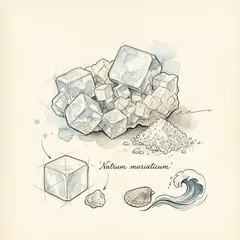
Natrum Muriaticum.
Sodium chloride. Common Salt. NaCl. Trituration. Solution.
Clinical
Addison's disease. Anaemia. Aphthae. Atrophy.
Brain-fag. Catarrh. Chorea. Constipation.
Cough. Cracks in the skin. Debility. Depression.
Diabetes. Disparunia. Dropsy. Dyspepsia.
Epilepsy. Erysipelas. Eyes, affections of. Eye-strain.
Face, complexion unhealthy. Gleet. Glossopharyngeal paralysis. Goître.
Gonorrhoea. Gout. Headache. Heart, affections of.
Hemiopia. Hernia. Herpes. Herpes circinatis.
Hiccough. Hodgkin's disease. Hydroa. Hypochondriasis.
Intermittent fever. Leucocythaemia. Leucorrhoea. Lips, eruption on.
Lungs, oedema of. Menstruation, disorders of. Mouth, inflammation of. Nettlerash.
Pediculosis. Ranula. Seborrhoea. Self-abuse.
Somnambulism. Speech, embarrassed. Spermatorrhoea. Spinal irritation.
Spleen, enlarged. Sterility. Stomatitis. Sunstroke.
Taste, lost; disordered. Tongue, blistered; white coated; heavy. Trifacial-nerve paralysis. Ulcers.
Varices. Vaginismus. Vertigo. Warts.
Whooping-cough. Worms. Yawning.
Characteristics
If Nat. carb. is the typical salt of the Natrum group (as Kali carb. is of the Kalis), Nat. m. is the most important. In power and range it stands in the first rank of homoeopathic remedies, but it has an additional significance, in that it exemplifies the power of attenuation in a remarkable way. The problems involved in Nat. m. may be regarded in a sense as the pons asinorum of homoeopathy. Those who are able to grasp in a practical way the homoeopathic uses of this remedy are not likely to meet with any insuperable difficulties elsewhere.
Those who can see nothing but "common salt" in Nat. m. may conclude that they have not "the root of the matter" in them. It may be inconceivable to some that the attenuations of Nat. m. should act independently, as curative or pathogenetic, at the same time that crude salt is being ingested in quantities; and it may seem that an infinitesimal amount of a substance which is a necessary constituent of our tissues cannot possibly have any action at all; but this problem is constantly before the homoeopathist, and if he cannot master it in respect to Nat. m. he need not trouble his brains to try elsewhere.
Nat. m. has been extensively proved, both in the lower triturations and in the 30th and higher attenuations, and the latter produced the most marked effects. I have mentioned in the Preface an experience of my own, which I will give here in more detail. For a common cold which had proved troublesome I took eight globules of Nat. m. 200. The next day the cold was not better, but I felt ill, and presently a copious, gushing, watery, light-coloured diarrhoea set in, and persisted for some days, draining all my tissues and reducing my weight by half a stone before I could think of the cause.
Then the dose of Nat. m. flashed on my mind, and I at once began to smell at a bottle of Sweet Nitre, the antidote. The diarrhoea and all other symptoms vanished in a way I have never forgotten; and the lesson was well worth all the suffering I had undergone. My weight came back as rapidly as it had disappeared. In Nat. m. is illustrated the antidotal action of a substance of high attenuation over the effect of a lower.
A large number of people are steadily poisoning themselves by taking excessive quantities of salt with their food; and it is generally useful to ask patients if they are fond of salt. Without restricting the amount of salt taken, Nat. m. 30 will antidote most of the effects of the crude, and enable the patient to cut down the quantity taken afterwards. But the effect of a high potency can also be antidoted by a higher. A patient to whom I gave Nat. m. 1m developed this new symptom: Aching pain deep in left shoulder and down the arm;
< lying on right side; no tenderness. A single dose of Nat. m. c.m. quickly removed it. Nat. m. is one of the remedies adopted by Schüssler from homoeopathy. Though arrived at by a different route, his indications are for the most part identical with Hahnemann's, and a recital of them will serve to emphasise some points; and there is no need to accept Schüssler's semi-material theories as an all-sufficient explanation of the remedy's action, for they do not anything like cover the field.
Says Schüssler: "The water which is introduced into the digestive canal in drinking or with the food enters into the blood through the epithelial cells of the mucous membrane by means of the common salt contained in these cells and in the blood, for salt has the well-known property of attracting water. Water is intended to moisten all the tissues, i.e., cells. Every cell contains soda. The nascent chlorine which is split off from the Nat. m. of the intercellular fluid combines with this soda.
The Nat. m. arising by this combination attracts water. By this means the cell is enlarged and divides up. Only in this way can cells divide so as to form additional cells. If there is no common salt formed in the cells, then the water intended to moisten them remains in the intercellular fluids, and hydraemia results.
Such patients have a watery, bloated face; they are tired and sleepy and inclined to weep. They are chilly, suffer from cold extremities, and have a sensation of cold along the spine. At the same time they have a strong desire for common salt. (The cells deficient in salt cry for salt.) The common salt, of which they consume comparatively large quantities, does not heal their disease, because the cells can only receive the common salt in very attenuated solutions.
The redundant common salt present in the intercellular fluid may in such cases cause the patients to have a salty taste in their mouth, and the pathological secretions of the mucous membranes, as also of excoriations of the skin, may be corrosive (salt-rheum)." Disturbances in the distribution of salt in the cells cause: Lachrymation; salivation; toothache with salivation; watery diarrhoea; mucous diarrhoea; lack of mucus; catarrh of stomach with vomiting of mucus; water-brash; vesicles clear as water on skin or conjunctiva; constipation
Thus far Schüssler. But whilst using his theory as a useful means of stringing many characteristics of Nat. m. together, it is necessary to free oneself from them entirely in order to see the remedy in all its range of action. A complete view of the symptom picture can alone give that. In old-school practice Nat. m. is used chiefly in solution as a douche or spray in nasal and other catarrhs, and in the mixture of "Brandy and Salt," in which large quantities of salt are given for pulmonary haemorrhages.
The relation to catarrh, which Schüssler brings out, is specific. Excessively fluent coryza, with much sneezing; sore nose, especially the left wing; cold sores on lips and nose; loss of smell and taste, are indications which I have verified repeatedly in acute colds and the tendency to them. With the coryza there is copious lachrymation; and whether or not Schüssler is right on the chemistry of the process, Nat. m. is indicated by tears. ("Flow of tears with cough" is Burnett's keynote of Nat. m. in whooping-cough, H.
W., xviii. 179.) The characteristic of the tearful Nat. m. patient is that she (or he) wants to be alone; any attempt to console irritates beyond endurance. "Wants to be alone to cry." "Very much inclined to weep and be excited." There are even tears with laughter. For in addition to the sadness there is hysterical laughter; laughs till she weeps at things not at all ludicrous. The excitement of Nat. m. is always followed by melancholy.
The hypochondriasis and hysteria of Nat. m. generally go pari passu in the degree of constipation; and Nat. m. is one of the most commonly needed remedies in that complaint. The most characteristic symptom in this connection is a sensation of "contraction of the rectum during stool; hard faeces at first evacuated with the greatest exertion, which causes tearing in anus, bleeding and soreness; afterwards thin stools also passed; constipated every other day." There is also retention of stool; and a feeling after stool as if there were more to pass.
Nat. m. answers equally well to constipation and diarrhoea when the collateral symptoms correspond. The constipation is often found associated with anaemia; with chilliness, cold feet and chills down the back; with indigestion such as is met with in victims of masturbation: Nat. m. is one of the most helpful of remedies in such cases. The unclean complexion of earthy line, "dirty face" in spite of any amount of washing, is a still further indication. The skin is greasy from excess of sebaceous secretion.
Nat. m. corresponds to affections due to loss of fluids. This recalls China, with which it has a very important antidotal relation. Both correspond to the effects of masturbation, haemorrhages, and loss of fluids; both are remedies for intermittent fever, and Nat. m. is the chief antidote to the effects of over-dosing with China and Quinine. Another important antidotal relation of Nat. m. is to Arg. n.
And here another interesting fact appears-namely, the parallel between chemical and the dynamic action. Salt is the best antidote to poisoning with nitrate of silver, as it changes the soluble nitrate of silver into the insoluble harmless chloride. Nat. m. in the attenuations is also the best remedy for the ill effects of Arg. n. whether used as a cautery or administered as a medicine. Whenever there is a history of cauterisation and Arg. n. has been used, Nat. m. will do great good.
Scrofulous ophthalmia which has been treated locally in vain with Arg. n.; sore throats that have been cauterised; the effects local and remote of uterine injections of Arg. n., or cauterisings of the os uteri. W. J. Guernsey (H.
P., vii. 127) relates a striking instance of the last. Mrs. P., 32, complained of "lump" in the throat which could not be swallowed, and yet required constant efforts to do so. < On empty swallowing; yet on swallowing food it seemed to pass over a sore spot.
Bar. c., Lach., Bell. were given in succession in vain. Remembering the injunction of the Organon, § 207, to inquire as to what allopathic treatment a patient has been subjected to in order to discover if there is anything to correct, Guernsey discovered that the patient had had a severe ulceration of the womb which had been "burnt out" several times and was "now well." She had had a very profuse discharge, but that had stopped, and on the same day she had commenced to "choke" with the throat trouble.
Nat. m. 295m (F.) was given. In a few days the throat was better and the discharge had returned, much to the patient's horror. Without further treatment throat and vaginal discharge were both cured. Lambert has recorded (L.
H. H. Rep., vii. 144) several cases of headache associated with errors of refraction and consequent eye-strain cured with Nat. m. 30. The headaches were noticed on waking.
In one case it was like a cloud over brain with intense depression and had lasted ten years. It disappeared before the vision was corrected. The effect of living too exclusively on salt food in producing scurvy gives a key to the use of Nat. m. in many conditions of blood degeneration, haemorrhage, and skin disorder and ulceration. In aphthous and ulcerative conditions of the mouth it is a leading remedy.
The characteristic tongue of Nat. m. is either a mapped tongue, with red islands; or a clean shining tongue with froth along each side. There are many characteristic symptoms in connection with the tongue: hair sensation; numbness and stiffness of one side; heavy, embarrassing speech. Nat. m. corresponds to children who are late in talking. The tongue is blistered; sticks to roof of mouth.
Dryness of mouth and throat. Unquenchable thirst. Nausea. Vomiting.
The drying-up property of Nat. m. is general. One very characteristic effect is dryness of vagina, with painful coitus; aversion to coitus (in the female); aversion to men. Menses may be early and profuse; or scanty and delayed. Nat. m. corresponds to many cases of anaemia, and especially to delay in the first appearance of the menses.
Much bearing down and much leucorrhoea. Backache generally accompanies these, and the backache has this peculiarity, that it is > by pressure; by lying down with the back on something hard. There is also sensitiveness of the back and spinal irritation. With the menses there is generally headache, both before, during, or after.
The headaches of Nat. m. are intermitting. They come on in the morning on first waking up and last throughout the day; or else they come on at 10 or 11 a.m. They are < from mental exertion. Nat. m. is one of the first remedies for headaches of schoolgirls.
Headache with partial blindness. Headache much < by coughing. Throbbing; beating as with little hammers; pain as if the head would burst. The throbbing headache has its analogue in palpitation of the heart.
Nat. m. is a great heart remedy. Fluttering palpitation with faint feeling, < lying down. In one case of huge hypertrophy with degeneration of most of the valves, the patient told me nothing gave her so much relief as Nat. m. (which I had given for some incidental condition).
Very characteristic is sense of coldness at heart or precordia with trembling of heart. Constrictive sensations run throughout this remedy: in heart; chest scalp; throat; rectum; of anus (sensation as if anus were closed) cramps in uterus; vaginismus; contraction of hamstrings. Paralytic symptoms with numbness are the counterpart of these. Nat. m. has the sinking sensation of the antipsorics.
Great hunger, with no appetite. Eats heartily but emaciates. Heartburn after eating. Emaciates whilst living well.
Ravenous appetite but grows thin, especially about neck. There are some very characteristic desires and aversions: Desires: bitter things; beer; farinaceous foot; sour things; salt; oysters; fish; milk. Aversion to: bread; meat; coffee; tobacco. While eating, sweat on face.
Is > when stomach is empty. After eating: empty eructations; nausea; acidity; sleepiness; heartburn; palpitation; epigastric pressure and heat radiating up to chest. Violent hiccough. The nausea and vomiting of Nat. m. have been turned to account in the morning sickness of pregnancy.
One patient, who said she could "eat the brine out of a mackerel kit," was cured with a single dose of Nat. m. (Amer. Hom., xxiii. 385). Nat. m. is a great periodic remedy.
It not only antidotes Quinine, but it causes intermittents on its own account. Chilliness predominates. Chill 10 to 11 a.m. with thirst, drinks after a meal; fever blisters round mouth. Fever with violent headache; great thirst; nausea; vomiting; blueness; faint; averse to uncover.
Fever may come on without chill 10 to 11 a.m. Sweat > headache and other symptoms though it weakens; averse to uncover. There are many eruptions, herpes, hydroa, eczema. Eczema on hair margins, especially at back of head.
Warts on palms of hands. Corns. Painful scars. Nat. m. is suited to: Cachectic persons; old people; teething children; anaemic, chlorotic people with catarrhal troubles; tuberculous; scrofulous; dropsical; emaciated persons.
Among Peculiar Sensations are: As if head too heavy and would fall forward; as if some displacement in head had taken place; as if cold wind blowing through head; as though forehead would burst on coughing; as if head in a vice; pain like a rope round head drawing tighter and tighter; as if nail driven in left side of head. As if eyeballs too large; as if foreign body in eyes; as if eye being torn open. As if a small worm squirming in nose. Of hair on tongue.
Splinter in throat. Plug in throat. As if one had to swallow over a lump. Difficulty of talking, as if organs of speech weak.
As if foreign body sticking in cardiac orifice behind sternum. When walking, as if abdominal viscera loose, dragging. As if rough, hard, foreign substance in rectum. As if there was a string between uterus and sacrum in hind part of fornix.
Back as if beaten; broken. Nat. m. corresponds to effects of going to seaside; and if patients say they are always < at seaside or cannot stay by the sea, Nat. m. will probably be the remedy. Constipation at seaside. But > at seaside may also indicate it.
There is great desire for open air and washing in cold water. < Heat of stove; of room; of sun. < In summer. Warm food < toothache.
Drawing in air < toothache; cold drink < toothache. Likes to be covered but it does not >. Lying down > vertigo, headache, constriction of scalp; < cough; fluttering of heart.
Lying on left side <. Moving, least exertion <. Exercising arms > breathing. Walking <.
In back troubles, can stoop readily but it hurts to straighten. < Mental exertion; talking; writing; reading. < After sleep. Coitus <.
Most symptoms are < in morning; < after sleep. < 10 to 11 a.m. < During full moon.
< By eating. < From bread, acid food, fat, wine. < After breakfast. > Going without regular meals.
< Touch and pressure. Full sensation is > by tight clothes. Back > lying on something hard. > Rubbing.
Relations
Antidoted by: Smelling Nit sp. dulc.; Phos. (especially abuse of salt in food); Ars, (bad effects of sea-bathing).
Nux will relieve headache if persistent, or prostration if prolonged after Nat. m. Antidote to: Arg. n. (abuse of, as cautery); Quinine (when diseases continue intermittent and patients suffer from headache, constipation, disturbed sleep);
Apis (bee-stings). Nat. m. should not be given during the paroxysm of fever. Complementary: Apis, Sep., Caps. Nat. m. is the Chronic of: Ign.
(its vegetable analogue); also of Apis and Caps. Compatible: Before—Sep., Thuja; after—Kali m., Kali p., Kali s., Nat. sul., Calc. ph., Fer. p. Compare: Borax, Nat. c., Nat. hyp., K. chl. In mapped tongue, Ars., Rhus, K. bi., Tarax., Ran. s.
(acidity). Hypochondriasis with indigestion, Nat. s. (Nat. m. melancholy keeps step with the constipation; Nat. s. melancholy with degree of indigestion).
Lachrymose, Puls. (> consolation), Sep., Ign. Schoolgirls' headache, Calc., Calc. p. Headache coming and going with sun, Spi., Gels., Glo., Sang.
Headache with partial blindness, K. bi., Ir. v. Half sight, Aur., Lith. c., Lyc., Titan. Headache with cough, Caps., Bry., Sul. (Sul. occiput, Nat. m. forehead).
Spurting of urine with cough, Fer., Scill., Caust., Pul. Ravenous yet wastes, Iod. (Nat. m., especially neck). Distended stomach > tight clothing, Fl. ac.
(opp. Lach., Hep.). Hydroa labialis, Hep., Rhus, Ars., Camph. Herpes circinatus, Sep., Bar. c., Tell.
Chill 10 a.m., Stn. (Stn. hectic, Nat. m. intermittent). Paralysed by emotion, Gels., Staph. Amenorrhoea, K. ca.
(acts when Nat. m. fails). Backache, spinal irritation, K. ca. Cold feeling about heart, Petrol. Spinal irritation, Act. r.
(Nat. m. > lying flat, Act. r. < from touch). Oily sweat on face, Bry.
Intermittents, chill beginning in small of back, Eup. pf.; Rhus (chill begins in one leg, or thigh, or between shoulders), Gels. (runs up spine). Prolapsus uteri, Sep., Lil. t.
Sensation of foreign body in anus, Sep. (ball). Constriction in anus, Lach., Bell., Caust., Nit. ac., Ign., Op., Pho. Sadness during menses, Lyc., Nit. ac., Sep.
(Nat. m. < or > 10 a.m.). Stitches in heart, Spi., Ars., K. ca., Carb. v. < After sleep, Lach., Sul.
Ripping-up sensation of anus after stool, Sep. Stomatitis, Caps., Sul. ac. Dreams persist after waking, Chi. Chilblains on feet only, Lyc.
Sinking 11 a.m., Sul. Breasts painful before menses, Calc., Con. Umbilical hernia with absence of urging, Bry., Ver. (with urging, Nux, Cocc.).
Laughs at serious things, Anac., Pho., Lyc., Plat. Weeps if looked at, Kissingen. Hair sensation on tongue, Sil. Head and face > uncovering, Nat. c., Lyc.
Headache from eye-strain, Onos. (Teste includes Nat. m. in his Lycopod. group, with Viol. t. and Ant. c.)
Causation
Disappointment. Fright. Fit of passion. Loss of fluids. Masturbation. Injury to head. Quinine. Lunar caustic. Bread. Fat. Wine. Acid food. Salt.
Mind
Melancholy sadness, which induces a constant recurrence to unpleasant recollections, and much weeping; all attempts at consolation <
Obliged to weep
Hypochondriacal, tired of life
Joyless, taciturn
Great tendency to start
Hurriedness, with anxiety and fluttering of heart
Prefers to be alone
Anthropophobia
Anxiety respecting the future
Anguish, sometimes during a storm, but esp. at night
Indifference, laconic speech, moroseness, and unfitness for labour
Impatient precipitation and irritability
Timidity
Hatred to persons who have formerly given offence
Irascibility and rage, easily provoked
Inclination to laugh
Laughs so immoderately at something not ludicrous that tears come into her eyes and she looks as if she had been weeping
Alternate gaiety and ill-humour
Laughs immoderately and cannot be quieted
Difficulty of thinking; absence of mind
Weakness of memory and excessive forgetfulness
Heedlessness and distraction
Tendency to make mistakes in speaking and writing
Brain-fag, with sleeplessness, gloomy forebodings
Exhaustion after talking, embarrassment of brain
Incapacity for reflection, and fatigue from intellectual labour
Distraction; does not know what he ought to say
Awkwardness.
Head
Painful confusion in head
Emptiness of head with anguish
Weariness in head
Vertigo, during which everything seems to turn round before eyes, with tendency to fall forwards, esp. on walking and getting out of bed
Vertigo: in forenoon; pressing head down when sitting; on rising from bed and on waking; on stooping; on turning round (on turning in bed from r. side to l.); everything seems to turn in circle; with flickering before eyes and dulness of head; and nausea woke her 5 a.m., > lying with head high; on crossing a stone bridge the stones seemed to sink under feet;
> lying down; keeping quiet; by cold applications
Intermittent reeling like vertigo;
< moving head, like a thrust from vertex to forehead, for the moment depriving him of his senses
Burning on the vertex
Vertigo, with shocks in head and dizziness
Violent headache, as if the head would burst
Sensation of congestion of blood to head; head feels heavy
Stitches through head, extending to neck and chest
Heat in head, with redness of face, nausea and vomiting
Periodical headaches during, after, or before menses
Headache in morning, on waking; on turning, and while moving body or head; when running; or in cold air; or after being thwarted
Heaviness of head, every day, esp. in occiput, forcing eyes to close;
< in the morning; from warmth and motion;
> when sitting, lying, or perspiring
Headache, as if head were about to split; or as if it were tight and compressed, esp. when writing
Fits of headache, with nausea and vomiting (eructations, colic, and trembling of limbs)
Aching and compression in head, esp. in temples and above eyes, < by frowning
Acute pullings and shootings in head, esp. above eyes, with want to lie down, and clouded sight
Lancinating shocks across head
Throbbing, pulsation, and hammering in head, esp. during movement, > when lying with head high;
> by perspiration
Rheumatic (tearing) pain in head, from root of nose extending to forehead, with nausea, vomiting, vanishing of sight;
< in morning when waking from sleep, from mental exertion and motion;
> sitting still or lying down
Throbbing and drawing pains in forehead
Sensation on moving head as if brain wavered
Painful sensitiveness of scalp, as if excoriated
Contraction and mobility of scalp
Tendency of head to become easily chilled
Sweat on head, esp. in morning and at night
Scurf on scalp
Great sensitiveness of scalp; with greasy, shining face; sensitiveness of forehead and the borders of hair;
< in warm room, > in open air
Itching eruption of margins of hair at nape of neck
Abundant falling off of hair (as soon as it is touched, more on forepart of head and temple), even of whiskers; and on the genitals, esp. during child-bed.
Eyes
Itching in eyes
Shootings, smarting, and burning in eyes
Inflammation of eyes
Corrosive lachrymation (morning)
Frequent lachrymation
Secretion of humour in external canthi
Nocturnal agglutination of eyes
Eyelids continually red and ulcerated
Inflammation of eyes with ulcerated lids and glutinous mucus in (external) canthi
Spasmodic closing of lids, esp. in morning, in the evening (during twilight) and at night
Eyes give out on using them.—(Headache associated with eye-strain; esp. headache on waking.)
Feeling as if balls were too large and compressed
Pressure in eyes on looking intently at anything
Sensation of sand in eyes, mornings
Cloudiness of sight when stooping and walking, as well as on reading and writing
Sight confused, as from down before eyes, or looking through a veil
Letters appear confused, when reading
Diplopia
Hemiopia (perpendicular)
Presbyopia
Weakness of sight, as from incipient amaurosis
Black specks, luminous marks, and sparks before eyes
Fiery, zigzag appearance around all things
Affections of r. eye; angles of eyes; momentary loss of sight
Myopia.
Ears
Shootings in ears
Pulsations and beatings in ears
Swelling and heat of ears
Discharge (of pus) from ears
Hardness of hearing
Tinkling, ringing, rumbling, and humming in ears
Painful cracking in ear when masticating
Itching behind ears.
Nose
Numbness and insensibility of one side of nose
Inflammation and swelling of nose, on one side (l.) only, with pain when touched
Boring in bones of nose.
Excoriation of interior of nose, with swelling of interior wings
Scabs and scurf in nose
Scurf on the nose
Loss of smell and taste
Abortive sneezing
Obstruction and dryness of nose
Dry coryza, sometimes in morning only
Violent coryza, fluent or dry, with loss of smell and taste, and sneezing
Bleeding of nose (when coughing at night) when stooping
Blood clotted
Painful burning pustules below septum of nose, afterwards confluent and covered with a scab.
Face
Face yellowish, pale, livid, earthy
Face shining, as if greasy
Swelling of face
Itching and eruption of pimples on face and forehead
Heat in face
Pains in zygomatic process, during mastication, like those of ulceration
Lips dry, chapped, cracked, or excoriated and ulcerated, with scabs, and burning and smarting eruption
Fever blisters on the lips
Ulcer on (l.) cheek
Tingling and numbness of lips
Tettery eruption round mouth
Swelling of lips
Sanguineous vesicles in internal surface of upper lip, with burning pain when touched
Granulated and ulcerated eruption on chin
Frequent swelling of submaxillary glands.
Teeth
Teeth very sensitive to air and touch
Drawing, like extraction, in teeth, extending into ear and throat, after a meal, and at night, with swelling of cheek
Lancinations, boring, and pulsation in carious teeth
Looseness and caries of teeth
Fistula in gums
Gums swollen, easily bleeding, and very sensitive to cold or hot things
Putrid inflammation of gums
Ulcers in gums.
Mouth
Ulcers and vesicles on tongue and in mouth, with burning smarting, and pain from contact with food and drink
Blisters like pearls about the mouth; esp. in intermittent fever
Haemoptysis
Speech embarrassed in consequence of heaviness of tongue
One half of tongue numb and stiff
Tongue stiff and, with hard palate, unusually dry
Prolonged sensation, as of a hair on tongue
Dryness of mouth, lips, and esp. of tongue
Burning at tip of tongue
Mapped tongue; red insular patches; ringworm on r. side
Tongue: clean, shiny, bubbles of frothy saliva along sides; clean in front, dirty at back; broad, pallid, puffy, with pasty coat
Swelling under tongue, with stinging pain; ranula
Numbness on lips and one side of tongue (trifacial and glosso-pharyngeal paralysis.)
Copious salivation; saliva salty.
Throat
A sensation during deglutition as of a plug in throat
Spasms in the throat
Swelling; sensation of constriction and stitches in throat
Long-continued sore throat, with sensation as if she had to swallow over a lump
Inflammation of throat, with shooting pain and ulceration
Expectoration of mucus, on hawking, esp. in morning
Frequent hawking of salty-tasting mucus
Swelling of cervical glands.
Appetite
Loss of taste (and smell)
Bitter taste in mouth
Putrid or acid taste, as when fasting
Putrid taste of water
After-taste of food, esp. of acids
Continual thirst, often with nausea, distension of abdomen, and other unpleasant symptoms after drinking
Loss of appetite, esp. for bread, and repugnance to tobacco smoke.—(Vomiting of pregnancy with aversion to bread.)
Dislike to food, esp. when fat
Sufferings from acid food, from bread, fat, and wine
Immoderate appetite in afternoon and evening
Bulimy, without appetite, with fulness and satiety, however little may have been eaten
Desire for acids
Longing for bitter food and drink
Sweat on face during a meal
After a meal, empty risings, nausea, fulness and inflation of the abdomen and stomach, somnolence, head confused, acidity in the mouth, and pyrosis, palpitation, and intermittent or accelerated pulse
Disagreeable risings after fat food or milk.
Stomach
Risings, with taste of food
Violent hiccough
Sensation as if a foreign body were sticking in the cardiac orifice and behind sternum
Acid and acrid risings, sometimes with taste of food
Pyrosis, which ascends from stomach
Nausea, esp. in morning
Waterbrash, with revolving sensation in stomach, sometimes followed by a sour vomiting of food
Vomiting of food and bile
Aching of stomach in morning, or during the day, with nausea, and sudden sinking
Pressure at epigastrium, as if there were a hard body in stomach
Epigastrium swollen and painful, when touched and pressed, as if it were ulcerated
Contractive cramps in stomach, sometimes with nausea
Shocks and clawing in pit of stomach
Pulsation in epigastrium
Red spots on pit of stomach.
Abdomen
Drawing, tension, pressure, pinching, and shootings in hepatic region (chronic inflammation of liver)
Pain, shootings, and pressure in splenic region.—(Reduces size of enlarged spleen.)
Cramp in diaphragm on stooping
Inflammation of abdomen
Swelling of abdomen
Tensive, pressive, and hypochondriacal uneasiness in abdomen
Pressive pain in abdomen
Drawing and contractive pains in abdomen, like labour pains
Daily cuttings and pinchings in abdomen, sometimes in morning, and at night
Rigidity in l. side of abdomen
Incarceration of flatus, sometimes at night
Colic with nausea > by discharge of flatulence
Loud grumbling and borborygmi in abdomen
Burning in intestines
Pain in ring when coughing, extending into testicles, as if spermatic cords would be torn to pieces
Protrusion of hernia.
Stool And Anus
Constipation, sometimes prolonged, or every second day
Frequent, urging, and ineffectual effort to evacuate, or scanty evacuation
Stools difficult to discharge, hard, dry, crumbling, like sheep's dung
Hard and broken evacuations
Difficult evacuation of faeces, often with tearing and shooting in rectum and anus
Evacuations too frequent
Prolonged relaxation of abdomen
Diarrhoea like water, with colic
Alternate constipation and diarrhoea, irregular unsatisfactory stools
Diarrhoea, with colic, and evacuation of mucous matter
Painless watery diarrhoea
Involuntary evacuations
Discharge of blood during evacuations
Burning in anus and rectum, during and after stools
Shootings, excoriation, and pulsation in rectum
Cramp-like constriction, and feeling of contraction in rectum
Prolapsus recti, and burning pain in anus, with oozing of sanguineous and sanious matter
Painful and shooting haemorrhoidal tumours in anus
Excoriation in anus, and between the buttocks, esp. when walking
Tetters in anus
Lumbrici.
Urinary Organs
Frequent and urgent want to urinate, day and night, sometimes every hour, with copious emission
Involuntary emission of urine, sometimes on coughing, walking, laughing, or sneezing
Nocturnal emission of urine
Clear urine, with red sediment, resembling brick-dust
Discharge of mucus from urethra, after the emission of urine
Discharge of mucus from urethra during and after urination, causing itching and biting
Discharge of mucus from urethra, which is sometimes yellowish, as in gonorrhoea
After micturition spasmodic contraction in abdomen; burning, drawing, and cutting in urethra
During micturition stitches in bladder, smarting, burning in urethra; smarting and soreness in vulva
Urine dark, like coffee, or black.
Male Sexual Organs
Itching, tetters, and excoriation between scrotum and thighs
Itching and stinging on glans and scrotum
Secretion behind glans, like gonorrhoea balani
Phimosis
Excessive excitement of genital organs, and of the amative feelings; or dulness of sexual desire
Want of energy during coition
Impotence
Pollutions after coition
Strong fetid odour from genital organs
Hydrocele
Loss of hair from pubes.
Female Sexual Organs
Pressure and general bearing down towards genital organs every morning; has to sit down to prevent prolapsus
Prolapsus uteri with aching in loins, > lying on back; cutting in urethra after micturition
Catamenia premature and profuse; or retarded and scanty
Sterility, with too early and too profuse menstruation
Prolonged catamenia
Suppression of catamenia
Difficulty in appearance of first menses
Headache before, during, and after catamenia
Before catamenia, moroseness and irritability
At commencement of catamenia, sadness
During catamenia, cramps in abdomen
Spitting blood at menstrual nisus; bloody saliva
Itching in genital organs
Repugnance to coition
Coition: painful from dryness of vagina; burning smarting during; in anaemic women with dry mouth and dry skin
Leucorrhoea, with headache, disposition to diarrhoea, colic, and mucous evacuations
Acrid (greenish) leucorrhoea (increased discharge when walking), with yellow colour of face
Abundant discharge of transparent, whitish, and thick mucus from vagina
Vulvitis with falling off of hair
Itching of external parts with falling off of hair
Pimples on mons veneris
Nausea and vomiting during pregnancy; morning sickness with vomiting of frothy, watery phlegm
During pregnancy: dysuria; albuminuria; craves salt; congestion to chest; palpitation; haemorrhoids; cough; escape of urine
Labour slow, pains feeble, apparently from sad feelings and forebodings
Loss of hair in children or during lactation
Child refuses breast; nursing sore mouth
Lancinating pains in breasts
Stitches beneath nipples
Dull stitch beneath r. nipple, also in abdomen
Breasts sensitive to slightest touch.
Respiratory Organs
Hoarseness, and sensation of dryness in larynx
Dry cough with rattling in chest
Accumulation of mucus in larynx in morning
Chest embarrassed with catarrh and cough
Cough excited by a tickling in throat, or in epigastrium, day and night, esp. on walking or taking a deep inspiration
Cough in morning
Choking, spasmodic cough in bed, in evening
Short, chronic cough, with expectoration of mucus and swelling in chest
Cough, with expectoration of bloody mucus
Cough, with sanguineous expectoration, retching and vomiting
Pains in head, on coughing, as if forehead were about to burst
Whooping-cough caused by tickling in throat or pit of stomach, with expectoration (only in morning) of yellow or blood-streaked mucus, with violent pain in head, or with shocks; beating and hammering in head; involuntary micturition; stitches in liver
Tears stream down his face whenever he coughs (whooping-cough).
Breath: hot; offensive
Shortness of breath, esp. when walking quickly
Obstructed respiration, esp. during manual labour, > when exercising arms and in the open air
Wheezing respiration in bed, in evening.
Chest
Pains in chest (dyspnoea on ascending stairs and shortness of breathing), as if caused by internal tension
Stitches in the chest and sides with shortness of breathing, esp. when taking a long inspiration
Breath short and chest tight, and as if a dry stick of wood were down the throat, with cough
Lancinating pains in chest and sides of chest, with impeded respiration, sometimes when taking a full inspiration, and when coughing.
Heart
Anxious and violent palpitation of heart at every movement of body, but principally when lying on l. side
After eating, breath impeded, with violent palpitation
Jerking and shooting pain in region of heart
Fluttering motion of heart
Irregular and intermittent palpitation of heart
Jerking movement of heart
Enlargement of heart.
Neck And Back
Aching, rigidity, and tension in nape
Stitches in neck and back of head
Painful stiffness of the neck
Throat and neck emaciate rapidly, esp. during summer complaint
Goître of a large size
Scurf under axillae
Scabs in axilla; painful soreness of cervical glands when coughing
Engorgement of axillary glands
Contusive pain and feeling of paralysis in sacrum, esp. in morning
Paralytic weakness nearly all day, > from lying, < from eating
Shootings, incisive pains, and violent pulsation in sacral region
Tearing across loins and hips
Nocturnal pains in back
Over-sensitiveness of spine
Pain in back > by lying on something hard
Lassitude, pressive tension, and pulling in back.
Upper Limbs
Wrenching pains in joints of shoulders and fingers
Lassitude and paralytic heaviness of arms
Contusive pain in arms and hands, but esp. in shoulder-joints (sensation of lameness and of a sprain), which prevents arms from being elevated or moved
Digging in arms
Shocks in elbow
Lancinations in muscles and joints of hands and fingers
Brownish spots on back of hand
Warts on palms
Skin of hands dry and cracked, esp. round the nails
Coldness of hands
Cramp in arms, hands, finger and thumb
Sweat on hands
Difficulty in bending the joints of the fingers
Numbness and tingling in the fingers
Tingling in the hands (and feet), esp. on joints and tips of fingers and toes
Trembling of hands when writing
Swelling of r. hand
Numerous flaws in the nails
Hang-nails
Whitish hives on arms and hands
Panaritium.
Lower Limbs
Wrenching pain in hips, with shootings
Drawing pains in thighs, knees, and legs
Restlessness and jerking in limbs (in legs, compelling one to move them constantly)
Paralytic weakness of legs, and esp. of joint of foot
Pain as if knees and ankles were sprained
Weakness and trembling of lower extremities, on rising from a seat, > from continued walking
Jerking of muscles of thighs
Tension in bends of limbs and sensation as if the tendons were shortened; painful contraction of tendons of ham
Wrenching pain in joints of knee and foot
Lassitude in knees and calves
Cramps in lower legs and calves
Tetters in hams
Tension in legs and calves
Great heaviness in legs and feet
Burning in feet
Swelling of feet
Coldness of feet
Pain as from ulceration in malleoli, when putting down foot, and on touching the parts
Sensation as if limb had gone to sleep (feet, fingers)
Suppression of perspiration of feet
Redness of great toe, with acute pullings and shootings, when walking, and after standing a long time
Tetters on malleoli
Corns on feet, with shooting and boring pains.
Generalities
Pressive drawing in limbs Rigidity of all joints, which crack when moved Contraction of tendons (muscles shortened) Jerking in the muscles and limbs
Jerking of r. side and head Tendency to dislocation, and to strain back Old sprains Paralysis
Swelling of glands Fungus haematodes; polypus; hang-nails Fits of uneasiness, esp. in morning or evening, with nausea, weakness, deadly paleness in face, headache, numbness of limbs, want to lie down, &c Bad effects of a disappointment
After fright, chorea After fit of passion, paralysis. The symptoms manifest themselves, are renewed, or <, generally when lying down, and esp. at night, or in morning; and are > by rising up in bed The nocturnal pains suspend respiration, and occasion a sort of semi-lateral paralysis
General ebullition of blood, with pulsation over whole body, on slightest movement Trembling of whole body, caused by tobacco smoking Congestion in head, chest, and stomach, with coldness of legs Obstruction from inactivity of the bowels
Affections of the pit of the stomach; rectum; external belly Reddish urine; complaints after making water Uneasiness and inconvenience after prolonged speaking Great relaxation of all physical and moral powers, after fatigue
Heaviness and indolence, esp. after having risen in morning, with repugnance to movement and walking Excessive soreness and lassitude in limbs, esp. in morning, and when seated Hysterical debility; in morning in bed Great weakness
Alternate weakness and agility in limbs Great emaciation (more of body than face) Tendency to take cold Inquietude in body, with shivering.
Skin
Miliary eruption, with shooting pain
Itching and pricking in skin
Rash over whole body, with stinging sensation in skin
Red tetter in hollow of knees
Pain and redness of an old cicatrix
Skin of hands, esp. about nails, dry, cracked; hang-nails
Whitish hives on arms and hands
Itching tubercles
Nettle-rash after violent exercise (itching)
Tetters
Furunculi
Exanthema on mouth; lips; in intermittent fever where there are large exanthematous spots looking like large peas, on lips (cold sores); lips look puffy
Warts; on palms of hands
Panaritium
Varices
Corns.
Sleep
Great drowsiness during day, with frequent yawning
Retarded sleep, and sleeplessness at night, with ineffectual efforts to go to sleep
Difficulty in falling asleep again, at night, after awaking
Difficulty in waking, and excessively drowsy lassitude early in morning
Agitated sleep, full of vivid and lascivious dreams, with prolonged erections and pollutions
Anxious, distressing dreams, with tears and talking during sleep
Frightful dreams of quarrels, murders, fire, thieves, &c
Dreams of thieves in the house, making so strong an impression that patient wakes up and cannot go to sleep again until the house has been searched; fantastic dreams
Dreams of burning thirst; starts and talks in sleep and tosses about
Dreams which still keep possession of the mind after waking, and which are believed to be realities
Ebullition of blood at night, with anxious heat (perspiration, violent throbbing of the arteries) and palpitation of heart
Nightmare
Somnambulism
At night, pains in back, quivering, apparently of the nerves, frequent emission of urine, headache, colic, asthmatic sufferings, and great anguish of body.
Fever
Frequent, internal, shudderings
Continued shivering and want of vital heat
Chill predominates; chilliness internally, as from want of vital heat, with icy coldness of hands and feet (evening)
Continued chilliness from morning till noon
Shivering, with and without thirst
Shivering and shuddering, with drowsiness, followed by slight perspiration
Flushes of heat and shivering alternately, with headache; chilliness over back and perspiration in axilla and on soles of feet
Continuous heat in afternoon, with violent headache and unconsciousness; they are gradually > during the perspiration which follows
Violent perspiration > the painful symptoms present during fever
Debilitating, somewhat sour-smelling perspiration
Chilliness with increasing headache in forehead every day at 9 a.m. until noon; afterwards heat with gradually increasing perspiration and thirst, the headache decreasing afterwards gradually
Heat with burning thirst
Dejection before fever
Before shivering, headache; during shivering, short breathing, yawning, and desire to sleep
During heat, violent headache, dizziness, cloudiness of eyes, vertigo, and redness of face
Fever, with pains in bones, pains in back, yellowish complexion, headache, weakness, bitter taste in mouth, ulceration at commissures of lips, want of appetite, pressure at pit of stomach, with great sensitiveness of that part to touch; quotidian or tertian fever, generally commencing in morning by shiverings, followed by heat and thirst
In forenoon chilliness for three hours, with blue nails and chattering of teeth; this is followed by heat, lasting as long, accompanied by obscuration of sight, stitches in head much thirst, pains in back, followed by perspiration.—[Ague, fever at noon, generally 9 to 11 hard chill, great thirst for large quantities of water, longing for salt food, headache during the heat, profuse sweat and complete apyrexia leaving languor and debility
Spleen and liver enlargement and obstinate constipation
Pernicious fever and fever with anaemia often benefited by Nat. m.
(Majumdar)]
Typhus fever, with debility, dryness of tongue, and violent thirst
Pulse irregular and often intermittent (esp. when lying on l. side)
Pulse at one time rapid and weak, at another full and slow
The pulsations shake whole body
Intermittent fever: chilliness with great thirst; afterwards great heat with violent thirst and excessive headache; at last profuse perspiration
Intermittent fevers after the abuse of Chininum sulph.
(< during hot stage)
During apyrexia: stitches about the liver; languor; emaciation; fever blisters on lips
Sweat in morning
Profuse sweat, too easily excited by movement
After the fever passes off the patient wishes to retain a recumbent position, does not "feel able" to get up or go about anything.